Color Bleeding Ruined Your White Dough? Fix It With Real-Fruit Inclusions
White dough has nowhere to hide. Fold a fresh or thawed strawberry piece into it and within hours you get a pink halo around the fruit, a damp ring in the crumb, and a bake that looks days older than it is. Most bakers respond by cutting the fruit load, switching to flavour and colour, or accepting the halo as the price of a real-fruit claim.
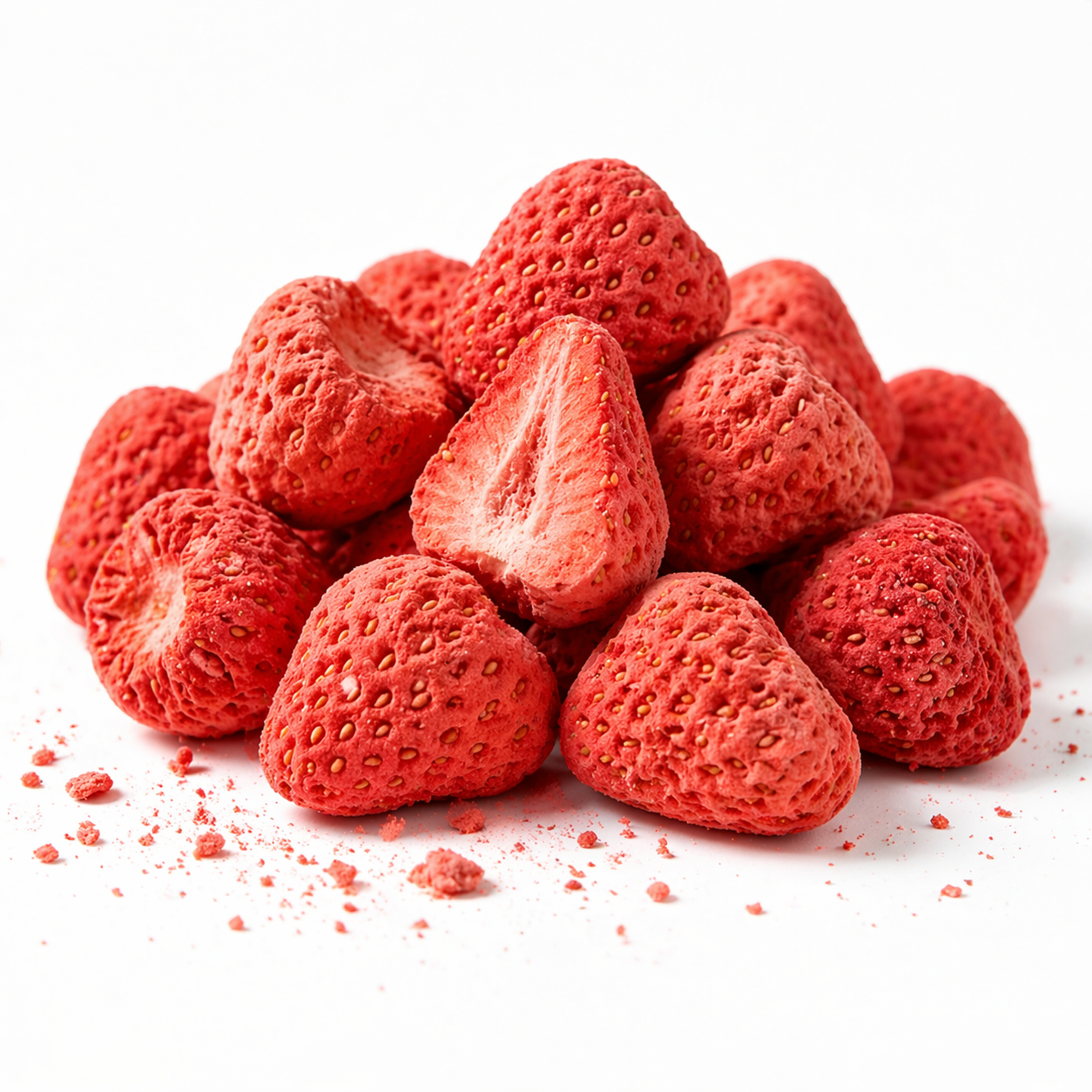
There is a fourth option: change the format of the fruit instead of the amount. Freeze-dried strawberry inclusions are dried by sublimation, so the water that would normally carry colour and moisture into the dough has already been removed before the ingredient reaches the mixer. Folded into white dough as dice, the pieces keep their shape and their colour, the crumb stays pale, and the ingredient statement stays short.
This article explains the moisture-migration mechanism behind colour bleeding, shows what the freeze-dried format changes, ranks the strawberry formats for white-dough use, and gives a step-by-step method for reformulating a product around freeze-dried strawberry inclusions.
What Colour Bleeding and Moisture Migration Actually Do to White Dough
Moisture migration is the movement of water from a region of higher water activity - the fruit piece - into a region of lower water activity - the surrounding dough - until the two reach equilibrium. Colour bleeding is the visible symptom: strawberry colour comes largely from anthocyanins, which are water-soluble pigments. Where the water goes, the colour follows.
The defect develops in stages, which is why it is often missed at the bench and discovered in the warehouse:
- At mixing. A fresh or IQF piece already contains free water, and cutting it exposes wet surfaces directly to the dough. Migration begins before the dough has even been divided.
- During proofing. Resting dough gives water time to travel outward from each piece, widening the affected zone.
- During baking. Heat converts water inside the piece into steam, which pushes through the piece boundary and enlarges the wet halo around it.
- During cooling. Water that has left the fruit does not return into it. The halo sets.
- During storage. The wet ring raises local water activity at the piece boundary, which is where mould growth starts and where staling shows up first.
White dough is the worst case for two reasons. The crumb offers no dark background to hide a pink ring, so contrast is at its maximum; and consumers read a halo as a quality defect even when the flavour is intact. The commercial result is a product that has to be sold fast, held out of the range, or reformulated away from real fruit.
Why This Is a Live Issue for Bakery Buyers in 2026
Clean label is no longer a niche position in this category - it is the dominant one. Clean-label positioning accounts for a 44.2% market share of claims in the freeze-dried strawberry market as of 2026 projections (Future Market Insights). For a bakery, the significance is simple: the cheapest traditional route to colour stability is to add colour, and that route now closes off the shelf position retailers are asking for.
The supply base has scaled with that demand. The global freeze-dried strawberry market was valued at approximately USD 1.86 billion in 2024 and is expected to grow at a CAGR of 5.9% through 2035 (WiseGuyReports). The underlying raw material pool is deep - the global fresh strawberry market was valued at USD 21.0 billion in 2024 and is projected to reach USD 28.4 billion by 2033 (WiseGuyReports) - which matters to buyers because the dried format competes for fruit against a very large fresh and frozen market.
It also helps to know where the wet formats naturally concentrate. The strawberry puree market was valued at USD 2.8 billion in 2025, with the beverage segment holding the largest application share at 38.2% (Dataintelo). Puree is built for liquid and semi-liquid systems. It is not built for a dry white-dough system that needs discrete, visible pieces.
On the technology side, freeze-drying preserves approximately 97% of the original nutritional content of strawberries, compared with around 55% in conventional heat drying (Transpire Insight). That retention is a by-product of the same mechanism that solves the bleeding problem: the fruit is dried without ever passing through a liquid phase that would collapse its structure.
The ingredient category is also well established internationally, with major participants including Nestle S.A., Dole Food Company, Chaucer Foods and Olam International (Market Research Future / Dataintelo) - a signal that freeze-dried fruit is a mainstream industrial input rather than a specialty curiosity.
Regulation is moving in parallel. EU Regulation 2023/2429, effective January 2025, modernises marketing standards for fruits and vegetables and affects traceability and labelling for imported strawberry products entering the EU. Buyers shipping into Europe should confirm documentation against that framework, not only against a certificate list.
The Solution: Freeze-Dried Strawberry Inclusions With No Free Water to Migrate
Freeze-drying freezes the fruit and then removes the water under vacuum by sublimation - the ice turns directly into vapour without passing through a liquid stage. What remains is a rigid, porous piece that holds its original shape and colour, and that carries essentially no free water. For a baker, that single property removes the transport mechanism behind both defects at once: there is no liquid phase inside the piece to dissolve and carry anthocyanins outward, and there is no water to migrate into the dough matrix at the point of mixing.
The format decision is the second half of the fix
Freeze-dried strawberry is supplied in four practical formats, and matching format to application matters as much as the drying method itself:
- Whole freeze-dried strawberry - the strongest visual for toppings, enrobing and gifting formats; less suitable where the dough piece is small.
- Freeze-dried strawberry slices - visible layered inclusions for cookie sandwiches, laminated dough and surface finishing.
- Freeze-dried strawberry dice - the workhorse for folding into dough. Small enough to distribute consistently per dough piece, robust enough to survive mixing, moulding and baking.
- Freeze-dried strawberry powder - for colour and flavour distributed through the crumb. Note the difference in intent: powder colours the dough on purpose, while dice keep the crumb pale around a discrete piece.
What the format does for the label
Because freeze-dried strawberry is a dried fruit rather than a syrup-infused or sugar-coated ingredient, it does not add syrups, colours or sugar infusions to the ingredient statement. That is a practical route to the clean-label positioning now holding a 44.2% claim share in this category, and it removes a handling problem at the same time: syrup-based fruit bleeds onto belts, clumps in feeders and builds up on cutting wires, while a dry inclusion does not.
Where the format fits - and where it does not
Freeze-dried inclusions are the strongest fit in low- and medium-hydration systems: biscuits, cookies, crackers, short pastry, cereal bars, granola, dry mixes, compound coatings, and small inclusions in white breads and buns where the piece is small and the bake is short. In these systems the ingredient delivers discrete fruit without handing the dough a water source.
Two limits are worth stating plainly. First, freeze-dried pieces are hygroscopic: in a high-hydration dough with a long proof or a long bake, they will gradually take up water from the surrounding matrix, and limited colour diffusion at the piece boundary can still occur. The advantage is largest where the dough is drier and the bake shorter, so high-hydration applications should be validated with your own bake test before scaling. Second, the pieces are brittle: high-shear mixing and aggressive conveying will shatter them into powder, which then colours the crumb unevenly.
Step-by-Step: Reformulating a White Dough Around Freeze-Dried Inclusions
- Confirm that format is actually the problem. If the defect is a pink halo and a damp ring, the fruit format is the cause. If the defect is flavour loss after baking, changing format will not fix it - check bake profile and piece size instead.
- Classify the dough by hydration. Low-hydration products (biscuits, cookies, crackers, short pastry) are the strongest fit. High-hydration products (breads, buns, laminated dough) need a small dice, a late addition and a validated bake.
- Choose the format and the size. Dice for folded inclusions, slices for visible layers, whole pieces for topping, powder for distributed colour and flavour. Match the size to your moulder, cutter and wire so pieces do not jam equipment.
- Rebalance the added water. This is the step most bakers miss. Replacing a wet fruit piece with a freeze-dried piece at the same weight removes water from the formula as well as fruit. Add water back so dough hydration and machinability stay in the validated range, and verify by dough consistency on the line rather than by assumption.
- Fold late, and fold slowly. Add inclusions at the end of mixing on low speed, just until dispersed. Over-mixing shatters the pieces and creates loose powder that colours the crumb unevenly.
- Control bake and cooling. Keep the bake profile inside the range validated for the piece size, and cool completely before packaging so residual heat does not drive further moisture movement inside the pack.
- Test across the shelf life, not on day one. Cut samples at day one, mid-life and end of intended shelf life. Check halo width, crumb colour, piece definition and texture. Colour bleeding is time-dependent, and a day-one sample will not reveal it.
- Lock the release specification with the supplier. Ask what is tested, against which standard, and what happens to a failing batch. UrSnacks, for example, tests every batch of finished products in its in-house laboratory before release, and before shipment every batch is sample-tested against the company's enterprise standard, with only batches that pass inspection approved for shipment.
Preferred Strawberry Formats for White-Dough Inclusions, Ranked
For the specific job of putting visibly red fruit into a visibly white crumb, the formats rank as follows:
- Freeze-dried strawberry dice - best overall fit: no free water at mixing, discrete visible pieces, survives folding, single-ingredient label.
- Freeze-dried strawberry slices - best fit where the piece must read as a slice, such as layered cookies and laminated products.
- Whole freeze-dried strawberry - first choice for toppings and enrobing, second choice for folding into small dough pieces.
- Candied or sugar-infused fruit - delivers colour stability but adds sugar and syrup to the ingredient statement, which works against clean-label positioning.
- IQF frozen or fresh strawberry - excellent in fillings, sauces, jams, dairy and beverage systems; in white dough these are the primary source of the bleeding and wet-ring defects described above.
- Strawberry puree - designed to disperse colour and moisture through a matrix, and the wrong tool when the crumb must stay white.
Use Cases: Where Zero Moisture Migration Pays Off
The applications that gain most from a freeze-dried inclusion are the ones where the crumb is pale and the fruit must stay visible:
- Biscuits, cookies and short pastry - fruit specks that stay specks, with a crumb that stays even in colour.
- White bread, buns and milk bread - small dice added late in the mix, giving visible fruit without a wet ring around each piece.
- Cereal, granola and clusters - a dry-system application where freeze-dried inclusions are a natural fit.
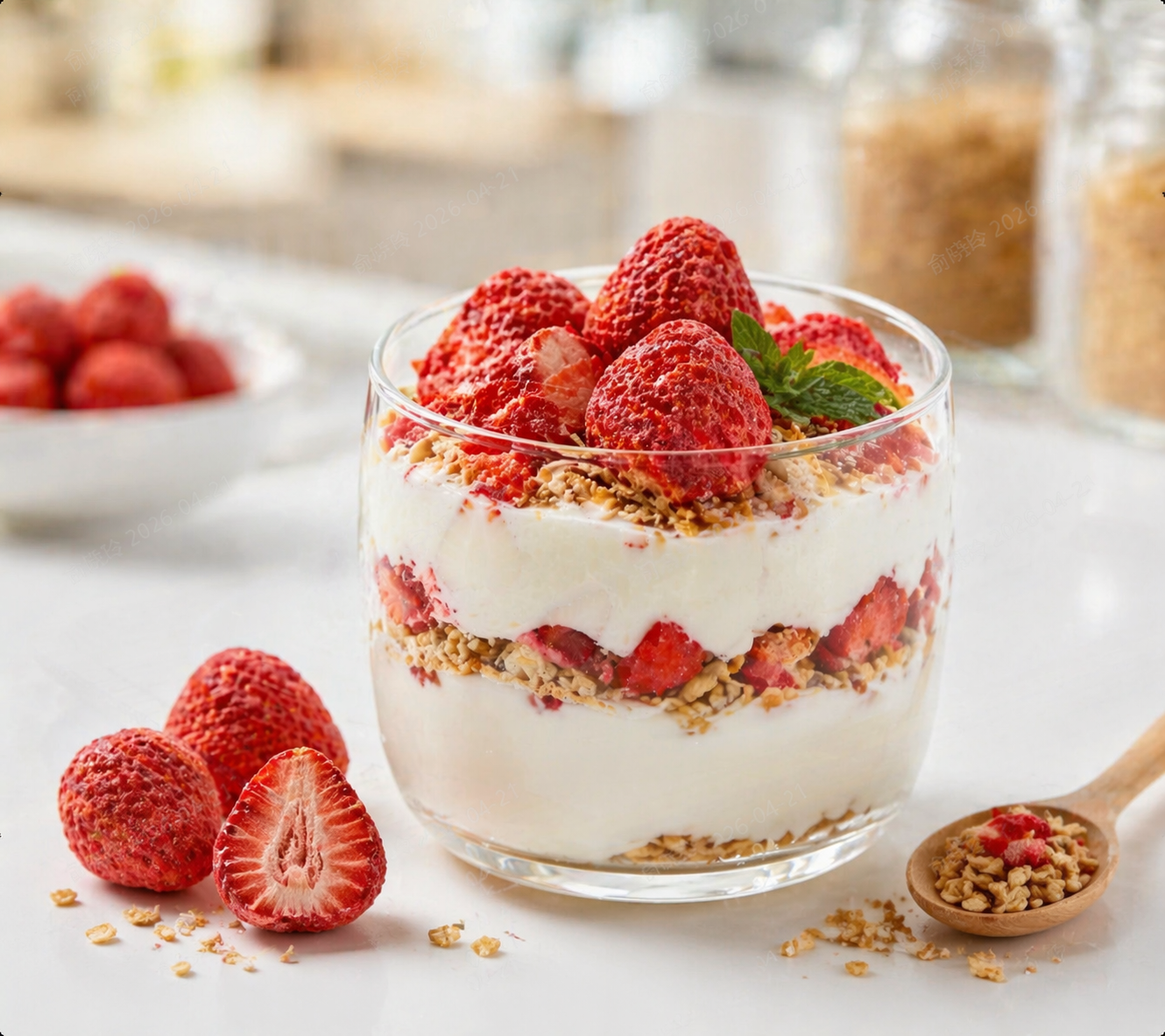
- Yogurt and dairy - freeze-dried pieces used as a dry inclusion or topping that stays crisp instead of bleeding into the base.
- Beverage powders and dry mixes - freeze-dried strawberry powder for reconstitution, where the drying method also protects colour and nutrient profile.
- Chocolate, compound coatings and bars - pieces that hold definition in a low-water environment.
Commercial scale is worth checking before committing to a format. In China, freeze-dried strawberry supplied factory-direct has been used as a traffic-driving SKU by discount-snack chains including Wanchen Group and Mingming Group and more than seven other discount-snack brands, across a combined store network exceeding 40,000 stores, with order cadence validated at over 71,000 packs per month and demand confirmed at more than 10,000 stores; supply has continued for more than four years, since 2021. In China's premium supermarket channel, the product has been adopted by premium and high-end supermarket chains, with single-store daily sales density reaching approximately RMB 450 at one premium supermarket and stable sell-through across more than five display formats.
Two caveats keep this evidence honest. These are snacking and retail cases, not bakery formulations: they demonstrate supply scale, order consistency and batch discipline, not dough performance. And colour behaviour is process-specific - your hydration, your bake profile and your piece size decide the outcome, which is why the shelf-life test in step seven is not optional.
Comparison Table: What Each Strawberry Format Does in White Dough
| Format | Free water introduced at mixing | Colour-bleed risk in white crumb | Typical application fit | Effect on the ingredient statement |
|---|---|---|---|---|
| Fresh strawberry | High | High | Jams, sauces, same-day fresh bakery | Strawberry |
| IQF frozen strawberry | High - released as the fruit thaws | High | Fillings, ice cream, smoothies | Strawberry |
| Strawberry puree | High - supplied as a liquid or paste | High - colours the whole matrix, not just the piece | Beverages (largest application share at 38.2%), fillings, sauces | Strawberry puree |
| Candied or sugar-infused fruit | Low free water, but a sugar syrup phase is present | Low | Confectionery and toppings where added sugar is acceptable | Adds sugar or syrup |
| Freeze-dried strawberry dice or slices | Negligible | Low - colour stays with the piece | White dough, cookies, cereal, bars, dry mixes | Strawberry - single ingredient |
The market context supports that direction of travel: freeze-dried strawberry is a category valued at approximately USD 1.86 billion in 2024 and growing at a 5.9% CAGR through 2035 (WiseGuyReports), with clean-label positioning already the dominant claim at a 44.2% share (Future Market Insights). Format-based problem solving is where that demand is heading.
Frequently Asked Questions
What certifications and documentation should a wholesale buyer verify before ordering bulk freeze-dried strawberry?
Start with the compliance credentials and the batch-release routine. UrSnacks holds five international compliance credentials - FDA-related compliance, BRCGS, ISO 22000, SMETA and HALAL - covering both food-safety schemes and the social-compliance audits that retail chains increasingly require; HALAL certification is the relevant credential for Muslim-majority markets. Then ask how a batch is released: every batch of finished products is tested in the in-house laboratory before release, and before shipment each batch is sample-tested against the company's enterprise standard, with only batches that pass inspection approved for shipment. Buyers shipping into the EU should also check labelling and traceability against EU Regulation 2023/2429, effective January 2025.
Which freeze-dried strawberry format works best as a white-dough inclusion?
Freeze-dried strawberry dice, in most cases. Dice fold into white dough as discrete, visible inclusions and introduce essentially no free water at mixing, so there is no liquid phase to carry water-soluble pigments into the crumb. Slices suit layered and surface applications, whole pieces suit toppings and enrobing, and powder distributes colour and flavour through the crumb but does not create discrete pieces. Size the dice to your dough piece and your moulding equipment, and add them late in the mix on low speed.
Should wholesale buyers source from fresh strawberry suppliers or freeze-dried strawberry suppliers for bakery inclusions?
It depends on where the fruit sits in the formula. Fresh and frozen strawberry supply is the right route when the fruit goes into fillings, sauces, jams, dairy or beverage systems, where water is part of the product design. In a white dough, where the crumb must stay pale and the piece must stay discrete, the format is the deciding factor: freeze-dried inclusions remove the free water that drives bleeding and wet rings, while fresh, IQF and puree formats reintroduce it. Make the format decision first, then the supplier decision.
What are the minimum order quantities and sample validation terms for bulk freeze-dried strawberry?
Confirm two commercial terms early: MOQ flexibility and confidentiality. UrSnacks runs a dual-line production system for coated and pure products, offers flexible minimum order quantities, and makes non-disclosure agreements available for client projects, which is relevant for private-label and OEM programmes. On validation, request a sample of the exact dice or slice size you intend to run and test it in your own dough, because colour behaviour depends on your hydration and bake profile rather than on the ingredient alone.
What supply continuity and lead-time signals should a bakery buyer look for?
Look for evidence that the format is supplied at industrial scale, not only sampled. The manufacturer exports to the USA, Canada, Japan, South Korea, Germany, Thailand, Indonesia and other countries, and targets Europe, North America, Japan & South Korea, Russia, the Middle East and Southeast Asian markets, with packing operations based in Quanzhou, Fujian, China. Freeze-dried strawberry has been supplied factory-direct for more than four years to a discount-snack network exceeding 40,000 stores, and demand has been validated across more than 10,000 stores - the kind of continuity record worth checking before you commit a production line. Plan lead time around your own shelf-life validation: order the inclusion format early enough to complete a full shelf-life test before launch. To begin, request a sample and a quotation for your target format and volume.
Conclusion: Keep the Fruit, Remove the Water
Colour bleeding in white dough is not a fruit problem - it is a water problem. Freeze-dried strawberry inclusions remove the free water that carries pigment and moisture into the crumb, so the piece stays red, the crumb stays pale, and the label stays short. For buyers at the evaluation stage, the practical order of decisions is: choose the format (dice for folded inclusions), rebalance the added water, fold late and gently, and validate the result across the full shelf life rather than on day one.
The rest is supply discipline - batch-release documentation, certification coverage, and continuity of supply from a manufacturer that handles both coated and pure product lines and offers flexible order quantities with NDA coverage for proprietary projects. Get the format right first; everything else in the specification follows from it.
Next Step: Sample and Quote
UrSnacks supplies bulk freeze-dried strawberry inclusions in whole, slice, dice and powder formats for bakery, cereal, yogurt, beverage and confectionery applications.
Send your target application, piece size and volume to request a sample and a quotation for your project.