
Freeze-Dried Durian Powder vs. Dice: A Head-to-Head for Frozen Dessert Lines
A frozen dessert line has two places to put durian: dissolved into the base, or suspended in the mass as a visible piece. Freeze-dried durian powder and freeze-dried durian dice answer those two jobs, and they are not interchangeable. Powder is the flavor-first and color-first choice, dosed into yogurt bases and ice cream mixes. Dice are the texture-first choice, folded into the ice cream mass and quick-frozen so the piece survives the scoop.
Swapping one format for the other changes the formula, the equipment downstream of the continuous freezer and the quality control plan — not just the label. This comparison treats both formats as production decisions: how each behaves in standard industrial mixers and continuous freezers, what handling controls each one demands, and which specification items belong in the RFQ.
Where the two formats actually diverge
Both formats start from the same material. The durian protocol behind UrSnacks freeze-dried durian uses post-flowering harvest at ≥120 days with ≥90% maturity, a ripening chamber held at 28–32 °C and 75–85% RH for no more than 24 hours holding, and four-tier maturity grading before drying. Low-temperature vacuum sublimation then brings moisture below 3%: freeze-drying retains up to 95% of nutrients and preserves original color, aroma and shape, while hot-air drying typically retains 30–50% of nutrients and causes color degradation, aroma volatilization and structural collapse.
What changes after drying is geometry, and geometry drives the rest of the decision:
- Where the durian sits in the matrix. Powder becomes part of the continuous phase, so durian flavor is present in every spoonful. Dice stay as discrete particles, so durian becomes an event in the mouth rather than a baseline.
- The moisture budget. Powder has a large surface area and picks up moisture quickly; once water activity rises, the documented consequences are texture softening, mold growth risk and a shortened shelf life. Dice expose far less surface per unit weight, but they sit inside a wet, high-sugar matrix that pulls on the piece from all sides.
- Mechanical survival. Powder has no structure to protect. Dice are brittle and porous, and every feeder screw, pump, bend and compression point is a chance to turn a whole piece into fines.
Why frozen dessert teams are comparing these formats now
Durian is no longer a niche import. Global durian exports grew from approximately 80,000 tonnes in 2003 to around 870,000 tonnes in 2022 (FAO, Durian Global Trade Overview 2023). Freeze-dried snacks are estimated at roughly 7% of total durian fruit market value (Mordor Intelligence, 2026) — a small share of a very large trade, and the share that travels without a cold chain.
That logistics profile is why freeze-dried formats keep appearing in frozen-dessert briefs. Freeze-dried durian carries a 12–24 month ambient shelf life and needs no cold chain, so it does not compete with finished product for freezer space and avoids the thaw-and-refreeze risks associated with frozen material: ice crystal damage, microbial growth and quality degradation during storage and transport. The trade-off is that a dry ingredient is being asked to perform in a wet, cold, high-sugar system, and powder and dice fail in different ways.
Freeze-dried durian powder: the flavor-first format
What powder does in a yogurt base
In yogurt and frozen yogurt bases, powder works as the primary durian note and the primary color source at the same time. Because the material is a single-ingredient fruit solid — a one-item ingredient list with no added sugar, preservatives, artificial colors, artificial flavors or thickeners — the durian declaration does the work that a flavor, a color and a sweetener would otherwise do in a conventional formula. That single-ingredient structure supports clean-label, vegan and gluten-free claims based on raw-material selection and simplifies the ingredient statement for EU, US and Japan documentation.
Powder's contribution is measured in the base rather than in the finished scoop: it disperses into the mix, so flavor intensity is uniform through the batch and through the pack. Yogurt bases also give powder an advantage it does not have in ice cream — the base is mixed and pumped before freezing, which leaves time for full hydration.
Compatibility with standard mixers and continuous freezers
Powder runs on standard equipment. It is weighed, added to the mix tank, dispersed by the plant's normal agitator and then travels through the pasteurizer, homogenizer and continuous freezer as part of the mix. No fruit feeder, downstream injection point or special nozzle is needed, because there is no particle integrity to preserve. The constraint is not mechanical; it is hygroscopic.
Why powder must be metered at RH ≤40%
Set the dosing area at or below 40% RH and treat it as a line control, not a comfort setting. The moisture risk is explicit: moisture content exceedance and a rise in water activity cause texture softening, mold growth risk and reduced shelf life. A powder below 3% moisture with a large surface area will find any water available in the room. Practical controls include weighing in a closed or conditioned room, keeping bags sealed between weighings, pre-blending the powder with a portion of the dry ingredients to reduce lumping before it meets liquid, and shortening open-air residence time instead of relying on operator speed.
Where powder wins on innovation
Flavor and color innovation is easier with powder because it can be dosed at low inclusion and blended with other fruit solids, and because the natural fruit color survives freeze-drying without added colorants. It also lets a line run a durian variant without changing the freezer configuration: same base recipe, one extra dry ingredient, one new SKU. That flexibility is why powder is usually the first format tested when a brand wants durian flavor without committing to a particulate line.
Freeze-dried durian dice: the texture-first format
Folding dice into the ice cream mass
Dice exist to be seen and felt. They are added after the continuous freezer, at the fruit or folding feeder, so the piece enters the mass cold, intact and late in the process. Putting dice into the mix tank defeats the purpose: they hydrate, soften and disappear before the product is frozen.
Quick-freezing after incorporation
Once a die is folded into the mass, the clock starts. The surrounding matrix is low-temperature and high-sugar, and it will draw moisture out of the piece. The product therefore needs to be quick-frozen after incorporation — moved through hardening without delay — to lock structure before the piece rehydrates. Slow hardening shows up as soft, chewy pieces and color bleed into the surrounding mass, and neither can be corrected downstream.
Protecting the piece from compression
Freeze-dried dice are brittle. Every compression point — feeder screws, transfer pumps, narrow bends, over-filled containers — converts whole pieces into fines. Those fines are not neutral: they read as grit, they color the base unevenly, and they reduce the visible piece count on which the product promise depends. Review the line from feeder to hardener for pinch points, and set feeder speed to move pieces rather than push them.
Storage: light-free, oxygen-free, away from strong odors
Dice must be stored light-free and oxygen-free and kept away from strong odors. The porous matrix adsorbs volatile compounds from its surroundings, while light and oxygen degrade the color and aroma that justify the format in the first place. Nitrogen-flushed sealed packaging with multi-layer barrier materials, supported by in-line seal integrity testing and drop-and-vibration packaging validation, is the packaging profile that matches this requirement. The 12–24 month ambient shelf life applies to the sealed pack, not to an opened one.
Powder vs. dice, side by side
The table compares the two formats on the criteria that change a frozen-dessert line, not on general product features.
| Criterion | Freeze-dried durian powder | Freeze-dried durian dice |
|---|---|---|
| Primary job | Flavor and color through the whole base | Visible piece and texture contrast |
| Added where | Mix tank, before pasteurization | Fruit or folding feeder after the continuous freezer |
| Equipment impact | Standard mixer and continuous freezer; no feeder | Folding feeder plus immediate hardening |
| Key handling control | Dosing room at RH ≤40%; sealed weighing | No compression; quick-freeze after incorporation |
| Main failure mode | Moisture pickup, water activity rise, caking | Broken pieces, fines, color bleed |
| Storage | Sealed, dry, ambient | Light-free, oxygen-free, away from strong odors |
| Best-fit products | Yogurt bases, frozen yogurt, ripple, coating, fillings | Ice cream, gelato and desserts with piece identity |
| Quality check point | The base, before freezing | The hardened scoop, after a storage cycle |
Step-by-step: running each format on the line
Powder in a yogurt or ice cream base
- Fix the target load and a reference sample. Agree the inclusion level and retain a control sample before the first commercial run; freeze-dried fruit is exposed to batch-to-batch variation in color, texture and taste, which is managed through standardized freeze-drying curves, automated lines and per-batch sample retention.
- Condition the dosing area. Bring the room to ≤40% RH, weigh in sealed containers and pre-blend with a dry ingredient fraction.
- Disperse under agitation. Add to the mix tank with the agitator running, then allow hydration time before pasteurization.
- Verify the base, not the pack. Assess color and sensory intensity in the base; a particulate format cannot be judged at this stage, which is one reason powder is easier to control early.
- Run the continuous freezer as normal. No feeder setting, no injection timing and no piece-integrity check downstream.
Dice on an ice cream line
- Fix the piece size and the piece count per liter, not only the inclusion rate by weight. The visible count is what the buyer and the consumer actually see.
- Set the folding feeder downstream of the continuous freezer and confirm the mass is cold and stiff enough to hold the piece.
- Walk the line for compression points before the first run, and adjust feeder speed to reduce breakage.
- Harden immediately after incorporation. Do not buffer filled product ahead of the tunnel.
- Check the finished scoop, not the mix. Break a sample after hardening, count intact pieces and repeat the check after a storage cycle.
Which format fits which product
- Yogurt, drinking yogurt and frozen yogurt bases: powder, for uniform flavor and color with no particle to protect.
- Ice cream, gelato and dairy desserts with piece identity: dice, fed after the freezer and hardened immediately.
- Ripple, variegato and coating systems: powder, because a uniform color and flavor carry better than a particle.
- Bakery and dessert fillings, beverages: powder for the base; dice work better as a topping than as an in-mass inclusion.
- Snack and retail packs: dice or larger formats, where the piece itself is the product.
Mixed formats are legitimate — a powder base carrying a dice inclusion — but they mean two dosing points, two handling controls and two sets of quality checks. Decide whether the resulting product is distinguishable enough to justify that added line complexity before committing capital.
What belongs in the RFQ
Both formats should be specified with the same discipline, because the specification is what makes a format decision executable:
- Moisture content below 3% and a stated water activity limit, with the test method named.
- Particle size distribution for powder; piece size, size tolerance and an acceptable fines level for dice.
- Microbiological limits, pesticide residues against destination-market MRLs (EU, US, Japan, Korea, Southeast Asia) and heavy metals including lead, cadmium and arsenic.
- Ripening-agent and colorant controls: the supplier's durian protocol calls for per-batch testing to ethephon ≤0.1 mg/kg with non-detectable curcumin and basic yellow.
- Certification evidence: BRCGS, ISO 22000, HACCP, HALAL, US FDA Food Facility Registration and GACC registration as an export food production enterprise.
- Per-batch factory release testing plus scheduled third-party type testing, and batch-level traceability from orchard to finished product.
- Packaging format — nitrogen-flushed, multi-layer barrier — with seal integrity and drop-and-vibration validation recorded.
- Trade classification: dried durian is generally declared under HS 081340, while frozen durian pulp falls under HS 081190.
Sourcing both formats from one supplier keeps a single QC standard across forms and a single point of contact, which reduces maintenance complexity compared with multi-supplier arrangements; dedicated SKU isolation also protects channel differentiation for OEM clients.
Cost: compare durian solids delivered, not price per kilo
No verified public price benchmark exists for bulk freeze-dried durian powder or dice, so any per-kilo comparison should be treated as incomplete. The more useful unit is durian solids retained in the finished product per kilogram of ingredient purchased. Powder loses material as dust and through over-dosing; dice lose material as broken pieces and fines, and need inclusion overage to hit a visible piece count. Add the line-side costs — conditioned dosing space at ≤40% RH for powder, versus feeder hardware, a compression review and immediate hardening for dice. Premium raw-material cost is partly offset by a lower defect rate and fewer QC rejections, which also simplifies incoming inspection, but that offset should be confirmed with your own rejection data rather than assumed.
Frequently asked questions
Which certifications and batch documents should come with a freeze-dried durian shipment?
A durian ingredient supplier serving export markets should be able to show BRCGS, ISO 22000, HACCP and HALAL certification, US FDA Food Facility Registration and GACC registration as an export food production enterprise. Ask for per-batch release testing covering microbial contamination (mold, yeast, total bacterial count), pesticide residues against the destination market's maximum residue limits and heavy metals such as lead, cadmium and arsenic, plus scheduled third-party type testing. Batch-level traceability from orchard to finished product should be available for every lot, and the HS classification should be stated on the documents.
Can a standard mixer and continuous freezer handle durian powder, or do we need a particulate line?
Powder needs no particulate equipment. It is weighed into the mix tank, dispersed by the normal agitator and carried through the pasteurizer, homogenizer and continuous freezer as part of the base. The only added requirement is environmental: dosing at or below 40% RH, because the powder is hygroscopic and moisture uptake raises water activity, which softens texture and shortens shelf life. Dice are the opposite case — they require a folding feeder after the freezer and immediate hardening, because they must never pass through the mix tank.
Which format is cheaper per unit of durian flavor delivered?
Compare durian solids retained in the finished product rather than price per kilo. Powder loses material as dust and through over-dosing; dice lose material as broken pieces and fines and need inclusion overage to reach a visible piece count. Then add line-side costs: conditioned dosing space at ≤40% RH for powder, versus feeder hardware, compression review and immediate hardening for dice. Because no verified public price benchmark exists for either format, the comparison has to be built from your own quotations, trial yields and rejection data.
How do we run a fair sample trial comparing the two formats?
Run both formats in the same base at the same durian solids level, and evaluate each one where it can actually be judged: the base for powder, the hardened finished product for dice. Request retained production samples rather than a hand-prepared bench sample, so the trial reflects the commercial process, and hold the samples through a storage cycle to see how color, aroma and piece integrity change. Because freeze-dried fruit varies batch to batch in color, texture and taste, ask for the batch traceability record and retained sample for the specific lots you trial.
What lead-time and supply factors should we plan around?
Two factors dominate the plan. First, format availability: powder and dice come off different downstream operations from the same freeze-drying line, so confirm which formats your supplier holds in stock and which are made to order. Second, capacity and shipping profile: ambient logistics and a 12–24 month shelf life remove the cold-chain window, but they do not remove production lead time. UrSnacks operates 3,000+ tons of annual freeze-drying capacity with 12 packaging lines and a customization center with 12 automated packing lines, and can quote a sample against your base recipe so the line trial starts from a real specification rather than a catalogue assumption.
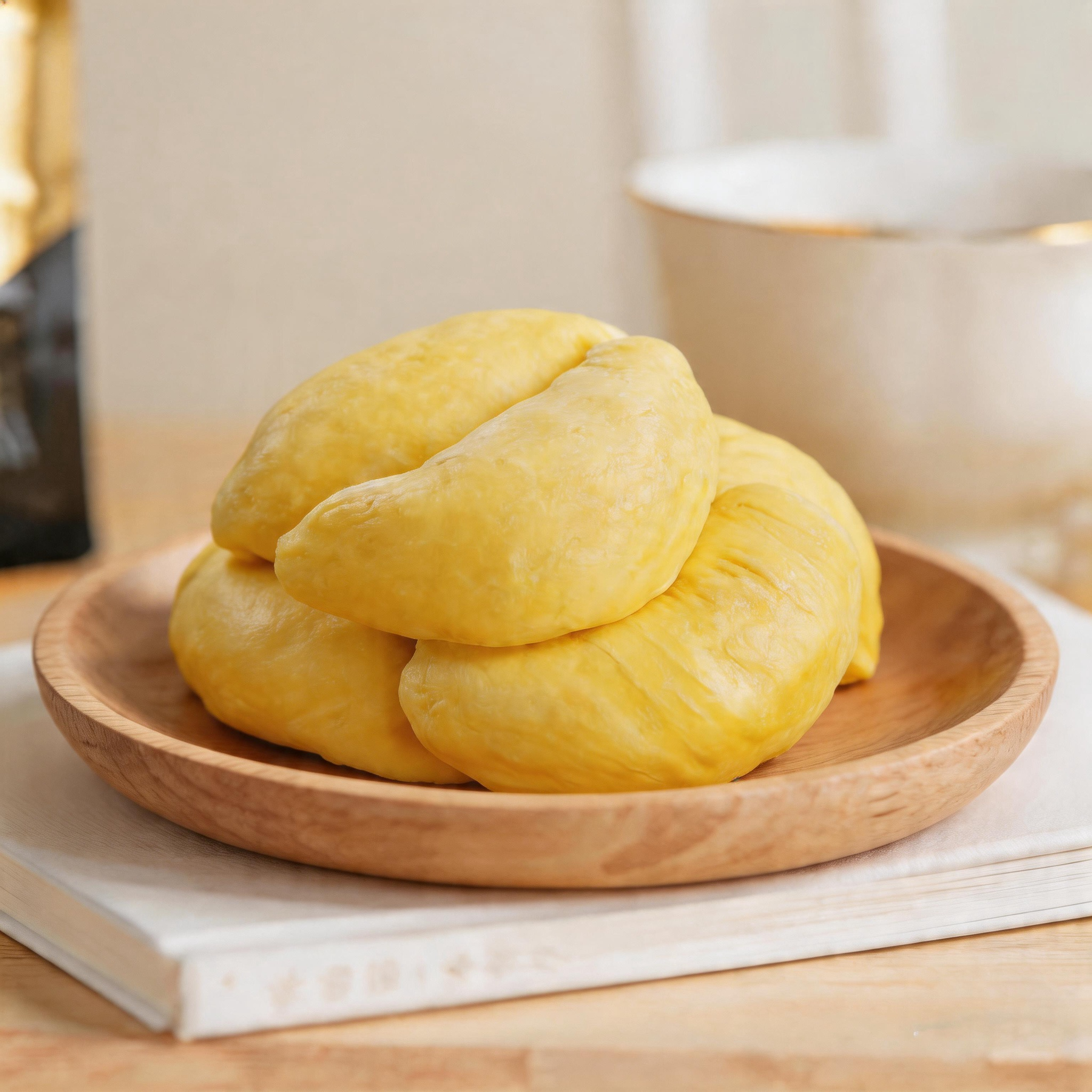
Next step: request a powder or dice sample against your base recipe, or download the UrSnacks brand book for the full durian range and specification set.
Conclusion
The choice between freeze-dried durian powder and dice is a choice about where durian does its work. If durian must be tasted in every spoonful and colored consistently through a yogurt base or an ice cream mix, powder is the format: it disperses into the continuous phase, runs on standard mixers and continuous freezers, and is governed mainly by dosing at RH ≤40% and keeping moisture out. If durian must be seen and felt as a piece, dice are the format: folded in after the freezer, quick-frozen immediately, protected from compression, and stored light-free and oxygen-free away from strong odors. Both share the same upstream discipline — mature fruit, controlled ripening, sublimation below 3% moisture, certified processing and batch traceability — which is what makes either decision defensible on a specification sheet.
UrSnacks, the core freeze-dried fruit brand of FUJIAN YOULINGYOUSHI TECHNOLOGY CO., LTD., supplies freeze-dried durian as finished product and as bulk ingredients in powder, chunk, slice and whole formats, produced under BRCGS, ISO 22000, HACCP and HALAL certification at facilities with 3,000+ tons of annual freeze-drying capacity.
For the full range, packaging formats and specification detail, download the brand book: UrSnacks Brand Book (PDF).
Have Questions or Need More Details?
Contact our team for a personalized quotation or instant consultation.
Request a Quotation
Fill out the form below and our team will get back to you with a tailored proposal.
WhatsApp Direct Chat
Prefer to chat in real-time? Message us on WhatsApp for instant assistance & quick answers.
- Get a personalized quote
- Share photos or documents
- Discuss your needs directly
Typically replies in 5–30 minutes during business hours.