
Freeze-Dried Strawberry in Industrial Bakery: An Application Guide for Dough, Fillings, and Enrobing
Freeze-dried (FD) strawberry is a dry, brittle fruit inclusion that allows industrial bakeries and confectionery plants to put visible real fruit into dough, fillings, cake tops and chocolate bases without adding water to the formulation. It behaves differently from fresh, IQF or candied fruit on a production line: it does not donate moisture into the surrounding matrix, it does not release juice into white dough or cream, and it carries an ambient shelf life of 12–18 months. It also breaks under compression and absorbs humidity quickly once a bag is opened, which is why the handling rules in this guide matter as much as the recipe.
This article is written for bakery and confectionery manufacturers, and for distributors who specify fruit ingredients on behalf of manufacturing customers. It covers format selection, equipment compatibility with industrial spiral mixers, horizontal dough mixers and automated filling depositors, handling and storage rules, label considerations, and the supply-side questions that determine whether a line trial becomes a recurring order. UrSnacks (有零有食) is the freeze-dried fruit brand of FUJIAN YOULINGYOUSHI TECHNOLOGY CO., LTD., a freeze-dried fruit manufacturer established in 2016 and headquartered in Jinjiang, Quanzhou, Fujian, China, supplying fresh fruit, frozen fruit, retail-ready freeze-dried products and bulk freeze-dried ingredients to export markets including the United States, Japan, South Korea, Canada, Germany, Thailand and Indonesia.
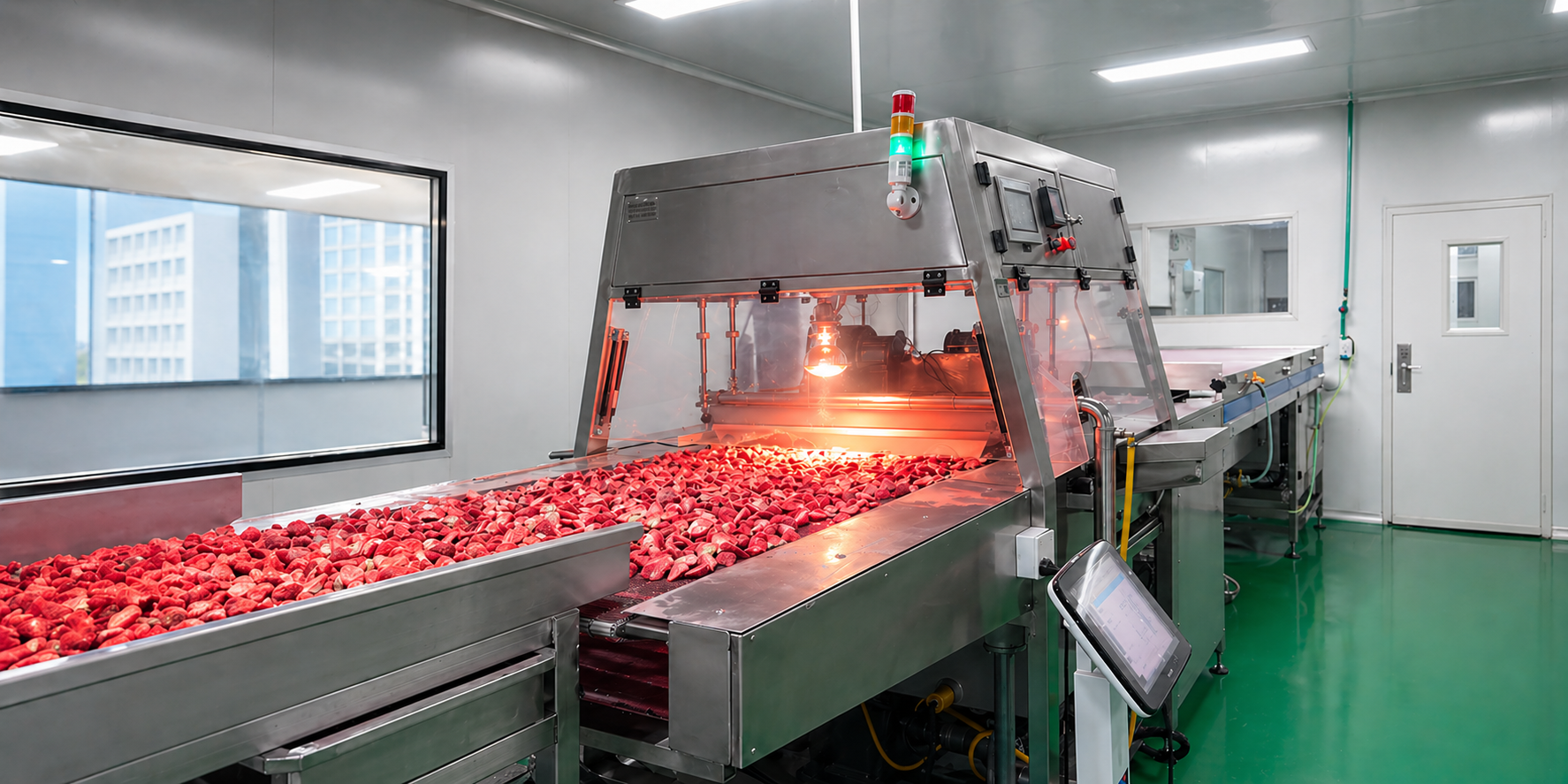
The Four Failure Modes Behind Most Strawberry Bakery Projects
1. Water where the recipe did not plan for it
Fresh strawberry, IQF strawberry and strawberry puree all bring free water into dough, cream and compound coatings. That water migrates during proofing, baking and storage, softening the crumb, dulling a white dough to pink, and — in cream fillings — creating the conditions for microbial instability. Freeze-dried strawberry has no free water available to migrate, so the moisture balance of the base formula stays where the formulator set it.
2. Breakage between the mixer and the depositor
FD strawberry pieces are crisp and fragile. High-shear mixing, screw conveying, pump impellers and depositor valves all compress or shear the fruit. The result is visible fruit that becomes dust: the fruit identity on the pack is lost, and the powder that remains can colour the whole batch unevenly instead of reading as discrete pieces.
3. Claim and documentation exposure
A real-fruit claim, a clean-label claim or a market-specific labelling statement only holds if the ingredient declaration, the residue status and the shipping documentation agree. In the European Union, Regulation (EU) 2023/2429 became effective in January 2025 and modernises marketing standards for fruit and vegetable products, including traceability and labelling expectations for imported fruit materials. Bakery buyers therefore need an ingredient partner whose declaration and documentation work is verified before the packaging artwork is signed off.
4. Continuity after the first trial
Approving an inclusion is easy; keeping it approved through a full season is not. Agricultural raw materials vary, and a bakery specification that cannot be repeated at the next production run forces reformulation. This is the point where buyers stop evaluating a sample and start evaluating a supply relationship.
Industry Background: From Snack Category to Bakery Ingredient
The global freeze-dried strawberry market was valued at approximately USD 1.86 billion in 2024 and is expected to grow at a compound annual growth rate of 5.9% through 2035, according to WiseGuyReports. Growth of this kind is driven less by snacking than by reformulation: brands removing syrup-based inclusions, adding visible fruit to baked goods, and simplifying ingredient lists.
Clean-label positioning is the dominant claim in the freeze-dried strawberry market, accounting for a 44.2% market share as of 2026 projections published by Future Market Insights. For a bakery formulator, that figure describes a customer expectation rather than a marketing preference — a strawberry inclusion is expected to be recognisable as fruit, not as a sugar-infused piece.
There is also a processing argument. An industry estimate published by Transpire Insight puts nutrient retention for freeze-drying at approximately 97% of the original content of strawberries, compared with about 55% in conventional heat drying. The retention figure is a useful directional reference during formulation discussions, but bakery buyers should treat it as an indicative industry estimate rather than a specification and validate their own claim positions with their supplier's batch documentation.
The practical consequence is a shift in sourcing behaviour. Bakery and confectionery plants are moving freeze-dried strawberry from the topping bowl into the dough and the filling, which raises the bar on particle size consistency, breakage tolerance and documentation. The same shift has reached the United States, Germany, the United Arab Emirates and Japan, each with a different emphasis: clean-label and allergen review in the United States, traceability and labelling discipline in Germany, Halal conformity in the UAE, and residue limits plus precise specification control in Japan.
Format Selection: Matching Strawberry Form to Bakery Function
Format choice determines what the fruit can physically do in a bakery application. The same fruit, dried the same way, behaves as four different ingredients once it is graded.
- Whole freeze-dried strawberry — the strongest visual signal, best used as a finished-surface decoration or a whole-piece inclusion in a large format bake where nothing downstream can crush it.
- Freeze-dried strawberry slices — a middle option for cake tops, layered desserts and enrobed bars, where a recognisable fruit profile matters but a whole fruit is too large.
- Freeze-dried strawberry dice / granules — the workhorse for dough, cream fillings and chocolate-enrobing bases, because a controlled particle size can be matched to a depositor nozzle or an enrobing curtain.
- Freeze-dried strawberry powder — used for colour and flavour distribution rather than visible pieces; it is the most hygroscopic format and the most sensitive to open-bag handling.
Adjacent formats should be considered in the same evaluation, because they are often proposed as substitutes: strawberry puree, IQF strawberry, fresh strawberry and bulk freeze-dried strawberry. Each brings a different moisture and storage profile to the plant, and the decision is rarely about fruit quality alone — it is about which format the line can handle repeatedly.
Equipment Compatibility on Industrial Bakery Lines
Industrial spiral mixers and horizontal dough mixers
Spiral and horizontal mixers apply sustained compression and shear to everything in the bowl. FD strawberry added at the start of the mix will lose its structure and tint the dough unevenly instead of appearing as discrete pieces. The workable pattern is to develop the dough first, then fold the fruit in at the end of the mix on the slowest available speed, or — better on high-volume lines — bypass the mixer entirely and dose the fruit into the dough stream with a downstream feeder. Either way, the operator's check is the same: count intact pieces in a dough cross-section, not in the bowl.
Batter sprinkling and surface dosing
Sprinkling onto batter before baking suits dice and small slices. Powder should not be used at a sprinkling station unless the equipment is designed for dust control, because fine strawberry powder is light, hygroscopic and difficult to contain. Sprinkled fruit also needs to sit on a surface that will not drag it during transfer into the oven.
Automated filling depositors
Depositors are the most common point of failure. Piece size must be selected against the nozzle orifice, the valve type and the pump design, and the fruit must be dispensed evenly rather than settling at the bottom of the hopper. Fruit-in-filling dosing is normally handled with gentle agitation and short residence time in the hopper; long holding times at temperature increase both breakage and moisture pickup in the filling.
Cake-top decoration
Decoration is the most forgiving application, because the fruit is applied after the bake or after the cream is set. Whole freeze-dried strawberry and slices are both used here, usually placed after cooling so that residual heat and steam do not soften the pieces.
Chocolate-enrobing bases
FD strawberry is a dry inclusion, so it can be used in the chocolate mass or applied as a surface topping on an enrobed bar without contributing water to the coating. The constraint is viscosity and flow: pieces are added at a level the enrobing curtain can carry evenly, and the tempering and cooling tunnel stages are checked for piece retention rather than for moisture.
Handling Rules That Protect the Inclusion
Three handling rules do most of the work in keeping a freeze-dried strawberry specification stable from goods-in to the depositor.
- Protect brittle pieces from compression. Minimise drop heights, avoid conveying equipment that squeezes the fruit, and keep valve and pump designs gentle. Breakage is cumulative: fruit that is only lightly damaged at goods-in will still reach the depositor as fragments after a few transfers.
- Reseal opened packaging within 24 hours. Freeze-dried strawberry is hygroscopic. Once a bag is opened, ambient humidity is absorbed by the fruit, and the consequences are progressive — loss of crispness, softening of the piece structure and, with powder, caking. Part-used bags should be resealed and returned to dry storage within 24 hours.
- Store in an ambient dry warehouse — no cold chain is required. This is a genuine operational advantage over frozen formats: freeze-dried strawberry does not occupy freezer capacity and does not depend on refrigerated transport. The storage requirement is dryness and protection from odour, not temperature control.
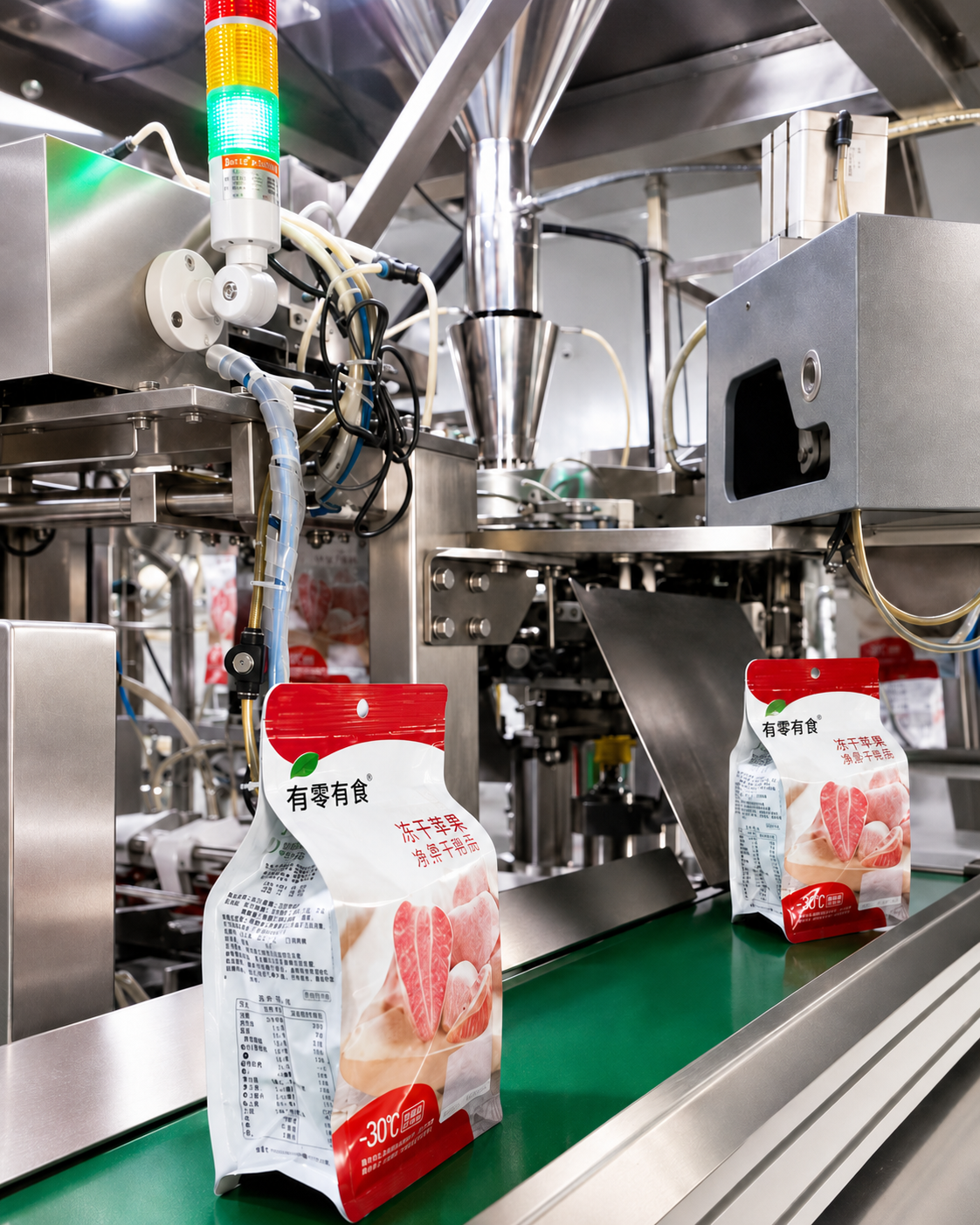
The packaging side supports these rules. UrSnacks uses nitrogen-flushed, sealed packaging with multi-layer barrier materials to prevent oxygen ingress and moisture absorption, supported by low-temperature vacuum sublimation drying and in-line moisture content monitoring, so that the product arrives in the condition the specification was written for. The 12–18 month ambient shelf life and packaging designed for cross-border logistics also reduce spoilage risk during long-distance transport.
Real-Fruit Claims, Clean Label, and Replacing Candied or Glazed Fruit
Freeze-dried strawberry is a single-ingredient fruit material, which is why it fits real-fruit and clean-label upgrade projects so directly: the strawberry in the ingredient list is strawberry. Whether a specific on-pack claim is permissible still depends on the market. UrSnacks supports this through ingredient declaration verification, market-specific labelling protocols and customs documentation pre-audit, backed by a multi-market certification portfolio that includes BRCGS, ISO 22000, HACCP and HALAL certification, SMETA (Sedex) audits, China's Food Production License (SC), U.S. FDA Food Facility Registration and GACC registration as an export food production enterprise.
The substitution most often requested by bakery customers is candied or glazed fruit, which is used in fruit cakes, panettone-style products, buns and cream fillings. Replacing it with freeze-dried strawberry changes the formulation in three ways that have to be managed deliberately.
- Added sugar solids fall out of the recipe. Candied fruit carries syrup solids; freeze-dried fruit does not. Sweetness, water activity and total solids in the base formula will need rebalancing.
- Fruit pieces no longer behave as a soft inclusion. A candied piece deforms; a freeze-dried piece fractures. Mixing and depositing settings written for candied fruit usually need to be relaxed for freeze-dried fruit.
- Colour and moisture behaviour change for the better. Syrup-based fruit can release coloured moisture into a white dough or a pale cream. Dry freeze-dried pieces do not have free water available to migrate, so the colour stays where the fruit is and the base stays as formulated.
Strawberry puree remains a legitimate option where a uniform fruit flavour and colour throughout the matrix is the goal — the strawberry puree market was valued at USD 2.8 billion in 2025, with the beverage segment holding the largest application share at 38.2%, according to Dataintelo. In bakery systems, however, puree works as a flavour system rather than as a visible inclusion, and it reintroduces the moisture question.
Step-by-Step: Qualifying Freeze-Dried Strawberry on Your Line
- Define the function before the format. Decide whether the fruit is a visible inclusion, a colour and flavour carrier, a surface decoration or a label-claim component. The same project rarely needs all four from one grade.
- Set the specification against the equipment. Match particle size to the depositor nozzle, valve and pump; match format to the decoration stage; match piece size to the mixer's shear profile.
- Run a breakage trial, not a recipe trial. Charge a known quantity of fruit, run the full line, and count intact pieces at the depositor outlet rather than at the mixer. If the count is unacceptable, change the dosing point before changing the ingredient.
- Set the reseal rule in the packaging area. Opened bags resealed and returned to dry storage within 24 hours; part-used powder sealed immediately; no open bags left in humid areas overnight.
- Confirm the storage plan. Ambient dry warehouse, no cold chain, stock rotation by batch, and protection from strong odours.
- Lock the label and documentation position. Ingredient declaration, market-specific labelling and customs documentation should be reviewed against the artwork before the first production batch.
- Define batch acceptance tests. Agree what the incoming certificate of analysis must state, and retain a sample from every batch so that any deviation is traceable.
- Convert the trial into a supply agreement. Fix the specification, the retention sample process and the reorder cadence so the approved trial can be repeated in the next season.
Use Cases: How the Same Ingredient Is Applied in Four Markets
United States — clean-label cookies, bars and enrobed snacks
U.S. bakery and snack producers typically use freeze-dried strawberry dice in cereal and bakery inclusions and as a surface topping on enrobed bars, with the formulation driver being a shorter, recognisable ingredient list. FDA Food Facility Registration and GACC export registration are relevant supplier checks for buyers in this market.
Germany — labelling discipline and traceability
German buyers tend to begin with documentation rather than with the sample: MRL compliance, per-batch residue testing, full traceability from orchard to factory and consistency with EU marketing standards under Regulation (EU) 2023/2429. Freeze-dried strawberry slices and dice are the common formats for cake decoration and cream fillings.
United Arab Emirates — Halal conformity and ambient logistics
In the UAE, Halal certification is a primary screening criterion, and the ambient storage profile of freeze-dried strawberry is a distribution advantage in a hot climate where frozen handling is a cost centre. UrSnacks holds trademarks registered in the UAE alongside China, the United States, Thailand, Vietnam, Indonesia and the Philippines.
Japan — residue limits and tight particle specification
Japanese buyers work to narrow particle-size windows and expect residue compliance aligned to Japan MRL standards. Freeze-dried strawberry dice and powder are commonly specified for confectionery fillings and decoration, with per-batch sample retention supporting repeat orders.
Comparison Table: Freeze-Dried Strawberry Against Alternative Bakery Formats
| Format | Typical bakery role | Free water available to migrate | Handling risk on line | Storage requirement |
|---|---|---|---|---|
| Whole freeze-dried strawberry | Cake-top decoration, large-piece inclusions | None; dry fruit | High breakage risk under compression | Ambient dry warehouse |
| Freeze-dried strawberry slices | Decoration, layered desserts, enrobed bars | None; dry fruit | Moderate breakage risk | Ambient dry warehouse |
| Freeze-dried strawberry dice / granules | Dough, fillings, enrobing bases | None; dry fruit | Moderate; nozzle and valve sizing critical | Ambient dry warehouse |
| Freeze-dried strawberry powder | Colour and flavour distribution | None; dry material | Dusting and caking risk; most hygroscopic format | Ambient dry warehouse, immediate reseal |
| Strawberry puree | Flavour and colour throughout the matrix | High | Low breakage risk; dosing and hygiene control | Depends on the specified product form |
| IQF strawberry | Filling fruit, thaw-and-fold applications | High on thawing | Thaw management, drip loss | Frozen / cold chain |
| Candied or glazed fruit | Traditional fruit cakes, buns, fillings | Syrup-bound moisture can release into the matrix | Low breakage risk; soft piece deforms | Ambient, but sugar-syrup handling |
Comparison reflects the physical behaviour of each format in bakery systems. It does not rank fruit quality, and format choice should follow the application, the label position and the equipment on the line.
Limitations and Trade-offs
Freeze-dried strawberry is not a universal replacement. It is the most expensive way to deliver strawberry solids per kilogram of fruit, it is fragile, and it is hygroscopic after opening. Where a project needs fruit distributed evenly through a batter, a puree will usually do the job more economically. Where a project needs whole fruit that survives aggressive mixing, a candied piece will survive better. Freeze-dried strawberry earns its place in applications where visible real fruit, no moisture migration and a clean ingredient declaration are the deciding requirements — and where the line can be adjusted to protect the piece.
Frequently Asked Questions
Do freeze-dried strawberry ingredients meet EU, U.S. and Japanese residue and labelling requirements?
Compliance is managed through raw-material pre-inspection, including multi-residue pesticide screening and heavy-metal testing before materials enter production, plus per-batch finished-product pesticide residue testing. UrSnacks sources directly from 10+ core production regions with full traceability from orchard to factory, and works to EU, U.S., Japan, Korea and Southeast Asia MRL standards. Labelling is handled through market-specific labelling protocols, ingredient declaration verification and customs documentation pre-audit, which reduces the likelihood of customs rejection and shipment delays. Multi-market certification includes BRCGS, ISO 22000, HACCP and HALAL, with SMETA (Sedex) audits completed.
Can freeze-dried strawberry survive industrial spiral mixers and automated depositors?
Yes, if the dosing point is downstream of high-shear operations. Freeze-dried pieces are brittle and will fracture under sustained compression in spiral or horizontal mixers, so fruit is normally folded in at the end of the mix on the slowest speed or dosed into the dough stream after the mixer. For automated filling depositors, particle size must be selected against the nozzle orifice, valve type and pump design, with gentle agitation and limited hopper residence time to control breakage and moisture pickup.
How should a bakery evaluate the cost of switching from candied fruit to freeze-dried strawberry?
Evaluate delivered cost per finished unit rather than price per kilogram of fruit, because the two formats behave differently in the recipe. A candied fruit replacement removes syrup solids from the formulation, which changes sweetness and total solids and requires rebalancing; freeze-dried fruit also breaks where candied fruit deforms, which affects rework and rejection rates. Line trials that measure intact-piece retention and rework give a more reliable comparison than an ingredient quote alone. UrSnacks quotes against the agreed specification, format and volume rather than publishing a standard price list.
Can we obtain samples for a line trial before committing to a specification?
Samples are the normal starting point for bakery projects, and the useful trial is a full-line run rather than a bench sample: charge the fruit, run the mixer, depositor or enrobing line, and assess intact-piece retention at the outlet. Trial planning should also confirm the reseal rule for opened bags — resealing within 24 hours — and the ambient dry storage arrangements before the first delivery.
What does a long-term freeze-dried strawberry supply relationship look like for food distributors?
A long-term relationship rests on repeatable supply rather than a single approved sample. UrSnacks supports continuity through direct sourcing from 10+ core fruit production regions, long-term cooperation with suppliers in core fruit categories including strawberry, apple, durian and banana, standardized fruit-specific freeze-drying curves, automated production lines, per-batch sample retention and statistical process control, with closed-loop data feedback from lab and pilot trials into mass production to minimise rejected batches. Core freeze-dried categories have 3,000+ metric tons of annual capacity, and the customization centre has a designed annual finished-product capacity of 4,500 metric tons across 12 automated packing lines. Product carries a 12–18 month ambient shelf life in packaging designed for cross-border logistics, so distributors can hold stock without a cold chain. To review specifications, formats and sample arrangements for a bakery or distribution project, contact the UrSnacks team at sales2@ursnacks.cn or WhatsApp +86 18005073978.
Conclusion
Freeze-dried strawberry is now a formulation decision as much as a sourcing decision. Used as a dry inclusion, it resolves the two chronic problems of fruit in bakery systems — moisture migration and colour bleeding — while supporting real-fruit and clean-label positions in the United States, Germany, the United Arab Emirates and Japan. The conditions are explicit: dose the fruit downstream of compression, size the pieces to the equipment, reseal opened packaging within 24 hours, and store in an ambient dry warehouse with no cold chain. Buyers who treat those handling rules as part of the specification, and who qualify the supplier on repeatability rather than on one sample, get a fruit inclusion that holds its identity from the mixer to the finished pack.
Planning a freeze-dried strawberry line trial?
UrSnacks supplies bulk freeze-dried strawberry in whole, slice, dice and powder formats for bakery and confectionery applications, with OEM/ODM and private label support. Request a specification-matched sample, a quotation, or the full product catalogue.
Email: sales2@ursnacks.cn | Tel / WhatsApp: +86 18005073978 | Website: www.urorchard.com
Download the brand book: UrSnacks Brand Book (PDF)
FUJIAN YOULINGYOUSHI TECHNOLOGY CO., LTD., Building 15, Sanchuang Park Design & R&D Center, No. 3001 Century Avenue South, Luoshan Subdistrict, Jinjiang, Quanzhou, Fujian 362200, China
Third-party market references: WiseGuyReports (freeze-dried strawberry market value and growth rate), Future Market Insights (clean-label claim share), Transpire Insight (nutrient retention estimate), Dataintelo (strawberry puree market), European Commission (Regulation (EU) 2023/2429). Supplier facts sourced from UrSnacks company documentation.

Have Questions or Need More Details?
Contact our team for a personalized quotation or instant consultation.
Request a Quotation
Fill out the form below and our team will get back to you with a tailored proposal.
WhatsApp Direct Chat
Prefer to chat in real-time? Message us on WhatsApp for instant assistance & quick answers.
- Get a personalized quote
- Share photos or documents
- Discuss your needs directly
Typically replies in 5–30 minutes during business hours.