
Freeze-Dried Durian Dice vs. Segments in High-Sugar Frozen Matrices: A Direct Decision Guide
High-sugar frozen matrices — ice cream and gelato bases, frozen dessert layers, bakery fillings that are chilled then frozen, and confectionery cores — are unforgiving to the wrong fruit inclusion format. The same freeze-dried durian piece that looks perfect in a dry snack application can lose its bite inside a sugar-heavy, water-bearing matrix within a few weeks, or arrive at the freezer already broken because the transfer line crushed it.
This guide isolates one decision: dice or segments, in a high-sugar, low-temperature matrix. It does not compare freeze-dried durian against frozen pulp or powder; those comparisons depend on water content, dosage and flavour targets, and they are documented separately. Here the question is narrower and more operational — which piece geometry survives your line, and what must be true before you lock it into a specification.
Short answer. Choose freeze-dried durian segments when the finished product must show whole fruit and the line can move the pieces without compression — that means gentle, folding-style transfer and a late, low-shear addition point. Choose freeze-dried durian dice when uniform piece size, dosing accuracy and even distribution matter more than whole-fruit appearance, and when the process can bring the mix back below freezing quickly after the fruit is incorporated. If the line has no compression-free transfer and the mix-to-freeze window is long, dice are the lower-risk format — but only once that window is measured rather than assumed.

Problem Definition: What Actually Changes When You Swap a Piece Format
A change from dice to segments is not a cosmetic variation of the same ingredient. It changes three physical variables at once, and each of them interacts with sugar concentration and low temperature.
1. Exposed surface versus retained structure
A freeze-dried durian segment keeps the natural structure of the fruit chamber, so most of its surface is the outer skin of the piece and the exposed cut area is comparatively small. A dice piece is cut on several faces, so a larger share of its mass sits behind an open, porous cut surface. In a matrix that still contains mobile water — and a high-sugar frozen matrix does, even when water activity is suppressed — the cut surface is the entry route for rehydration.
2. Mechanical stress during transfer
Freeze-dried fruit is brittle. Segments have a longer, more irregular shape and a natural fracture pattern, which makes them vulnerable to point loading, stacking pressure and screw-type conveying. Dice are uniform and short, so they tolerate volumetric dosing, vibratory feeding and conventional drop transfers with less breakage. This is the single most common reason a format that worked in a pilot fails on a production line.
3. Residence time in the matrix before freezing
The longer a piece sits in a water-bearing mix above its glass transition environment, the more it softens. Dice need to be frozen back quickly after incorporation because their cut surfaces begin taking up moisture almost immediately. Segments tolerate a longer residence time in terms of structure, but not in terms of compression — they can survive a slow line and still be destroyed by a tight transfer.
Industry Background: Why Format Is Now a Procurement Constraint
Durian supply has scaled into an industrial ingredient category, and that scale has pushed format questions into purchasing departments rather than leaving them with product development alone.
- China imported 1.56 million metric tons of durians in 2024, a historical record, with an import value of USD 6.99 billion — a 4.1% year-on-year increase (China Customs / Produce Report).
- Frozen durian pulp and paste accounted for approximately 70% of total durian market revenue in 2023 (Grand View Research, 2023).
- The global freeze-dried fruits market was valued at USD 9.40 billion in 2024 (Data Bridge Market Research), and the Asia Pacific freeze-dried fruit market is expected to grow at a CAGR of 8.18% from 2024 to 2029 (Mordor Intelligence).
- Freeze-dried durian is used as a shelf-stable ingredient in bakery, ice cream and beverage applications (EIN Presswire, 2024), which is precisely where high-sugar frozen matrices sit.
- Frozen durian pulp is increasingly used in the Halal-certified food segment across Southeast Asia and the Middle East (Tridge, 2024), so certification coverage of the finished format — not just the fruit — has become part of the specification.
The commercial consequence is simple. Buyers are no longer choosing between "durian" and "no durian"; they are choosing between geometries, and each geometry imposes its own storage, handling and validation constraints. A format that is certified, in stock and correctly priced can still be the wrong format if the line cannot move it intact.
UrSnacks (有零有食) is the core freeze-dried fruit brand of FUJIAN YOULINGYOUSHI TECHNOLOGY CO., LTD., a freeze-dried fruit manufacturer headquartered in Jinjiang, Quanzhou, Fujian, China, established in 2016. Its freeze-dried durian range includes Freeze-Dried Durian Segments, Freeze-Dried Durian Dice and Freeze-Dried Durian Powder, supplied as bulk B2B ingredients as well as retail-ready products, with channel wholesale, OEM and private-label cooperation available.
Detailed Solution: How Each Format Behaves in a High-Sugar Frozen Matrix
Freeze-Dried Durian Segments
Segments are the format of choice when the fruit has to be seen. They deliver a distinct fruit bite, a layered chew and a visible piece in cross-section, which is why the BRCGS certificate scope for this product names bakery, dessert topping and snacking applications. In a frozen matrix, that visual advantage is also the constraint: the piece must arrive in the finished product whole.
Storage and handling constraints. Segments should be stored compression-free — no pallet stacking that loads the product itself, no overfilled bins, no weight-bearing conveying. Because freeze-dried durian is hygroscopic and its fat fraction is sensitive to oxidation, light-protected and oxygen-barrier packaging belongs in the specification. Breakage that happens in storage is invisible until the finished product is cut open.
Equipment constraint. A folding or gentle-transfer feeder is the practical prerequisite. Equipment that pushes, screws or drops the pieces from height will generate fines, and fines behave like powder in the matrix — they dissolve into the base and leave a grainy texture instead of a fruit bite. If the line has no folding feeder and no low-shear route from mixer to freezer, segments are the higher-risk option regardless of sensory preference.
Freeze-Dried Durian Dice
Dice solve the distribution problem. Uniform cube geometry gives predictable piece counts per kilogram, consistent dosing by volume, and even spread through the matrix — which matters in products where a consistent number of fruit pieces per portion is part of the quality specification.
The rehydration window. The trade-off is that dice expose more cut surface, so they take up matrix moisture faster. In practice this means the fruit must be incorporated late and the mix must return below freezing quickly afterwards. Where a line can do that, dice hold their shape acceptably; where the mix sits in a buffer tank between dosing and freezing, dice soften and the texture drifts toward a fruit-flavoured paste rather than a discrete piece.
Equipment advantage. Dice tolerate conventional volumetric dosing, vibratory feeding and standard drop transfers, which is why they are usually the first format a new line can run without equipment changes.
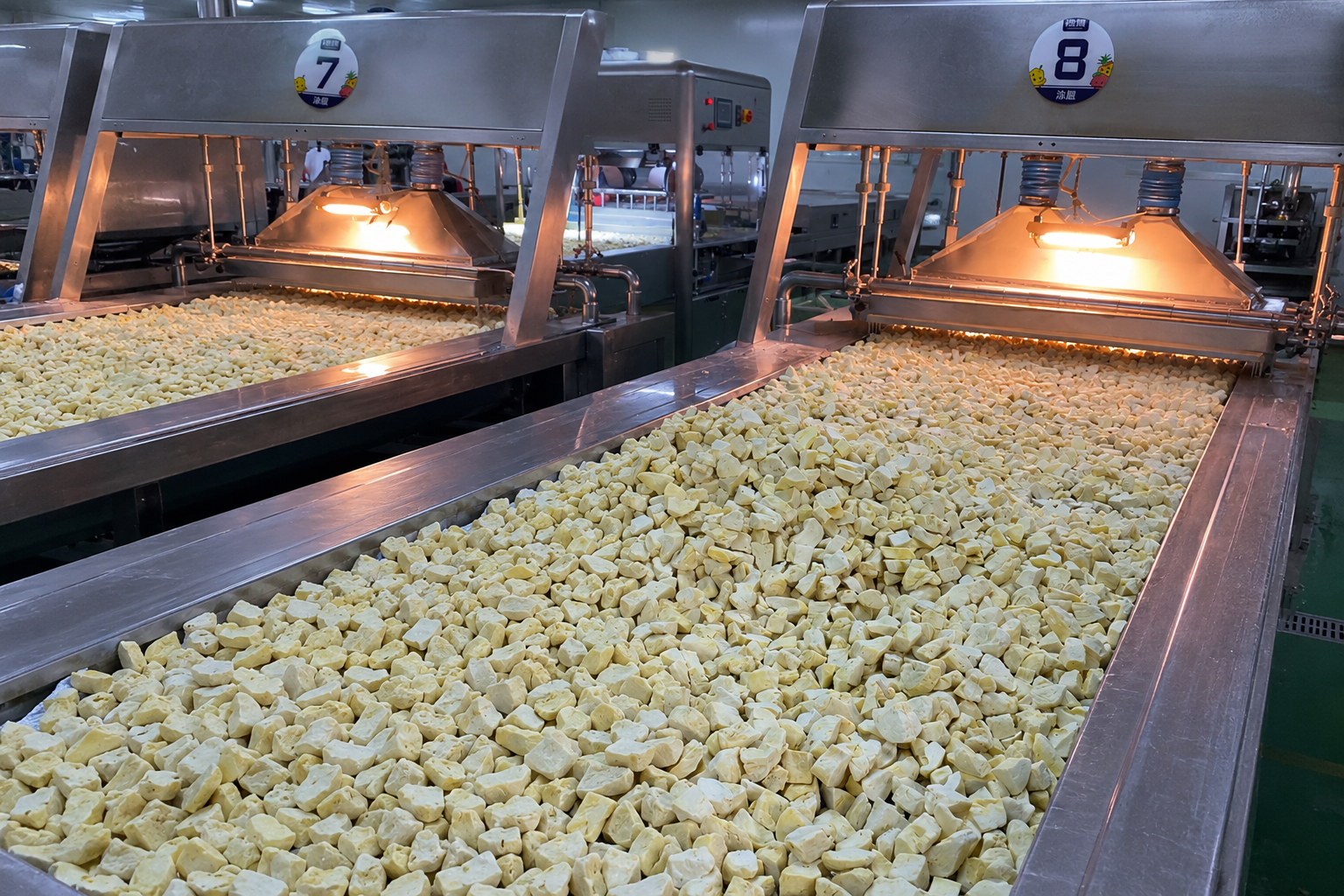
Where the two formats converge
Both formats share the same upstream constraints: raw material traceability, pesticide residue control under GB 2763 where China-bound product is involved, and a documented HACCP-based food safety system. The difference is downstream — storage load, transfer mechanics and residence time. That is why a format decision should be made against the line layout, not against a sample alone.
Comparison Table: Dice vs. Segments on the Criteria That Decide the Spec
| Decision criterion | Freeze-Dried Durian Segments | Freeze-Dried Durian Dice |
|---|---|---|
| Piece geometry | Intact natural fruit chambers; comparatively small exposed cut surface | Cut into cubes; multiple exposed cut faces per piece |
| Contribution to finished texture | Visible fruit bite and layered chew | Even distribution of smaller, softer pieces |
| Rehydration risk in a high-sugar matrix | Lower, because less surface is exposed to mobile water | Higher, because cut faces take up moisture quickly |
| Mechanical handling requirement | Compression-free, folding or gentle transfer; no weight loading | Tolerates volumetric dosing, vibratory feeding and standard drop transfers |
| Storage condition | No compression, light-protected, oxygen-barrier packaging | Light-protected, oxygen-barrier packaging; less sensitive to compression |
| Point of addition | Late stage, after the matrix has cooled, with minimal shear afterwards | Late stage, followed immediately by freezing |
| Dosing uniformity | Variable piece weight; portion control by weight rather than count | Uniform piece weight; portion control by count or volume |
| Halal coverage — BPJPH Certificate No. ID00410002836200323 | Named in the certificate scope | Named in the certificate scope |
| Food safety coverage — BRCGS Certificate C723738 | Named in the certificate scope | Named in the certificate scope |
| Applications stated in the certificate scope | Bakery, dessert topping and snacking | Format named in the scope; application is confirmed by the buyer's process validation |
The table uses only documentable facts — certificate scope, format geometry and process behaviour. It deliberately contains no price comparison: cost differences between dice and segments depend on whole-piece yield, sorting losses, the buyer's freezing capacity and order volume, and they cannot be stated as a general figure without a quotation against a defined specification.
Constraint Checklist: What to Verify Before You Lock a Format
This is the part of the evaluation that most often gets skipped, and it is the part that determines whether the format survives an audit and a production run.
1. Certification scope, stated per format
Ask for certificates that name the format explicitly, not a generic "freeze-dried fruit" scope. Format naming matters because dice and segments are processed and packed differently, and a certificate that names only powder does not cover a dice line. UrSnacks' BPJPH Halal Certificate No. ID00410002836200323 applies to Freeze-Dried Durian Segments, Freeze-Dried Durian Powder, Freeze-Dried Durian Dice, Dried Durian / Durian Crisps, Freeze-Dried Strawberry Powder, Whole Freeze-Dried Strawberry, and Freeze-Dried Strawberry Slices. BRCGS certificate C723738 covers the selecting and packaging of dried fruit products and coated dried fruit products in compound bags, and applies to Freeze-Dried Durian Segments, Freeze-Dried Durian Powder, Freeze-Dried Durian Dice, a 118g Durian · Pure Whole-Chamber freeze-dried durian product, a 58g Durian · Coated freeze-dried durian product, and a 32g Freeze-Dried Durian (Original Coated FD Durian).
2. Food safety management system
The factory is certified to ISO 22000:2018 food safety management system requirements, incorporating HACCP principles; the certification is CNAS-accredited and recognised under IAF MLA and the IQNET network for international markets. The production entity also holds FDA registration, Halal, ISO 22000, BRCGS and SMETA certifications, has completed China export filing, and operates under China Food Production Licence SC11735058207253. The Export Food Production Enterprise Filing Certificate covers fruit chips (sub-packaging) and flavored fruit chips, including freeze-dried durian products.
3. Storage and transfer constraints in your own building
Check where the cartons will be stored before they reach the line. Compression-free stacking and light-protected storage are line requirements, not warehouse preferences — a format that arrives intact but sits under palletised load for weeks will produce fines before it is ever dosed.
4. Equipment availability
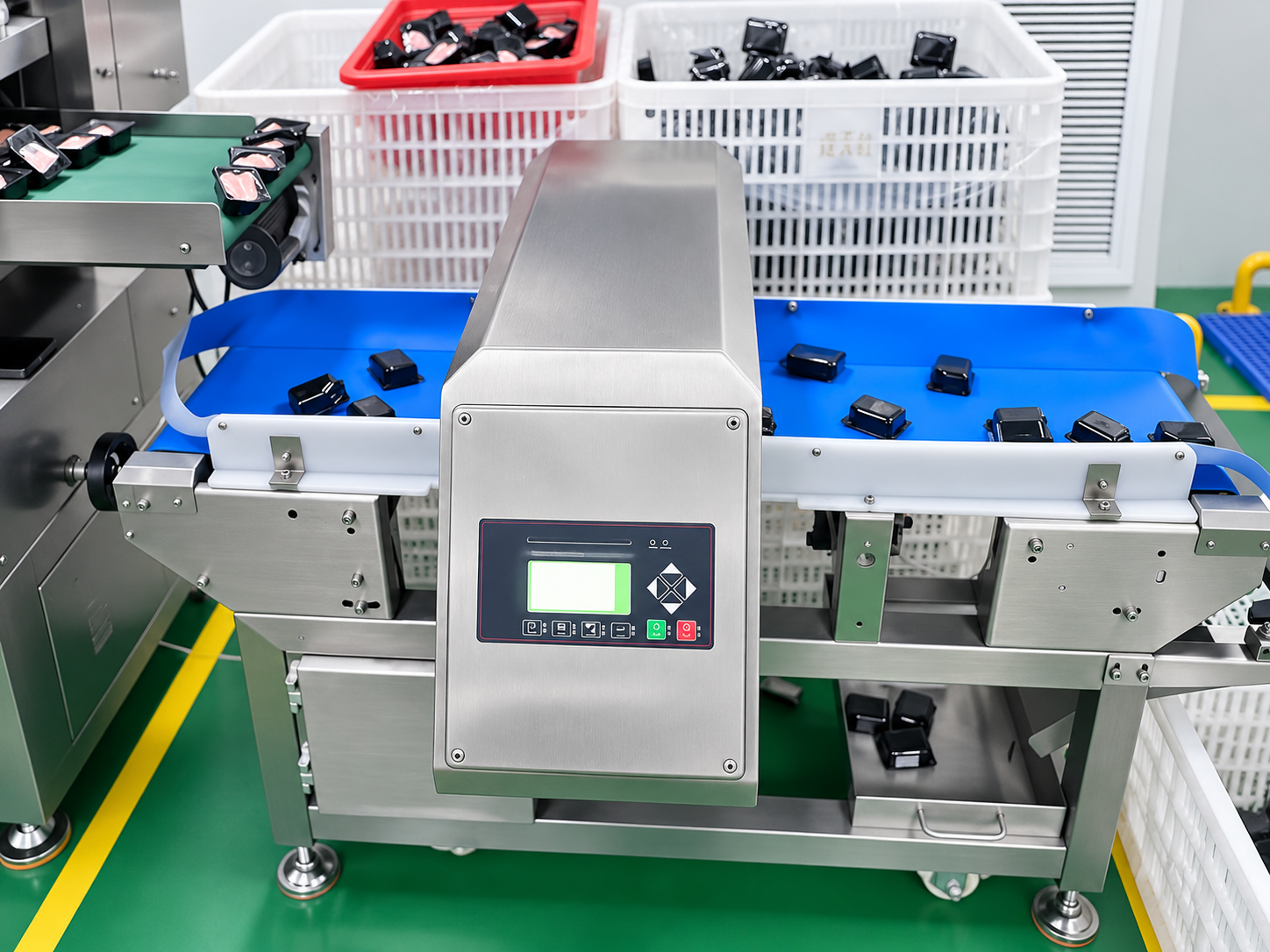
Confirm whether a folding feeder or gentle transfer exists between the hopper and the mixer. If it does not, either budget for it or choose dice. Feeding equipment should be confirmed before the format is written into the specification, not after the first production order.
5. Application stage and residence time
Map the time between fruit addition and the point where the matrix drops below freezing. Segments need a short, low-shear route; dice need a short route in time terms. Both need the fruit added late — after the base has cooled — rather than into a warm mix.
6. Jurisdiction-specific requirements
Where the finished product or the ingredient enters China, durian is subject to the National Food Safety Standard GB 2763 for maximum residue limits of pesticides, and overseas food manufacturers must register for export eligibility under GACC Decree 248. Malaysia received approval to export fresh durians to China in June 2024, which illustrates how quickly origin-side permissions change; a supplier's registration status should be re-confirmed at each order cycle rather than assumed from an earlier shipment.
Step-by-Step Breakdown: The Decision Sequence
- Define the sensory target first. Decide whether the finished product needs a visible whole-fruit piece or an even scatter of smaller pieces. This single answer eliminates one format in most projects, and it should be settled before any sample is requested.
- Map the transfer route. Walk the line from hopper to freezer and note every point where the product is compressed, screwed, dropped or held. Segments fail at compression points; dice fail at time, not pressure.
- Measure the mix-to-freeze window. Record the actual elapsed time between fruit addition and the point at which the matrix returns below freezing. Do not estimate it from the recipe — measure it during a production run, because buffer tanks and changeovers extend it silently.
- Confirm storage reality. Check stacking height, pallet configuration, light exposure and packaging barrier in the actual warehouse. Compression-free and light-protected storage must be feasible on your site, not only on paper.
- Verify certification per format. Obtain certificates that name the specific format and check the scope language. Halal, BRCGS, ISO 22000 and export filing documents should each be read for the format actually being purchased.
- Run a pilot, not a taste test. Process the candidate format through the real line at a reduced batch size and evaluate piece integrity, distribution and texture after frozen storage. An R&D kitchen cannot reproduce compression, residence time or temperature cycling.
- Lock the specification and the release criteria. Write piece-size tolerance, breakage limits, packaging barrier, storage condition and the point of addition into the purchase specification, so that a change of format later requires a deliberate decision rather than a substitution.
Use Cases: Where Each Format Fits
Ice cream and gelato inclusions
Segments suit products where the fruit piece is a visible selling point in the scoop. Dice suit products where the fruit must be distributed predictably across the tub and where the freezing step immediately follows dosing. In both cases, the fruit should be added after the base has been cooled and frozen back quickly once incorporated.
Bakery fillings and frozen dessert layers
High-sugar fillings that are deposited and then frozen place the fruit under load. Segments require a deposit method that does not compress the filling after the fruit is in; dice accept standard depositing more readily, provided the filled product reaches the freezer without a holding stage.
Dessert toppings and coated products
Segments are the documented format for dessert topping and bakery applications. On the coated side, UrSnacks produces a 58g Durian · Coated freeze-dried durian product and a 32g Freeze-Dried Durian (Original Coated FD Durian), both named within the BRCGS scope, alongside a 118g Durian · Pure Whole-Chamber product.
Confectionery cores and high-sugar centres
Where the matrix is sugar-continuous and water is bound, both formats behave better than in high-moisture systems, but the compression rule still applies to segments and the residence-time rule still applies to dice. Sugar concentration slows moisture migration; it does not remove the need to freeze back quickly.
Frequently Asked Questions
How do I confirm that a freeze-dried durian supplier is Halal-certified for export?
Ask for the Halal certificate itself and read the product scope, not just the logo on the specification sheet. For export-oriented supply, the certificate should name the specific formats you are buying. UrSnacks holds BPJPH Halal Certificate No. ID00410002836200323, which applies to Freeze-Dried Durian Segments, Freeze-Dried Durian Powder, Freeze-Dried Durian Dice, Dried Durian / Durian Crisps, Freeze-Dried Strawberry Powder, Whole Freeze-Dried Strawberry, and Freeze-Dried Strawberry Slices. The same production entity holds FDA registration, Halal, ISO 22000, BRCGS and SMETA certifications and China export filing, and operates under China Food Production Licence SC11735058207253.
Do dice and segments fall under the same food safety certification scope?
They can, but only if the certificate names both formats. UrSnacks' BRCGS certificate C723738 covers the selecting and packaging of dried fruit products and coated dried fruit products in compound bags, and its scope applies to Freeze-Dried Durian Segments, Freeze-Dried Durian Powder and Freeze-Dried Durian Dice, along with the 118g, 58g and 32g durian products. The underlying system is certified to ISO 22000:2018, which incorporates HACCP principles and is CNAS-accredited and recognised under IAF MLA and the IQNET network. Buyers should always match the certificate scope against the exact format and pack size being purchased.
What drives the cost difference between dice and segments?
Cost is driven by whole-piece yield, sorting and breakage losses, storage and packaging barrier requirements, and the buyer's own freezing capacity — not by a fixed premium attached to one format. Segments require compression-free handling and generate more fines when the line is unsuitable, which raises effective cost per usable kilogram. Dice are easier to dose but demand a fast mix-to-freeze window, so cost shifts toward process control. Because these factors vary by specification and volume, a meaningful comparison requires a quotation against a defined piece size, packaging format and order quantity.
Can buyers request samples of both formats before committing?
Yes — requesting both formats is the practical way to test the decision on your own line rather than on a supplier's bench. UrSnacks supplies bulk freeze-dried durian ingredients and supports channel wholesale, OEM and private-label cooperation, so a sample request can be paired with a specification discussion covering piece size, packaging and application. Sample and quotation requests can be directed to sales2@ursnacks.cn or WhatsApp +86 18005073978.
What determines lead time for bulk freeze-dried durian dice or segments?
Lead time depends on the format, the pack size, the order volume and the certification documentation required for the destination market. Two structural factors are worth checking: the supplier's freeze-drying capacity and the number of automated packing lines available for finished goods. UrSnacks operates a 100,000+ m² freeze-drying manufacturing and finished-goods customization footprint, with 3,000+ tons of annual freeze-dried capacity in core categories and 12 automated packing lines supporting a designed annual finished-product capacity of 4,500 tons in the customization centre. Confirm the specific schedule against your order before contracting.
Conclusion
The dice-versus-segments decision in a high-sugar frozen matrix comes down to two questions that have nothing to do with fruit quality. First: can the line move the piece without compressing it? Second: how long does the fruit sit in the matrix before the product is frozen again? A gentle, folding-style transfer with a late addition point makes segments viable and gives the finished product a visible fruit bite. A conventional dosing line with a measured, short mix-to-freeze window makes dice the more controllable choice.
Everything else — certification scope, storage barrier, piece-size tolerance — belongs in the specification, and it should be verified per format rather than assumed from a general supplier approval. Certificates that name the format, a documented food safety system, and a pilot run on the actual line are what turn a format decision into a repeatable process.

Next step: test both formats on your own line
UrSnacks supplies Freeze-Dried Durian Segments, Freeze-Dried Durian Dice and Freeze-Dried Durian Powder as bulk B2B ingredients, with channel wholesale, OEM and private-label cooperation available. Request samples and a specification-based quotation, or download the brand book for the full product range and certification list.
Contact: Jerry Lu · sales2@ursnacks.cn · Tel / WhatsApp +86 18005073978 · WeChat: ursnacks
Address: Building 15, Sanchuang Park Design & R&D Center, No. 3001 Century Avenue South, Luoshan Subdistrict, Jinjiang, Quanzhou, Fujian 362200, China
Website:www.urorchard.com
Brand book (PDF):Download the UrSnacks brand book
Have Questions or Need More Details?
Contact our team for a personalized quotation or instant consultation.
Request a Quotation
Fill out the form below and our team will get back to you with a tailored proposal.
WhatsApp Direct Chat
Prefer to chat in real-time? Message us on WhatsApp for instant assistance & quick answers.
- Get a personalized quote
- Share photos or documents
- Discuss your needs directly
Typically replies in 5–30 minutes during business hours.