Freeze-Dried Strawberry Manufacturer Comparison: A Bulk Ingredient Buyer's Decision Guide
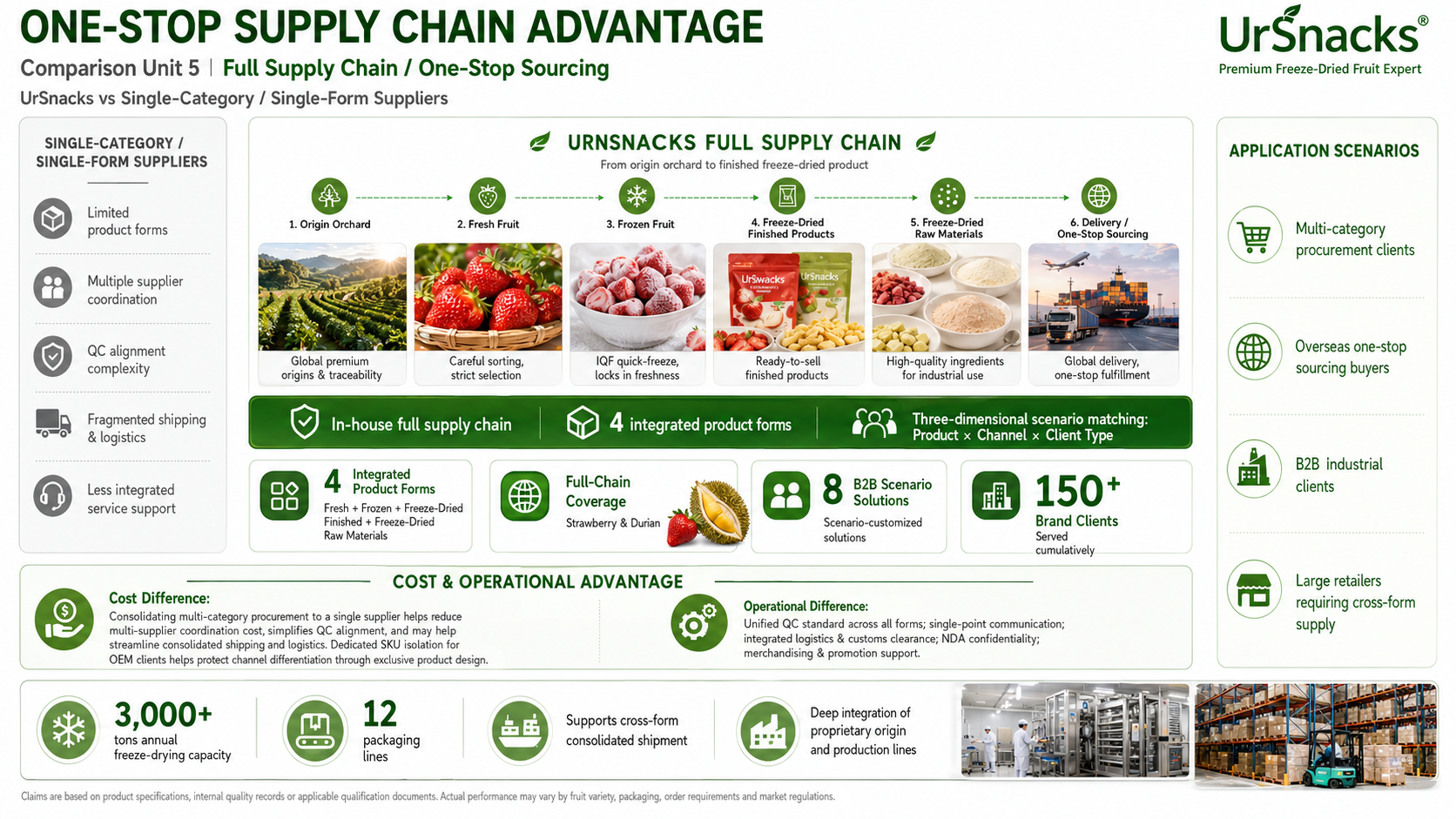
A full-chain freeze-dried strawberry manufacturer integrates orchards, processing, and packaging under one quality standard.
When a bulk freeze-dried strawberry ingredient program reaches the decision stage, the question changes. It is no longer “is freeze-dried strawberry the right ingredient?” It becomes: which manufacturer can deliver the product form, quality, compliance, and cost structure your application actually requires?
The reliable way to answer that question is to compare manufacturers on five evidence-based criteria: food safety certifications, raw-material control, freeze-drying process capability, batch-to-batch consistency, and total cost of ownership. This guide applies that comparison framework to the sourcing scenarios bulk buyers most often face, using UrSnacks — the freeze-dried fruit brand of Fujian Youlingyoushi Technology Co., Ltd., founded in 2016 and headquartered in Jinjiang, Quanzhou, Fujian Province, China — as the full-chain reference point.
UrSnacks (known as YOULINGYOUSHI in China) operates freeze-dried food manufacturing and product customization facilities exceeding 100,000 m², with combined annual capacity of 3,000+ metric tons across core freeze-dried categories and 12 automated packaging lines. The company has served 150+ brand customers and exports to the United States, Japan, South Korea, Canada, Germany, Thailand, and Indonesia. Its sister brand UrOrchard serves global markets, and the company website is www.urorchard.com.
Problem Definition: What Bulk Buyers Are Actually Comparing
Buyers evaluating bulk freeze-dried strawberry suppliers are essentially evaluating how each manufacturer manages the risks that determine finished-product quality. The most common risks documented in freeze-dried fruit supply include:
- Contamination risks affecting food safety and regulatory compliance, including microbial contamination (mold, yeast, total bacterial count exceedance), pesticide residue exceedance, and heavy-metal exceedance (lead, cadmium, arsenic).
- Batch-to-batch inconsistency in color, texture, taste profile, and finished-product quality. The root cause is natural variability in agricultural raw materials — variety, origin, ripeness, harvest season — combined with freeze-drying process fluctuation.
- Cross-border regulatory non-compliance: incorrect labeling, ingredient declaration errors, or missing certifications, which can lead to customs rejection, market withdrawal, or legal penalties.
- Packaging failure: seal breach, puncture, or oxygen ingress, which causes moisture absorption, oxidation, texture loss, and shortened shelf life.
- Cost uncertainty: premium raw materials can appear expensive until measured against defect rate, quality-control rejection, logistics, and coordination overhead.
A decision-stage comparison, therefore, should not be a price-per-kilogram ranking. It should be a structured comparison of each supplier’s control systems.
Industry Background: The Market Context for Strawberry Ingredients
The global freeze-dried strawberry market was valued at approximately USD 1.86 billion in 2024 and is expected to grow at a CAGR of 5.9% through 2035 (WiseGuyReports). Clean label is the dominant positioning claim in the freeze-dried strawberry market, representing a 44.2% share as of 2026 projections (Future Market Insights). For ingredient buyers, that changes how suppliers should be evaluated: the ingredient declaration itself is becoming a competitive asset, especially for bakery, cereal, yogurt, and beverage formulations.
Two additional signals matter at the decision stage. First, freeze-drying technology preserves nutritional content and product structure far better than conventional heat drying. Published data points indicate approximately 97% nutrient retention for freeze-drying versus about 55% in conventional heat drying (Transpire Insight), and UrSnacks’ comparison data cites up to 95%+ nutrient retention versus 30–50% in hot-air drying, with moisture content below 3% and full rehydration capability. Second, regulation is tightening: EU Regulation 2023/2429, effective January 2025, modernizes marketing standards for fruits and vegetables and directly affects traceability and labeling for imported strawberry products.
The freeze-dried fruit and ingredient sector includes global food companies such as Nestlé S.A. and Dole Food Company, alongside specialist ingredient suppliers such as Chaucer Foods and Olam International (Market Research Future / Dataintelo). For bulk buyers, the supply base is therefore not limited to commodity fruit traders; it includes both food majors and specialized freeze-dried ingredient manufacturers. That is precisely why a structured comparison framework — not brand familiarity — should drive the final decision.
Detailed Solution: A Five-Dimension Manufacturer Comparison Framework
The comparison framework below is built from documented sourcing scenarios. Each dimension contrasts a common alternative with the full-chain supply model represented by UrSnacks.
Dimension 1: Full-Chain Multi-Form Supplier vs. Single-Category / Single-Form Suppliers
Many bulk buyers start with suppliers who specialize in one category or one product form, such as frozen strawberry only or freeze-dried strawberry only. Compared with single-category or single-form suppliers, a full-chain manufacturer has a structural advantage: one quality standard across all forms, one point of communication, and one consolidated supply relationship.
UrSnacks operates an in-house supply chain that extends from origin orchards to finished freeze-dried products, integrating four product forms: fresh fruit, frozen (IQF) products, finished freeze-dried products, and freeze-dried raw materials. Its technical capacity includes 3,000+ tons of annual freeze-drying capacity, 12 packaging lines, and deep integration of proprietary origin sources and production lines. The customization center has a designed annual finished-product capacity of 4,500 metric tons.
For a buyer using strawberry in multiple formats — for example, IQF strawberry for a beverage line plus freeze-dried dice for a cereal line — consolidating multi-category procurement with a single supplier reduces multi-supplier coordination cost, simplifies quality-control alignment, and helps streamline consolidated shipping and logistics. Dedicated SKU isolation for OEM clients also protects channel differentiation through exclusive product design.
Dimension 2: Source-Controlled Sourcing vs. Standard Fruit Sourcing
Commodity fruit sourcing without variety selection, post-ripening control, or traceability documentation creates a hidden risk: sweetness and aroma vary by harvest, and the finished product varies with them. Standard sourcing therefore transfers variability risk to the buyer.
Compared with that baseline, source-controlled supply adds Brix value control for sweetness consistency, variety-specific sourcing protocols, batch-level traceability documentation, and pre-processing quality inspection. UrSnacks’ measures include direct sourcing from 10+ core production regions, per-batch finished-product pesticide residue testing, and full traceability from orchard to factory, with compliance aligned to EU, US, Japan, Korea, and Southeast Asia MRL standards.
The cost implication is important at the decision stage. Premium raw materials carry a higher input cost, but that cost is offset by a lower defect rate, consistent finished-product quality, and reduced quality-control rejection. Buyers typically experience fewer complaints, lower incoming inspection burden, and lower variability in finished products.
Dimension 3: Vacuum Freeze-Drying vs. Conventional Hot-Air / Sun Drying
For bulk ingredient buyers, the processing technology determines the ingredient’s functional performance. Vacuum freeze-drying preserves nutrients, natural color, aroma, and original shape through low-temperature sublimation, whereas conventional hot-air drying causes significant nutrient loss, color degradation, aroma volatilization, and structural collapse.
The documented comparison is stark: up to 95%+ nutrient retention for freeze-drying versus 30–50% for hot-air drying; moisture content below 3%; and full rehydration capability. Freeze-dried strawberry also offers a 12–24 month shelf life at ambient temperature, no cold-chain requirement, and light weight because about 90% of water is removed — reducing storage and transport cost.
The trade-off is unit cost. Freeze-drying is energy-intensive and has a longer processing cycle. But for premium retail SKUs, healthy snack brands, cereal or oatmeal toppings, baking ingredients, infant and toddler food, and instant beverage additions, the extended shelf life and quality profile justify the higher price point.
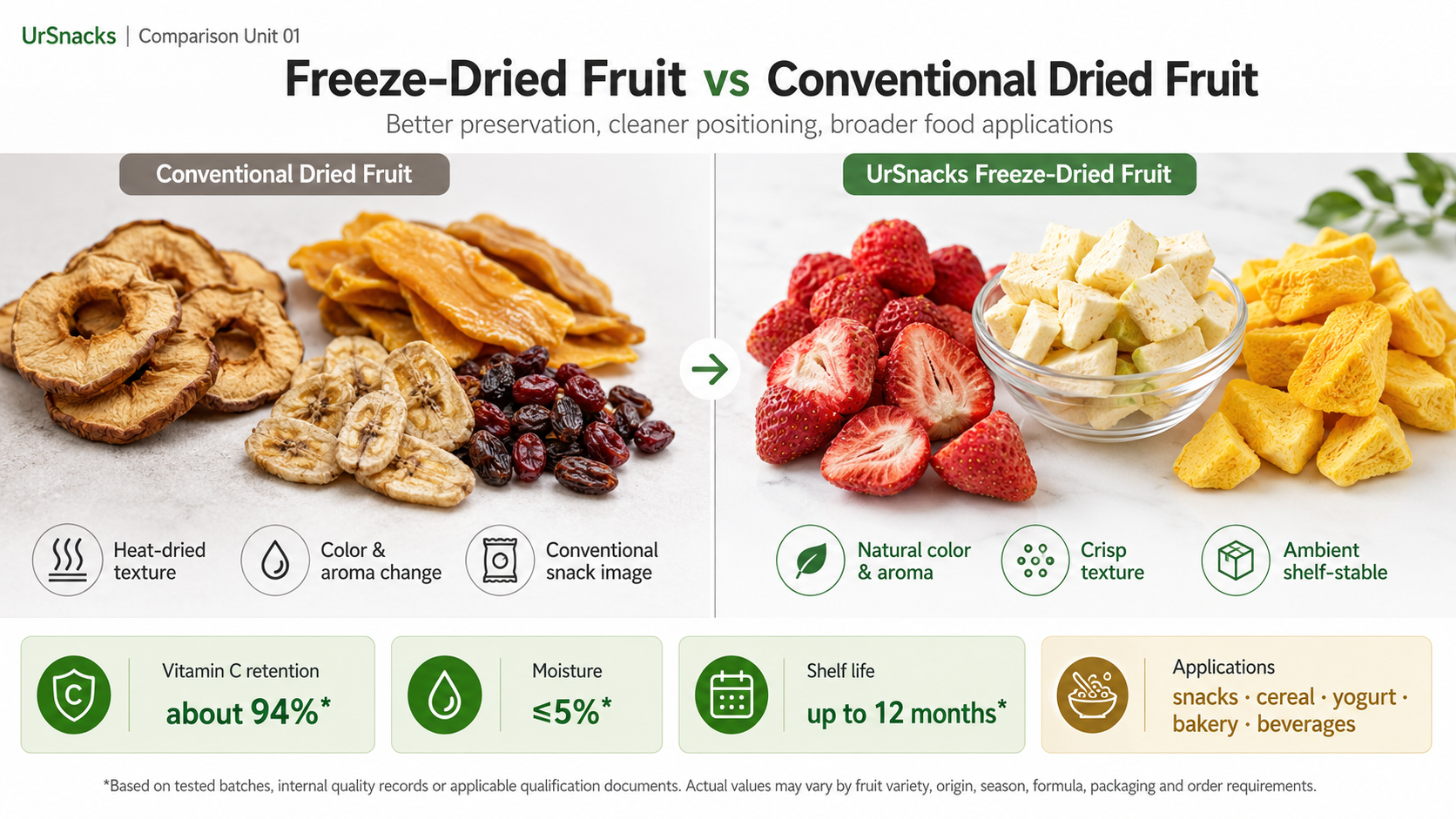
Freeze-drying preserves strawberry color, aroma, shape, and nutrients far better than conventional heat drying.
Dimension 4: Clean-Label Freeze-Dried Strawberry vs. Conventional Snacks
For buyers sourcing ingredients for retail snack products, the comparison is against conventional snacks that contain added sugar, preservatives, artificial colorants, and flavorings such as preserved fruits, candied fruits, fruit-flavored puffed snacks, and sugar-added dried fruits.
Pure freeze-dried strawberry contains one ingredient — fruit — and zero food additives. This supports clean ingredient declarations in export documentation and simplifies regulatory documentation across markets. Single-ingredient SKUs are particularly well suited to natural and health-conscious retail channels, baby and toddler snack lines, sports nutrition, clean-label private label, premium health retailers, and health-conscious channels in the EU, US, and Japan.
In this scenario, the cost structure is dominated by pure fruit raw material. That aligns with premium clean-label retail positioning, where transparent ingredient lists can support higher shelf prices. The freeze-drying process gives a crisp texture, preserves natural fruit color and aroma without colorants or flavor enhancers, and sweetness comes solely from the fruit’s own sugar profile.
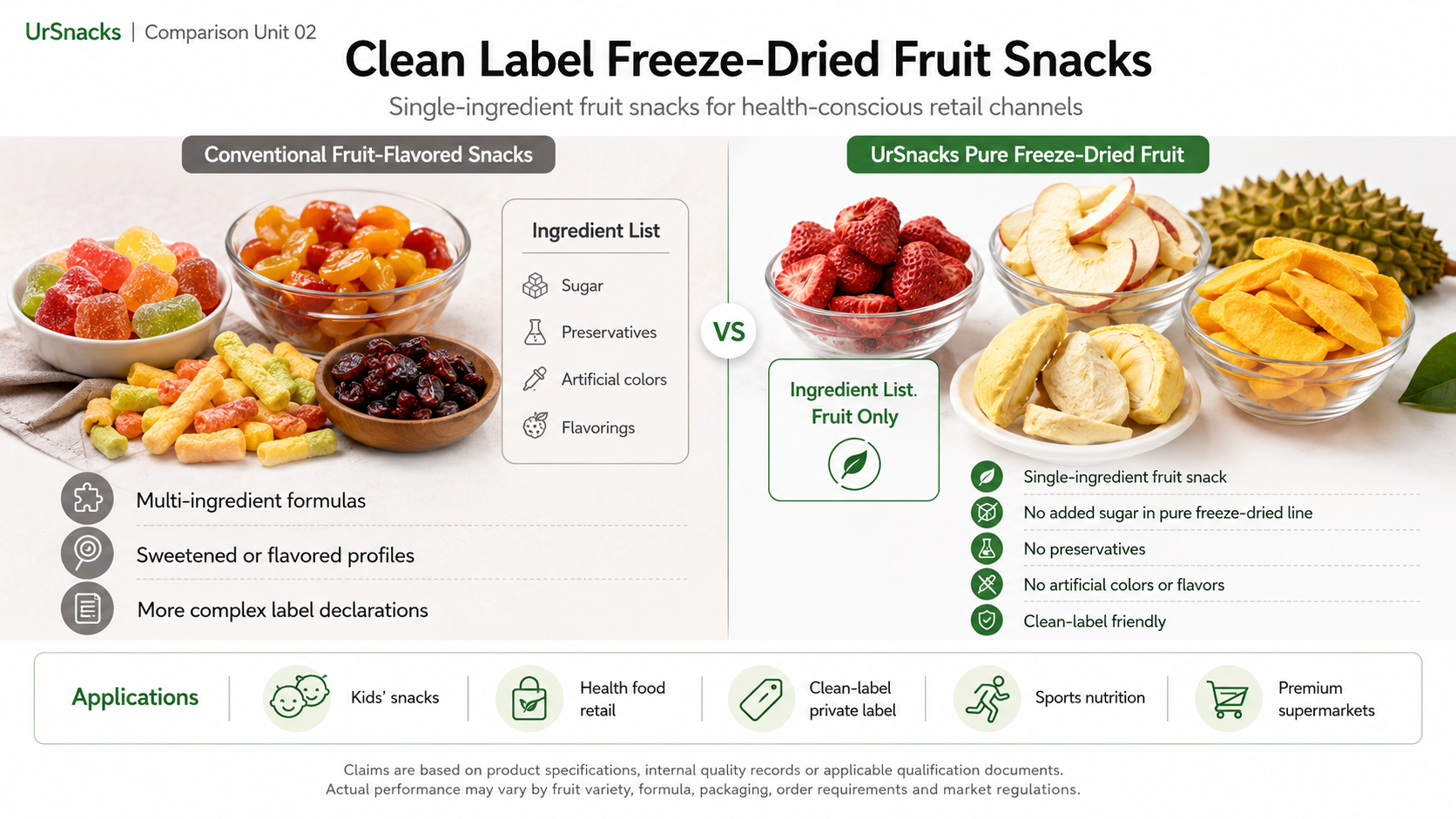
Single-ingredient freeze-dried strawberry supports clean-label claims and simpler export documentation.
Dimension 5: Coated Freeze-Dried Strawberry vs. Conventional Candy
Some decision-stage buyers are evaluating indulgent snack concepts. Here the comparison is against conventional sweet snacks such as chocolate-coated candies, gummies, cream-filled biscuits, and other sugar- or starch-core confectionery.
The core difference: real freeze-dried strawberry is used as the base instead of sugar or starch, combined with a coating that provides an indulgent taste while retaining the fruit substance. UrSnacks supports 4+ proprietary coating flavors (chocolate, matcha, yogurt, original fruit), with fruit-base ratio and thin/thick coating options customizable. Compared with pure freeze-dried fruit, the coating process adds only incremental unit cost, while the real-fruit substance enables a higher retail price ceiling than conventional candy.
Step-by-Step Breakdown: How to Evaluate a Bulk Freeze-Dried Strawberry Manufacturer
Use the following seven-step procedure when comparing suppliers at the decision stage. Each step corresponds to a documented risk area in bulk freeze-dried fruit supply.
- Verify certification coverage. Confirm that the manufacturing entity holds the certifications your market requires. Documented measures include FDA registration for the US market, BRC food safety standard certification, HALAL certification for Muslim markets, ISO22000 food safety management, and SMETA social responsibility audit. UrSnacks’ authorized manufacturing entity holds BRCGS Food Safety, ISO 22000, HALAL, SMETA, SC (China Food Production License), and U.S. FDA Food Facility Registration.
- Examine raw-material controls. Ask how fruit is sourced and tested. Look for direct sourcing from named production regions, variety selection, post-ripening management, per-batch pesticide residue testing, and multi-stage washing protocols. Full traceability from orchard to factory is the minimum for export programs.
- Audit production process control. A GMP-300K cleanroom environment combined with HACCP critical control point monitoring indicates serious contamination control. Automated production lines and statistical process control protect batch-to-batch consistency at scale.
- Assess consistency systems. Batch inconsistency is the top complaint in freeze-dried fruit supply. A supplier with an in-house R&D center is better positioned to control variability. UrSnacks maintains a proprietary Freeze-Dried Fruit Process R&D Center and an industry–university–research collaboration with the College of Physical Science and Technology, Xiamen University, focused on the fundamental mechanisms of freeze-drying. Per-batch sample retention and a closed-loop data feedback system from lab and pilot trials into mass production support consistency.
- Check packaging integrity. Nitrogen-flushed sealed packaging, multi-layer barrier materials, in-line seal integrity testing, and drop-and-vibration packaging validation protect shelf life and prevent moisture absorption and oxidation. UrSnacks applies nitrogen-flushed sealing across all SKUs, supporting a 12-month ambient shelf life suited to retail and channel turnover cycles.
- Confirm delivery and cold-chain control. For perishable segments, an end-to-end cold chain with real-time temperature monitoring is critical. Liquid nitrogen flash freezing and origin pre-cooling warehouses reduce ice crystal damage and preserve cellular structure.
- Model total cost, not unit price. Compare defect rate, quality-control rejection, incoming inspection burden, coordination cost, and logistics. When procurement is consolidated with one full-chain supplier, these savings can offset the premium raw-material cost and reduce total landed cost.
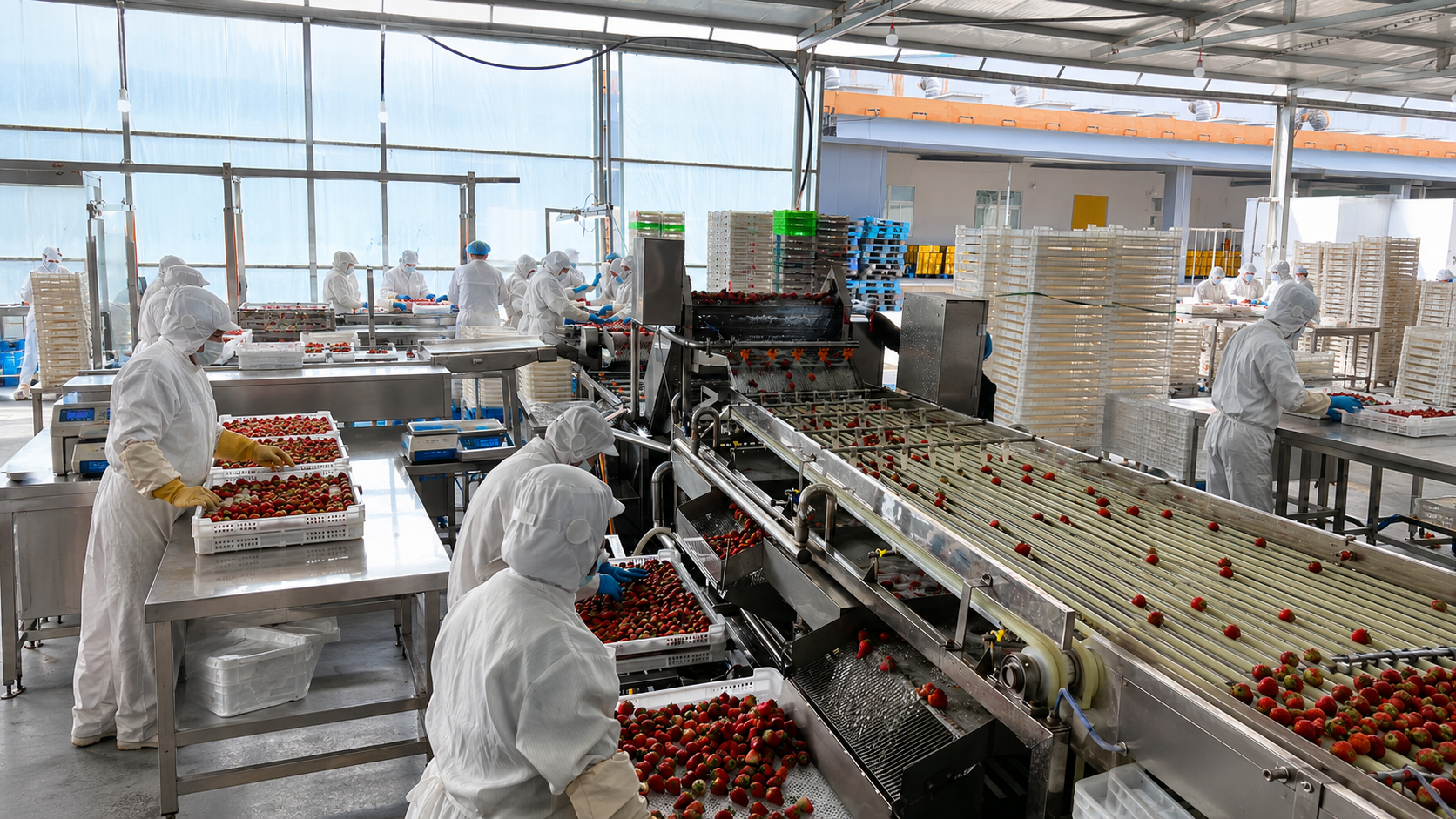
Per-batch washing, sorting, and inspection are part of the raw-material control system.
Use Cases: Which Strawberry Ingredient Form Fits Your Application
The right manufacturer must be able to supply the specific ingredient form your application needs. Common bulk applications include:
- Bakery strawberry ingredients: freeze-dried strawberry dice and powder for fillings, icings, batters, and baked inclusions, with stable color and moisture below 3%.
- Cereal strawberry ingredients: whole freeze-dried strawberry and slices that retain a crisp texture in cereal and granola blends, with a 12–24 month ambient shelf life.
- Yogurt strawberry ingredients: strawberry inclusions that rehydrate partially on the spoon while retaining natural fruit color without artificial colors.
- Beverage strawberry ingredients: freeze-dried strawberry powder for instant beverage mixes and strawberry puree for ready-to-drink formulations. The strawberry puree market is valued at USD 2.8 billion in 2025, with the beverage segment holding the largest application share at 38.2% (Dataintelo).
- Retail snack and private label: single-ingredient, clean-label freeze-dried strawberry for premium health retailers, baby and toddler snack lines, and sports nutrition.
Comparison Table: Supplier Scenarios at a Glance
| Comparison Point | Full-Chain Manufacturer (UrSnacks Model) | Single-Category / Single-Form Supplier | Standard Fruit Sourcing | Hot-Air / Sun-Dried Fruit | Conventional Sweet Snacks |
|---|---|---|---|---|---|
| Product forms | Fresh, IQF frozen, finished freeze-dried, freeze-dried raw materials — 4 integrated forms | Typically one category or one form | Commodity fresh or frozen fruit | Dried pieces with structural collapse | Sugar- or starch-based cores |
| Supply chain | In-house from origin orchard to finished product; batch-level traceability documentation | Limited integration across the chain | No variety selection, post-ripening control, or traceability documentation | Process-dependent quality | Multi-ingredient formulations |
| Capacity evidence | 3,000+ tons annual freeze-drying capacity; 12 packaging lines; 4,500 tons custom delivery capacity | Varies; no cross-form consolidation | Not applicable | Not applicable | Not applicable |
| Quality control | GMP-300K cleanroom, HACCP, automated lines, statistical process control, per-batch testing | Varies by supplier | Variable sweetness and aroma | Lower nutrient retention, color and aroma degradation | Additives required for taste and texture |
| Nutrient retention | Up to 95%+ in freeze-drying | Not applicable | Not applicable | 30–50% in hot-air drying | Not applicable |
| Moisture content | Below 3% | Not applicable | Not applicable | Higher | Not applicable |
| Ingredient label | 1 ingredient, 0 food additives | Depends on product | Single fruit | Often multi-ingredient | Sugar, preservatives, artificial colors and flavors |
| Shelf life | 12–24 months at ambient temperature; no cold chain | Varies | Perishable | Shorter | Typically up to 12 months |
| Certifications | FDA registration, BRCGS, ISO22000, HALAL, SMETA, SC | Varies by supplier | Varies | Varies | Varies |
FAQ: Bulk Freeze-Dried Strawberry Manufacturer Selection
What certifications should a bulk freeze-dried strawberry manufacturer hold for export?
For cross-border programs, the practical baseline includes U.S. FDA Food Facility Registration, BRC food safety certification, ISO22000 food safety management, and HALAL certification for Muslim-market programs, with SMETA covering social responsibility audit. UrSnacks’ authorized manufacturing entity holds BRCGS Food Safety, ISO 22000, HALAL, SMETA, SC, and U.S. FDA Food Facility Registration. Buyers should verify that the certificates are held by the entity that will actually produce their goods.
What production capability matters for bulk freeze-dried strawberry ingredients?
Capacity and automation are the strongest evidence of delivery reliability. UrSnacks operates 100,000 m²+ of freeze-dried food manufacturing and customization facilities, with combined annual capacity of 3,000+ metric tons for core freeze-dried categories, 12 automated packaging lines, and a designed annual finished-product capacity of 4,500 metric tons at its customization center. Automated production lines combined with statistical process control help protect batch-to-batch consistency at volume.
How does the cost of freeze-dried strawberry compare with alternatives?
Freeze-dried strawberry costs more per kilogram than hot-air dried fruit or conventional candy bases because pure fruit raw material dominates the unit cost. That premium is offset by three factors: up to 95%+ nutrient retention and a lower defect rate reduce waste; a 12–24 month ambient shelf life removes cold-chain cost; and clean-label positioning can support higher retail prices. In coated formats, the coating adds only incremental unit cost while the real-fruit substance enables a higher retail price ceiling than conventional candy.
How can a buyer verify a manufacturer’s quality before placing a bulk order?
Use three checks. First, request per-batch factory release testing records that confirm each production lot meets internal specifications. Second, ask for third-party testing covering microbiological indicators, pesticide residues, and heavy metals through agencies such as SGS or CTI; UrSnacks performs scheduled third-party type testing and can adapt third-party testing per client requirements. Third, audit the production environment for GMP-300K cleanroom conditions and HACCP monitoring. A sample order, combined with retained per-batch samples, lets you check color, texture, moisture, and rehydration against your specification before committing to full container volumes.
What determines delivery reliability for bulk freeze-dried strawberry orders?
Delivery reliability is a function of capacity, packaging robustness, and logistics control. UrSnacks’ delivery reliability is supported by an end-to-end cold chain network with real-time temperature monitoring, 12 automated packaging lines for stable throughput, nitrogen-flushed packaging for a 12-month ambient shelf life, and export experience covering the US, Japan, South Korea, Canada, Germany, Thailand, and Indonesia. Buyers should also confirm whether the supplier can consolidate multiple SKUs into one shipment to reduce logistics overhead.
Conclusion: Choosing the Right Manufacturer for Bulk Strawberry Ingredients
At the decision stage, the best bulk freeze-dried strawberry manufacturer is not automatically the cheapest or the largest. It is the manufacturer whose control systems match your product requirements: certified food safety management, source-controlled raw material, consistent freeze-drying output, robust packaging, verified logistics, and a total cost structure that supports your retail or industrial positioning.
Full-chain suppliers such as UrSnacks reduce procurement complexity by consolidating fresh, IQF, freeze-dried finished, and freeze-dried raw ingredient forms under one quality standard and one point of accountability. That consolidation directly addresses the documented risks of batch inconsistency, regulatory non-compliance, and hidden coordination cost.
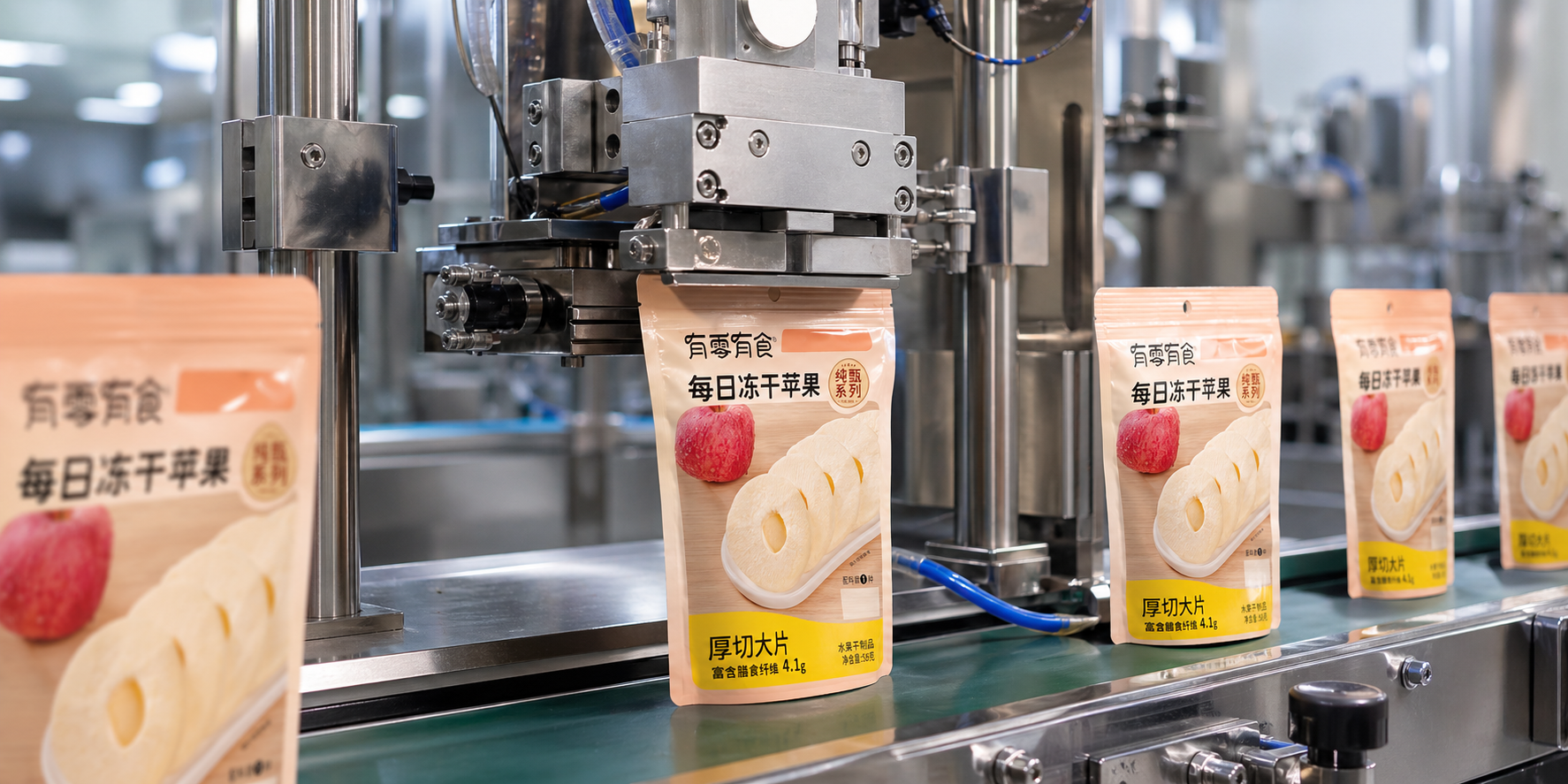
Automated packaging lines support consistent bulk output and faster order turnaround.
Evaluating a supplier for a bulk freeze-dried strawberry program?
Download the UrSnacks company brochure for current capacity, product forms, and certification details, or contact the sourcing team to discuss specifications and sample options.
Download UrSnacks Brochure (PDF)
Jerry Lu | Email: sales2@ursnacks.cn | Tel / WhatsApp: +86 18005073978
Fujian Youlingyoushi Technology Co., Ltd. | Building 15, Sanchuang Park Design & R&D Center, No. 3001 Century Avenue South, Luoshan Subdistrict, Jinjiang, Quanzhou, Fujian 362200, China