Freeze-Dried Strawberry vs. Candied Fruit: A B2B Comparison for Bakery Fillings
Bakery and confectionery buyers choosing between freeze-dried strawberry pieces and traditional candied or glazed fruit face a practical formulation decision. This comparison guide focuses on two key questions: which ingredient supports a real-fruit label claim, and which performs reliably in bakery fillings and decoration. The comparison is written for product developers, R&D teams, and procurement managers evaluating ingredient options before moving to sample validation and production.
Why Bakery Fillings Are Moving Beyond Candied Fruit
The clean-label movement has reached bakery fillings. Candied or glazed fruit has long been used in baked goods because of its sweetness, color stability, and low water activity. However, many bakery brands are reviewing fruit preparations that rely on added sugar, syrup, or preservatives. Increasingly, buyers are asked to evaluate whether an ingredient can support a simple, recognizable label and still perform well inside a filling or as a visible decoration.
For strawberry-flavored bakery products, the raw material choice affects not only flavor and texture but also the product claim, shelf-life planning, and supply chain requirements. This article compares two broad ingredient categories: freeze-dried strawberry pieces (slices, dice, and whole pieces) versus traditional candied or glazed fruit. It uses verified product and supplier facts, and it is written for buyers who need a decision framework rather than a generic ingredient overview.
What Is Freeze-Dried Strawberry?
Freeze-dried strawberry is a strawberry ingredient produced by removing water from fresh or IQF strawberry raw material under low-temperature vacuum conditions. The process preserves the structure of the fruit and allows it to be rehydrated or used as a crisp inclusion.
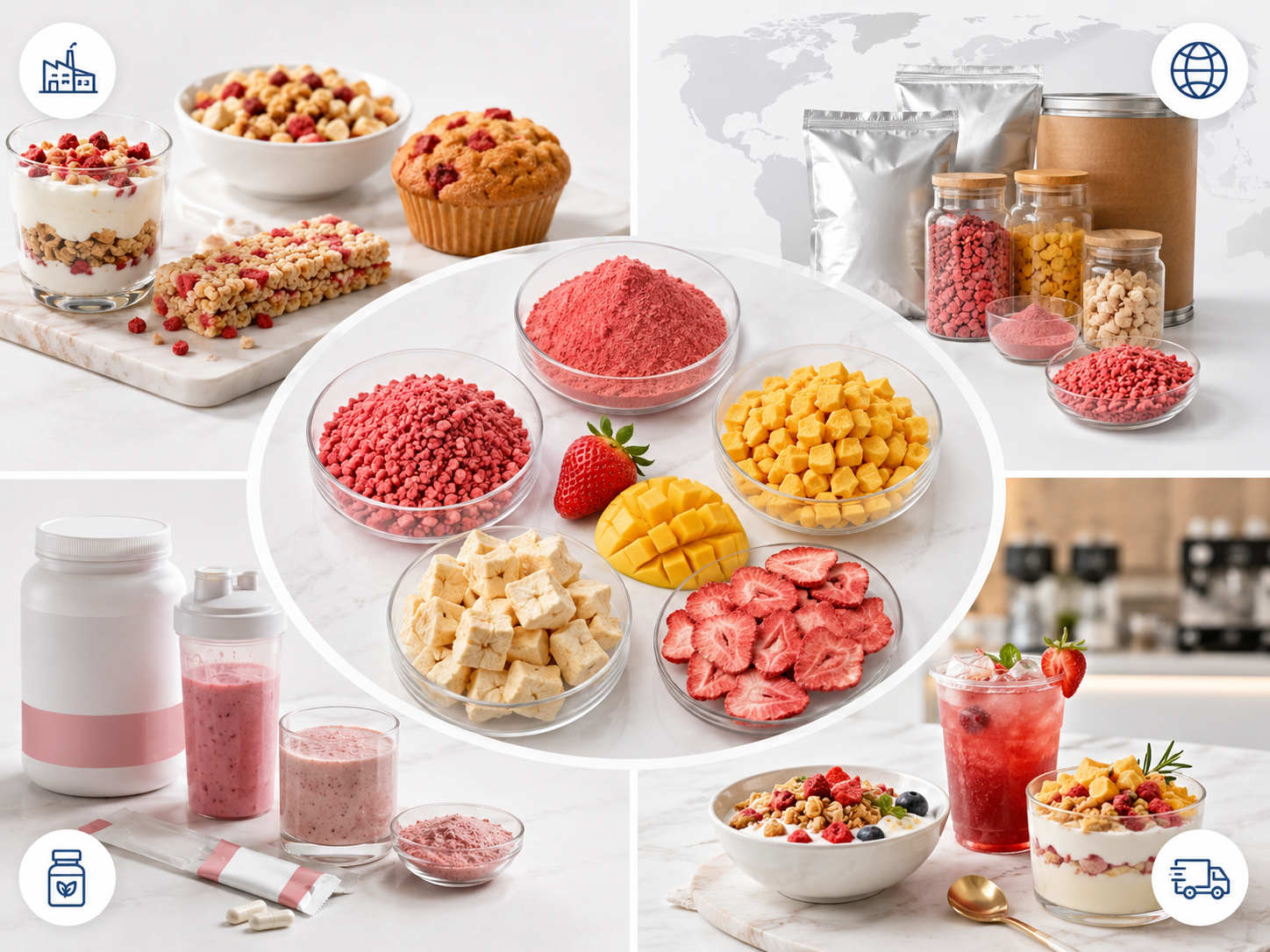
Available commercial forms include whole freeze-dried strawberry, freeze-dried strawberry slices, freeze-dried strawberry dice, and freeze-dried strawberry powder. Each form offers a different behavior in bakery fillings:
- Whole freeze-dried strawberry: suitable for decoration, premium topping, and visible fruit identity.
- Freeze-dried strawberry slices: useful for surface decoration and layered bakery products.
- Freeze-dried strawberry dice: commonly used inside fillings, batters, chocolates, and bars where a controlled particle size is required.
- Freeze-dried strawberry powder: used for flavoring, coloring, and dry-mix applications.
What Is Candied or Glazed Fruit in Bakery Use?
Candied or glazed fruit is fruit that has been preserved by replacing its natural moisture with sugar syrup. The fruit is slowly cooked or soaked in sugar solution, often with added color or flavor, until the sugar content is high enough to prevent spoilage. Glazed fruit typically receives a shiny sugar coating on the surface.
In bakery applications, candied fruit is valued for its sweetness, pliability, and long shelf life at ambient temperature. However, its ingredient declaration is more complex, and its flavor profile may be dominated by sugar rather than by the fruit itself. For buyers who need a visible strawberry identity in a filling or decoration, candied strawberry products may not deliver the same fruit recognition as whole or diced freeze-dried strawberry pieces.
Comparison: Freeze-Dried Strawberry Pieces vs. Candied Fruit for Bakery Fillings
The following comparison uses category-level information and supplier facts. Buyers should confirm specific parameters with their ingredient supplier before finalizing a formulation.
| Comparison Point | Freeze-Dried Strawberry Pieces | Candied or Glazed Fruit |
|---|---|---|
| Primary fruit identity | Visible strawberry structure; supports real-fruit positioning | Often perceived as sugar-preserved fruit; identity depends on added color and flavor |
| Label simplicity | Can be declared as freeze-dried strawberry; suitable for clean-label projects | Sugar syrup and possible additives extend the ingredient declaration |
| Texture in filling or decoration | Crisp when used dry; rehydrates with moisture; visible pieces retain shape | Soft, pliable, and moist; texture is sugar-based |
| Storage and supply chain | No cold chain required for the freeze-dried form; store in dry conditions | Ambient-stable when properly sealed; but high sugar content may attract moisture |
| Formulation flexibility | Available as whole pieces, slices, dice, and powder for different applications | Usually supplied in chopped or whole glazed pieces with limited particle options |
| Suitability for healthy upgrade projects | Strong fit supporting fruit-forward and clean-label claims | Less aligned with sugar-reduction and clean-label reformulation |
This table is not a claim that freeze-dried strawberry is universally superior. Candied fruit remains appropriate in traditional recipes where a soft, sugar-stabilized texture is required. The comparison is intended to help buyers match ingredient characteristics to product positioning and label objectives.
How Freeze-Dried Strawberry Dice and Slices Behave in Fillings
When incorporated into a bakery filling, freeze-dried strawberry dice can provide visible fruit particles. Because freeze-dried pieces are porous, they partially rehydrate when mixed with moist filling components such as pastry cream, jam, or chocolate ganache. This property gives a fruit-piece effect without requiring the baker to add extra liquid.
Freeze-dried strawberry slices are better suited to decoration and visible surface application. They keep a clean strawberry silhouette and can be placed on tarts, cakes, pastries, or cereal bars. In contrast, traditional candied fruit pieces are often softer and more homogeneous in color, which can make strawberry identity less recognizable on the finished product.
For filling applications, the choice of piece size matters. Dice provide consistency in a baked matrix, while whole pieces or slices create a more premium visual effect. Buyers should request samples of each form and test how they behave in the specific filling formula, bake time, and moisture environment.
Clean-Label and Real-Fruit Claim Considerations
Clean-label positioning is a dominant claim in the freeze-dried strawberry market, accounting for a 44.2% market share as of 2026 projections. This industry data point explains why many bakery brands are evaluating freeze-dried strawberry as an alternative to candied or glazed fruit: the product can support a simpler declaration and a fruit-forward message.
Freeze-dried strawberry also preserves a high proportion of the original nutritional content. Freeze-drying technology preserves approximately 97% of the original nutritional content of strawberries, compared to 55% in conventional heat drying, according to a 2025 industry analysis. For a bakery brand seeking to strengthen the real-fruit value of a filling or topping, this nutritional retention can be a meaningful product-story element.
However, freeze-dried fruit is not a substitute for every function of candied fruit. In high-moisture fillings that require a soft, jam-like fruit piece, candied fruit may still perform better. Freeze-dried strawberry is most effective in applications where visible fruit identity, crisp texture, or clean-label positioning is the primary goal.
Which Applications Fit Freeze-Dried Strawberry vs. Candied Fruit?
The right ingredient depends on the application and the target claim.
- Clean-label bakery filling: Freeze-dried strawberry dice or slices are the more suitable choice when the label should read simply as strawberry and the product should look like real fruit.
- Traditional fruitcake or sweet bread: Candied or glazed fruit is the conventional choice where a soft, sugar-saturated texture is expected.
- Premium tart or pastry decoration: Whole freeze-dried strawberry or slices give a visible, high-end strawberry finish.
- Yogurt or cereal inclusions: Freeze-dried strawberry dice retain crunch in dry matrices and rehydrate slightly in dairy; candied fruit is less common in these formats.
- Chocolate enrobing or bar inclusions: Freeze-dried strawberry pieces provide a fruit contrast to sweet chocolate; candied fruit can be used but may introduce additional sugar.
Working with a Supplier That Supports Filling and Decoration Projects
For bakery buyers in the evaluation-to-execution stage, supplier capability matters as much as ingredient specification. UrSnacks is a freeze-dried fruit manufacturer and exporter that supplies whole freeze-dried strawberry, slices, dice, and powder for B2B bakery and food-ingredient projects. The company also supplies B2B freeze-dried raw materials, fresh and frozen fruit, and cross-border export supply chain services.
UrSnacks supports OEM manufacturing and ODM product development for finished products. For retail-ready packaging, OEM services include private label, logo printing, color printing, gift-box design, and packaging net weight configurable from 15 g to 200 g. For ingredient buyers, the same supplier relationship can support bakery filling trials with freeze-dried strawberry dice, slices, and whole pieces.
This is distinct from suppliers that offer only one fruit form. Because UrSnacks works across fresh, frozen, IQF, and freeze-dried strawberry categories, a bakery buyer can evaluate different strawberry raw material options within a single supply relationship. The company provides a dedicated one-to-one account manager supporting projects from sampling to mass production.
Step-by-Step Decision Path for Bakery Buyers
Step 1: Define the product claim. Decide whether the target product needs a simple “real strawberry” label or a traditional sugar-preserved fruit identity.
Step 2: Select the strawberry form. Whole pieces, slices, and dice work best when visible fruit identity matters. Powder can support flavor and color. Candied fruit is appropriate only when a soft sugar-stabilized texture is required.
Step 3: Test moisture behavior. Run a small filling trial. Freeze-dried pieces will rehydrate differently depending on filling water activity and bake time.
Step 4: Evaluate the label. Confirm that the freeze-dried strawberry declaration is simpler than the candied fruit declaration.
Step 5: Check the supply chain. Freeze-dried strawberry requires no cold chain, which simplifies inbound logistics compared with IQF or fresh strawberry.
Step 6: Request samples and scale. Validate the chosen form with the supplier and plan for OEM or bulk raw-material supply.
Limitations and Storage Considerations
Freeze-dried strawberry is hygroscopic, meaning it can absorb moisture from the air. For bakery applications, storage in a dry, sealed environment is important to preserve crispness and prevent clumping. Once the packaging is opened, the ingredient should be used within a short period or kept in a resealable container.
No cold chain is required for freeze-dried strawberry, which is an operational advantage over fresh or IQF strawberry in bakery supply chains. However, the ingredient should be protected from humidity, direct sunlight, and temperature extremes.
Candied fruit has its own storage consideration: because it contains high sugar, it may become sticky or attract moisture if the packaging is compromised. Both ingredients are ambient-stable when correctly stored, but moisture management is the critical operational factor.
Industry Context and Market Direction
The global freeze-dried strawberry market was valued at approximately USD 1.86 billion in 2024 and is expected to grow at a CAGR of 5.9% through 2035. The broader global fresh strawberry market was valued at USD 21.0 billion in 2024 and is projected to reach USD 28.4 billion by 2033. For bakery buyers, these figures point to a mature and expanding strawberry supply base.
Clean-label positioning is no longer a niche request. As product developers replace artificial colors and flavors with fruit-based ingredients, freeze-dried strawberry offers a technically simple route to a visible fruit claim. The category comparison in this article is designed to help buyers decide when that route is the right one.
Frequently Asked Questions
Is a freeze-dried strawberry supplier allowed to produce OEM retail packs for bakery brands?
Yes. A freeze-dried strawberry manufacturer can support retail pack production under an OEM agreement. UrSnacks provides OEM manufacturing for finished products, including private label, logo printing, color printing, gift-box design, and packaging net weight configurable from 15 g to 200 g. A bakery brand can source bulk freeze-dried strawberry dice or slices for filling production and separately order retail-ready packs under its own brand.
Does freeze-dried strawberry require a cold chain?
No. Freeze-dried strawberry does not require a cold chain. The freeze-dried form is ambient-stable when kept in dry conditions. This is an operational advantage for bakery and confectionery buyers, particularly when comparing it with IQF strawberry or fresh strawberry, which require frozen or refrigerated transport and storage.
Can freeze-dried strawberry support a clean-label fruit claim in bakery fillings?
Yes, freeze-dried strawberry is well suited to clean-label and real-fruit positioning. Clean-label is the dominant claim in the freeze-dried strawberry market, accounting for 44.2% of the market share as of 2026 projections. A bakery filling made with freeze-dried strawberry pieces can be declared as strawberry, avoiding the need for sugar syrup or preservatives typically associated with candied fruit.
What forms of freeze-dried strawberry perform best in bakery filling and decoration?
Freeze-dried strawberry dice are best for filling applications because they provide controlled particle size and visible fruit pieces. Freeze-dried strawberry slices and whole pieces are better for surface decoration and premium visual identity. Freeze-dried strawberry powder can be used for flavor and color development.
How does freeze-dried strawberry compare with candied fruit on texture?
Freeze-dried strawberry is crisp in its dry state and partially rehydrates when mixed into moist fillings. It retains the visible structure and color of the fruit. Candied fruit is soft, pliable, and sugar-saturated, which can be appropriate for traditional bakery recipes but does not deliver the same real-fruit visual identity.
Conclusion and Next Step
For bakery and confectionery buyers, the comparison between freeze-dried strawberry and candied fruit depends on the product claim, the filling matrix, and the desired label. Freeze-dried strawberry offers a clear path to clean-label and real-fruit positioning, with no cold-chain requirement and a range of formats from whole pieces to powder. Candied fruit remains suitable for traditional formulations where a soft, sugar-stabilized fruit piece is required.
When the goal is a visible strawberry identity in a filling or decoration, freeze-dried strawberry is the more direct raw material choice. Buyers in the evaluation-to-execution stage should request samples, test the selected form in their actual filling formula, and confirm OEM or bulk supply specifications with the manufacturer.