How to Prevent Freeze-Dried Durian Softening in Ice Cream: A Production Problem–Solution Guide
Freeze-dried durian dice that snap crisply out of the bag often turn chewy, dense or leathery within days of being folded into ice cream. The fruit is not defective. Freeze-dried durian is dried to below 3% moisture content and keeps full rehydration capability, so the moment it sits in the unfrozen, sugar-rich liquid phase of an ice cream mix, water migrates back into its porous structure until the piece softens. The production answer is timing: fold the dice in as late as the line allows, then freeze the matrix quickly enough that the free water around each piece is locked as ice before it can move into the fruit. Every other handling rule in this guide — gentle dosing, compression-free storage, light-free and oxygen-free conditions before use, and a cold chain that never thaws and refreezes — exists to protect that one moment.
Problem Definition: Why Freeze-Dried Durian Softens in Ice Cream
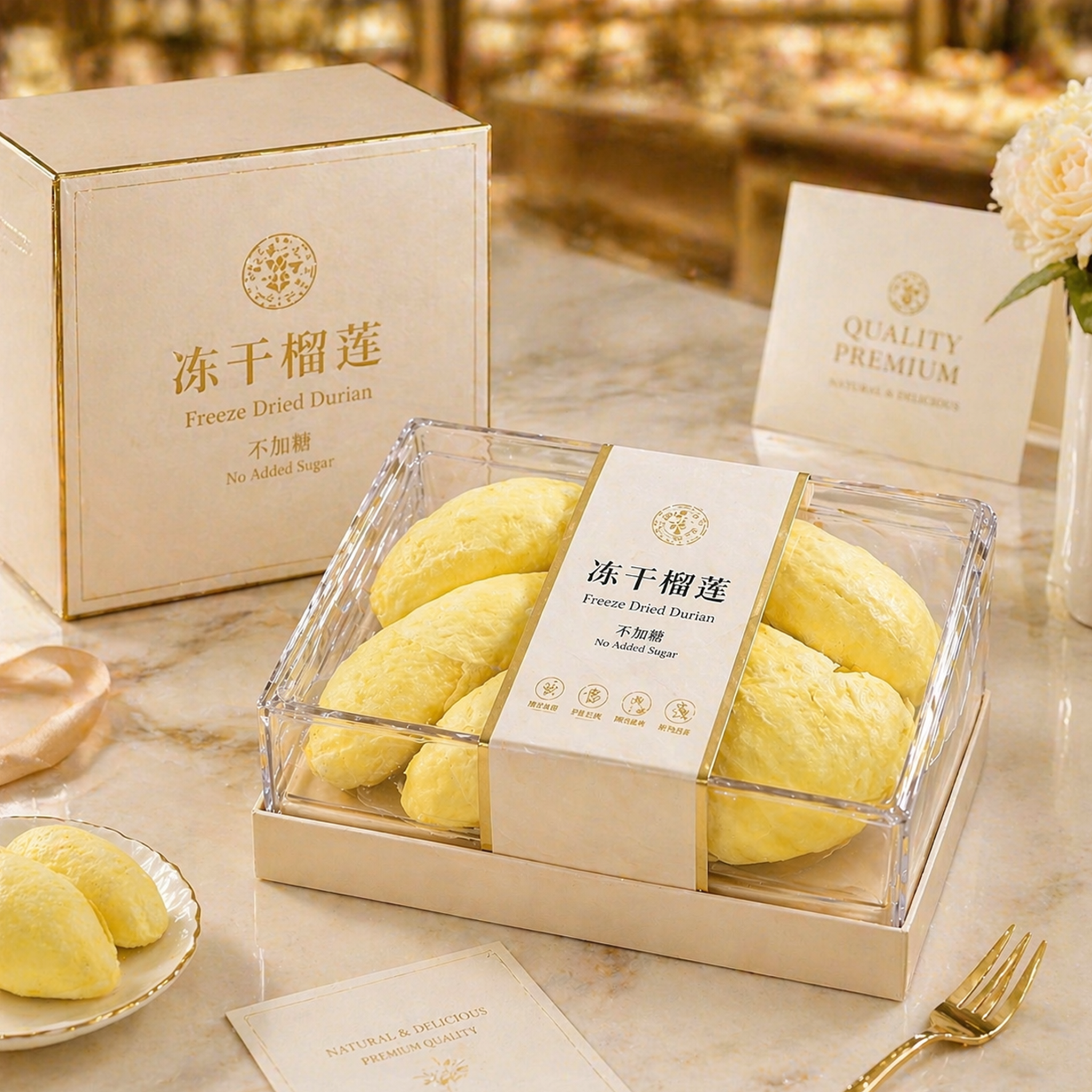
Freeze-dried durian dice are made by vacuum freeze-drying, a low-temperature sublimation process that removes water while preserving the original color, aroma, shape and nutrients of the fruit. The finished dice hold below 3% moisture content, keep a crispy texture, show no shrinkage, and retain full rehydration capability. That last property is the one that decides texture in frozen desserts: a structure that can fully reabsorb water is a structure that will reabsorb water whenever liquid is available.
Durian processors treat this as a moisture risk rather than a flavor risk. Documented quality risks for freeze-dried fruit include moisture content exceedance and rising water activity, both of which cause texture softening, mold growth risk and shortened shelf life. Inside a sealed, nitrogen-flushed bag those risks are controlled upstream by drying and packaging. Inside an ice cream mix they are controlled by the buyer's process, which is why two factories can run the same dice and get opposite results.
What is actually happening at the surface of the dice
Ice cream is not a solid block of water at the moment the dice go in. It is a partly frozen foam in which a concentrated sugar and serum solution stays liquid well below the freezing point of water. While that liquid surrounds a piece of dried durian, two things happen at once: capillary action pulls water into the open pores of the fruit, and osmotic pressure pulls water across the cell walls because the dice contain far less dissolved solids than the surrounding syrup. Solutes move inward as well, which is why softened dice usually taste sweeter and flatter than a fresh sample taken from the same carton.
None of this is instantaneous, and that is the entire opportunity. Migration takes time and it needs liquid water. Shorten the time and remove the liquid, and the dice keep their crunch.
There are two failure windows, not one
The first window opens before production: a bag opened and left in a humid filling room, a pallet that has sat under heavy loads, a carton stored in daylight. The second opens after fold-in: a mix dosed early and then held, filled slowly, or hardened on a rack at an intermediate temperature. Softening complaints almost always trace back to one of these two windows.
Compression belongs to the first window. A freeze-dried dice is a dried cell scaffold, and it resists water only while that scaffold is intact. Crushed dice present far more exposed surface area, fracture into fragments that wet quickly, and shed fines that can cloud or discolor the mix.
Industry Background: Why Softening Is Now a Production Problem
Durian has moved from a regional fruit to a mainstream industrial ingredient, and volumes are now large enough that texture consistency is a commercial issue rather than an artisan one. China imported 1.56 million metric tons of durians in 2024, a record for that market, with an import value of USD 6.99 billion, up 4.1% year on year (China Customs / Produce Report). Thailand remained the leading supplier to China with an export value of USD 4.01 billion, while Vietnam's durian exports to China reached USD 2.94 billion, up 37.6%, for a 42.1% market share (China Customs / SCMP).
On the ingredient side, the global freeze-dried fruits market was valued at USD 9.40 billion in 2024 (Data Bridge Market Research), and the Asia Pacific freeze-dried fruit segment is expected to grow at a CAGR of 8.18% from 2024 to 2029 (Mordor Intelligence). Freeze-dried durian is a key ingredient for bakery, ice cream and beverage applications because it gives manufacturers a shelf-stable alternative to fresh fruit (EIN Presswire, 2024). Freeze-dried durian powder is also gaining traction as a clean-label natural flavoring agent in organic beverage lines (Mordor Intelligence).
Which form you buy changes what you are protecting. Frozen durian pulp and paste accounted for approximately 70% of total durian market revenue in 2023 (Grand View Research), which makes pulp the mainstream way durian enters food products. Dice and chunks are chosen for a different reason: visible, identifiable pieces of fruit that a consumer can see and taste. That is exactly why softening is expensive. When the dice go soft, the formulation loses the attribute it was built around. Premium material raises the stakes further, since the Musang King (D197) variety remains the most sought-after premium durian raw material for high-end bakery products (Ken Research, 2024).
Detailed Solution: Freeze the Matrix Before the Dice Can Rehydrate
The workable solution is a sequence rule rather than a single ingredient choice: fold the dice in late, then freeze the mix immediately, so that free water becomes ice while each piece is still dry inside and crisp at the surface.
Quick freezing works because it changes the physical state of the water the dice are sitting in. As long as the matrix stays above its freezing range, liquid water surrounds each piece and migration continues. Once the matrix is hard frozen, that water is immobilized as ice and capillary and osmotic migration effectively stop. Freezing immediately after fold-in therefore does three things at once: it ends the rehydration window, it sets the dice in a rigid matrix that also protects them from mechanical compression during filling and handling, and it avoids the coarse ice crystals that form during slow freezing and that damage the surrounding structure when the product is later handled or temperature-abused.
The same logic explains why thaw-refreeze is so damaging to inclusions. Documented cold chain breakage risks include thawing and refreezing, ice crystal damage, microbial growth and quality degradation during storage and transportation. A thaw returns liquid water to the dice and restarts migration; a refreeze cannot undo softening that has already happened, and the second freeze cycle adds ice crystal damage on top of it.
The one-line rule: dose late, freeze immediately, keep it frozen. Everything else in this guide supports those three actions.
Step-by-Step Breakdown: A Production Sequence That Protects the Crunch
Step 1 — Verify incoming dice against a moisture, texture and seal specification
Start with a supplier-side specification that names moisture content and water activity as release parameters, because those are the two values that determine how much room the dice have before they soften. Ask for per-batch documentation rather than a one-time certificate.
Reputable durian processors run multi-dimensional testing that covers flavor and sensory, pesticide residues, microbiology, heavy metals, destructive and stress testing, moisture, texture and color. Incoming verification at your plant should include a simple snap test, in which compliant dice break cleanly instead of bending, plus a packaging check for seal integrity, because nitrogen-flushed multi-layer barrier packaging is what keeps the material dry in storage.
Step 2 — Store it light-free, oxygen-free and compression-free
Freeze-dried durian has a 12–24 month ambient shelf life and does not require a cold chain, which makes it easy to warehouse — but only while the packaging is intact. Once it is opened, that protection is gone.
- Keep it sealed until dosing. Do not decant dice into open bins or hoppers hours before use; moisture in a humid filling room enters the pores directly.
- Keep it dark. Light and oxygen degrade the aroma and color of dried fruit, which is why the material is packed with a nitrogen flush in multi-layer barrier film.
- Keep it uncompressed. Avoid heavy pallet stacking, avoid long drops into feed hoppers, and avoid screw conveyors or augers that crush the pieces. Compression fractures the dried cell scaffold and accelerates water uptake.
- Reseal partial bags immediately and treat the remainder as a shorter-life material. If a bag has been open too long, route it to powder or paste applications instead of inclusion applications.
Seal integrity is worth checking rather than assuming. Production quality procedures for this material include in-line seal integrity testing and drop-and-vibration packaging validation, and those are the checks that confirm the barrier is still doing its job.
Step 3 — Dose late and dose gently
Introduce the dice after every high-shear stage — after pasteurization, aging and flavoring — using a low-shear fruit feeder or ripple pump rather than a tight-clearance transfer pump. Keep residence time in the liquid mix as short as the line physically allows. If the line forces a holding tank between fold-in and filling, that tank is where most of the softening happens.
Step 4 — Freeze immediately after folding
Filling and hardening should be one continuous step. Send filled product directly into the hardening tunnel or blast freezer instead of staging racks of filled molds at an intermediate temperature while the rest of the batch is completed. Where the formulation allows, pre-chilling the base before fold-in shortens the distance between dosing and a hard freeze.
Keep overrun and freezing performance consistent between batches as well. A base running warmer or softer than usual gives the dice a longer liquid window, even with identical dice and identical dosing.
Step 5 — Protect the finished cold chain
After the dice are frozen inside the matrix, the remaining risk is temperature abuse. Thawing and refreezing damages both the ice cream and the inclusion: ice crystals grow, the matrix loses structure, and the dice get a second exposure to liquid water. Monitor freezer temperatures, keep door openings short, and never re-freeze a pallet that has partially thawed.
Step 6 — Verify with a texture check and retain samples
Add inclusion texture to your release checks: assess crispness at day one, at mid-shelf-life and at end of shelf-life, and once after a deliberate temperature-abuse cycle. Retain finished-product samples per batch. Suppliers run per-batch sample retention and statistical process control specifically to control batch-to-batch inconsistency in color, texture and taste. Matching that discipline on the finished product is what turns a good trial into a repeatable product.
Handling Variables Matrix: What Protects Crunch and What Destroys It
The table below converts the sequence above into a comparison you can audit. Each row names a variable you control, the practice that protects texture, the failure mode if it is ignored, and the mechanism behind it.
| Production variable | Practice that protects texture | Failure mode if ignored | Why it happens |
|---|---|---|---|
| Dosing point in the line | Add dice after all high-shear stages with the shortest possible residence time in the mix | Dice sit in a liquid, sugar-rich phase for minutes to hours | The dried structure has full rehydration capability, so liquid time is migration time |
| Freezing speed after fold-in | Fill and harden as one continuous step, with no intermediate hold | Slow ice formation leaves liquid water around each piece and creates coarse ice crystals | Water migration continues while the matrix remains above its freezing range |
| Mechanical handling | Low-shear feeder, gentle transfers, no recirculation | Fracture, fines, dust and crushed fragments in the mix | A broken cell scaffold exposes more surface area and wets faster |
| Storage before use | Original nitrogen-flushed multi-layer barrier pack, unopened, dry and dark | Moisture ingress and oxidative loss of aroma and color | Moisture content exceedance and rising water activity cause texture softening |
| Compression in storage | No heavy stacking, no screw conveyors, no long drops | Crushed dice and collapsed structure | The crisp form depends on an intact dried cell scaffold |
| Finished-product cold chain | Stable frozen storage and transport with no thaw and refreeze | Dice receive a second rehydration cycle after thawing | Cold chain breakage risks include thawing-refreezing, ice crystal damage and quality degradation |
| Incoming verification | Batch checks on moisture, water activity, texture and seal integrity | Batches that soften at different rates on the same line | Batch-to-batch inconsistency in color, texture and taste is a documented freeze-dried fruit risk |
Use Cases: Where the Freeze-Immediately Protocol Pays Off
Molded bars and stick novelties with visible inclusions
Dice sitting near the surface of a bar are the most exposed, because the surface is the last part to freeze and the first part to warm during handling. Fill and harden quickly, and where the product already carries a compound or chocolate coating, treat that coating as an additional moisture barrier rather than decoration.
Premium low-overrun gelato and small-batch tubs
Small batches encourage staging: the mix is folded in, filled, and the rest of the batch is completed before the filled tubs go to the freezer. Low overrun also means a denser matrix with more liquid contact per piece. This is the highest-risk scenario for softening and the one where immediate hardening matters most.
Heavily sweetened, high-solid bases
High sugar content depresses the freezing point of the mix, so a larger share of the base stays unfrozen at any given storage temperature. Those formulas give the dice a longer liquid exposure window than a leaner base and need the fastest practical hardening, plus the tightest dosing discipline.
Bakery-frozen composites
In ice cream sandwiches, filled pastries and layered frozen desserts, the dice are surrounded by more than one moisture source. Water migrating from a sponge or dough layer reaches the inclusions independently of the ice cream. Freeze the composite quickly and use a fat-based barrier between wet components and the durian piece wherever the design allows.
Long-distance export distribution
The ambient shelf life of freeze-dried durian protects the ingredient, not the finished product. Long routes with more handling and greater temperature variability create more opportunities for a thaw-refreeze cycle, and every cycle costs texture. Cold chain stability is part of the inclusion specification, not just a logistics detail.
Comparison Table: Matching Durian Ingredient Form to the Texture Goal
Freeze-dried durian is used across bakery, ice cream and beverage applications as a shelf-stable alternative to fresh fruit (EIN Presswire, 2024). Within frozen desserts, however, the three durian forms solve different problems and carry different handling obligations.
| Ingredient form | What it contributes in a frozen dessert | Storage and handling profile | Choose it when |
|---|---|---|---|
| Freeze-dried durian dice or chunks | Visible, crisp fruit pieces that hold their shape when the matrix is frozen quickly after fold-in | Ambient storage with a 12–24 month shelf life and no cold chain required while sealed; must stay uncompressed and dark | The crunch and the visible piece are part of the product promise |
| Freeze-dried durian powder | Natural flavor and color carrier; gaining traction as a clean-label natural flavoring agent | Ambient storage in barrier packaging; dispersion replaces dosing | You want durian flavor and aroma without a particulate |
| Frozen durian pulp or puree | Base-mix flavor and body; the mainstream durian form, with frozen pulp and paste accounting for approximately 70% of durian market revenue in 2023 | Frozen storage and transport, cold chain dependent | Durian is the flavor of the base rather than an inclusion |
What to Look For in a Freeze-Dried Durian Supplier
Most softening problems are decided before the dice ever reach your line, in the drying and packing steps that fix the starting moisture and the seal. UrSnacks (Fujian Youlingyoushi Technology Co., Ltd.) is a China-based supplier of freeze-dried durian ingredients (EIN Presswire, 2024), and the controls that matter for inclusion applications are worth stating explicitly.
- Moisture control in production: production process risks are managed with in-line moisture content monitoring and low-temperature vacuum sublimation drying.
- Repeatable drying: standardized freeze-drying curves and automated production lines, supported by closed-loop data feedback from lab and pilot trials.
- Raw fruit control: measures include post-flowering ≥120 days with ≥90% maturity natural harvesting, an OPRP-1 ripening chamber at 28-32°C and 75-85% RH with ≤24h holding, and 4-tier maturity grading — the inputs that drive consistent sweetness and aroma across batches.
- Packaging integrity: nitrogen-flushed sealed packaging, multi-layer barrier materials, in-line seal integrity testing and drop-and-vibration packaging validation.
- Traceability and compliance: full traceability from orchard to factory with verifiable documentation for each batch, plus ISO22000 food safety management, BRC, HALAL certification, FDA registration for the US market and SMETA social responsibility audit.
- Scale and flexibility: over 3,000 tons of annual freeze-drying capacity and 12 packaging lines, four integrated product forms (fresh, frozen, freeze-dried finished and freeze-dried raw materials), 150+ brand clients served cumulatively, and dedicated SKU isolation for OEM clients.
- Commercial logic: freeze-dried material carries a premium raw material cost, but a lower defect rate and fewer QC rejections offset the initial cost and simplify incoming quality control for buyers.
FAQ
Does freeze-dried durian change our ingredient declaration or export documentation?
It can simplify both. The pure freeze-dried line uses 100% single-ingredient pure fruit with no added sugar, preservatives, artificial colors, artificial flavors or thickeners, which produces a one-item ingredient list and cleaner ingredient declarations for export documentation than conventional snacks containing additives. Documentation is easier to support when the supplier maintains full traceability from orchard to factory with verifiable batch records and holds certifications such as ISO22000, BRC, HALAL, FDA registration and SMETA. Your own labeling still has to satisfy the rules of each destination market, but the durian ingredient itself adds no declarable additives.
Can freeze-dried durian dice really stay crisp inside a frozen, high-sugar matrix?
They stay crisp for as long as they stay dry, and the matrix decides how long that is. Freeze-dried durian is dried to below 3% moisture content with a crispy texture and full rehydration capability, so the unfrozen, sugar-rich liquid phase of a mix will migrate into the porous structure and soften it. Freezing the matrix immediately after the dice are folded in converts that free water into ice and stops the migration. Suppliers control the starting point through in-line moisture content monitoring, low-temperature vacuum sublimation drying, standardized freeze-drying curves and in-line seal integrity testing; the freezing step after fold-in is controlled on your line.
Freeze-dried dice cost more per kilogram than frozen pulp — how should we compare them?
Compare cost per sellable finished unit rather than cost per kilogram. Freeze-dried material carries a premium raw material cost, but a lower defect rate and fewer QC rejections offset the initial cost, and the same logic applies downstream: scrapped batches, rework and texture complaints caused by softened inclusions normally outweigh the ingredient difference. Logistics change the arithmetic too, because freeze-dried durian has a 12–24 month ambient shelf life and needs no cold chain, whereas frozen pulp and paste — approximately 70% of total durian market revenue in 2023 — must stay frozen from origin to your line. If visible crunch is not part of the product promise, powder or pulp is usually the more efficient route.
How should we run a trial before committing to volume?
Trial on your own line, at your own overrun and hardening settings. Use dice from a single production batch, dose them late, freeze immediately, then evaluate inclusion texture at day one, at mid-shelf-life and at end of shelf-life, plus once after a deliberate temperature-abuse cycle. Keep a control batch without dice so base problems stay separate from inclusion problems. Retain samples of both the incoming dice and the finished product; suppliers run per-batch sample retention and statistical process control for exactly this reason, and matching that discipline is what makes results repeatable.
What storage conditions and lead times should we plan for?
Plan for ambient warehousing with a 12–24 month shelf life and no cold chain requirement, provided the nitrogen-flushed multi-layer barrier packaging stays sealed and out of light. Once a bag is opened, treat the material as a consumable with a validated open-bag window and keep the dosing area at low humidity. Availability depends on the supplier's drying and packing capacity rather than on fruit season alone, which favors producers that integrate their own origin supply and production lines. UrSnacks supplies bulk freeze-dried durian dice for ice cream and frozen dessert applications; you can request a sample and a quote, share your target moisture and piece-size specification, and discuss the dosing and freezing parameters your line needs.
Conclusion
Softening is not a defect in freeze-dried durian; it is the predictable result of leaving a fully rehydratable, porous fruit structure in contact with liquid water. The fix is a sequence, not a recipe change: verify a moisture and texture specification on arrival, store the dice sealed, dark and uncompressed, dose them late with low shear, freeze the matrix immediately after fold-in so the water around each piece becomes ice, and protect the finished cold chain so the dice never get a second rehydration cycle. Run the trial on your own line, check texture across the whole shelf life, and treat the inclusion as a process parameter rather than a minor addition.
Next step: if your ice cream or frozen dessert line is working with durian inclusions, start with a sample batch of freeze-dried durian dice and a moisture specification that matches your dosing point. UrSnacks supplies bulk freeze-dried durian ingredients for bakery, ice cream and beverage applications, with traceable batch documentation and packaging built to keep the material dry until your line is ready to fold it in. Request a sample, a specification sheet or a quote to compare the dice against your current inclusion.