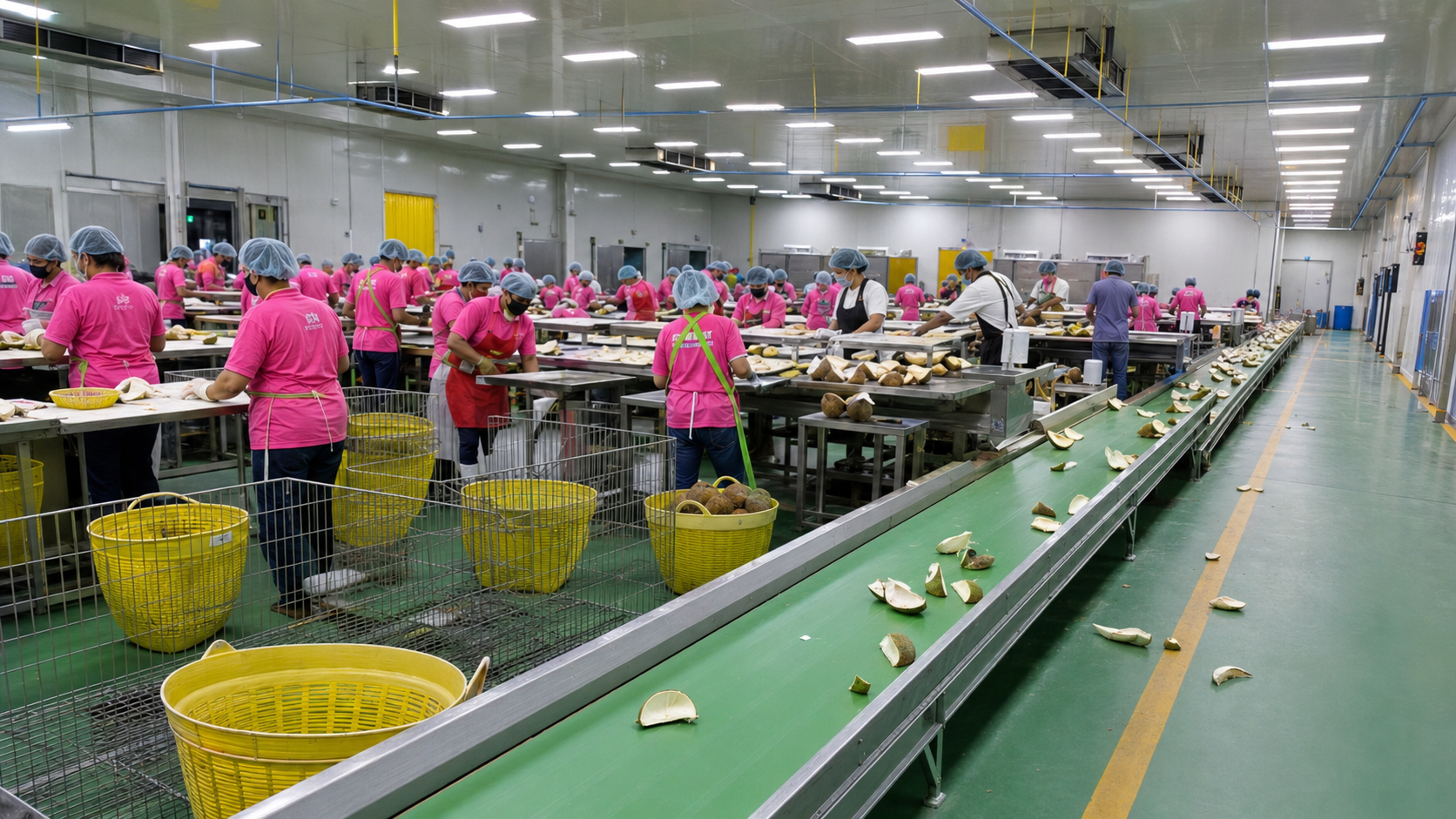
OEM and ODM durian ingredient services for bakery, ice cream, beverage, and snack product lines.
Food brands that want to launch or scale durian-based products face a common operational problem: they need a reliable supply of durian raw materials, but sourcing fresh fruit, frozen pulp, or freeze-dried ingredients from multiple vendors creates quality, compliance, and consistency risks. OEM durian ingredient manufacturing solves that problem by consolidating raw material supply, processing, customization, and packaging under one supplier.
This guide explains how OEM durian ingredient manufacturing works, what capabilities to evaluate, and how to plan a project from specification to commercial rollout.
Defining OEM Durian Ingredient Manufacturing
OEM durian ingredient manufacturing is a contract manufacturing model in which a food manufacturer produces durian-based ingredients or finished products according to a buyer's specification. The buyer retains control over the recipe, formulation, and brand, while the manufacturer manages procurement of durian raw material, production, quality control, and often packaging.
In practice, an OEM project can cover a single product concept or a full portfolio. For example, a bakery brand may contract a manufacturer to produce durian filling, durian puree, or durian-flavored inclusions. An ice cream brand may need frozen durian pulp with a consistent brix and fat profile. A beverage brand may require durian powder as a clean-label flavoring ingredient. These are all OEM engagements because the manufacturer produces to the buyer's formula, not to its own retail brand.
How OEM Durian Manufacturing Differs from Simple Durian Sourcing
Buying fresh durian, frozen durian pulp, or bulk freeze-dried durian from a trading company is not the same as working with an OEM manufacturing partner.
A supplier focused on commodity sourcing can deliver a specified grade of durian raw material. An OEM manufacturer offers more: it can convert that raw material into a customized intermediate or finished form. The distinction matters for food brands because customization affects how the ingredient behaves in production.
For example, durian filling for pastries needs to maintain stability during baking. Durian powder for beverage mixes needs consistent particle size and solubility. Frozen durian pulp for ice cream needs controlled solids content and microbial limits. A supplier that only trades whole fruit or standard pulp cannot adjust these parameters. An OEM manufacturer can align the product form, recipe, and processing method with the end application.
The Market Context Behind OEM Durian Demand
Several market developments explain why food brands are moving from simple durian sourcing toward OEM manufacturing.
China imported 1.56 million metric tons of durians in 2024, a historical record. The total import value reached USD 6.99 billion, up 4.1% year-on-year. Fresh and processed durian demand continues to grow across Asia and beyond.
Frozen durian pulp and paste accounted for roughly 70% of total durian market revenue in 2023. This is significant because processed durian is not a niche segment; it is the commercial backbone of the industry. For food manufacturers, that means processing capacity, not just farm supply, determines whether a product line is feasible.
Freeze-dried durian has also moved from a snack novelty to an industrial ingredient. Freeze-dried durian is now used in bakery, ice cream, and beverage applications because it offers a shelf-stable alternative to fresh fruit. The global freeze-dried fruits market was valued at USD 9.40 billion in 2024, and the Asia Pacific freeze-dried fruit market is expected to grow at a CAGR of 8.18% from 2024 to 2029.
For brands planning new durian products, these trends point in the same direction: processed durian ingredients with defined specifications and stable supply are becoming the preferred procurement model.
OEM Capabilities That Matter for Durian Projects
Not every "OEM supplier" has the same capability set. When evaluating a durian OEM manufacturing partner, buyers should assess the full service chain, not just the factory floor.
1. OEM Manufacturing
OEM manufacturing is available for fruit-based food products. The manufacturer produces goods according to the buyer's recipe or specification. This is the core requirement for a brand that already has a formula.
2. ODM Product Development
ODM goes further. It includes customization of fruit variety, product form, coating flavor and thickness, recipe, packaging, and private label. A brand without an in-house R&D team can describe the product experience it wants, and the manufacturer develops the formulation.
3. Raw Material Supply
Because OEM projects begin with raw material, a manufacturer with direct durian sourcing can control quality at the origin. This matters more for durian than for many other fruits because ripeness, variety, and post-harvest handling directly affect flavor intensity and processing yield.
4. Multiple Durian Product Formats
A capable OEM partner should be able to work with the durian form that matches the end product:
- Fresh durian for retail and export packing
- Frozen durian and frozen durian pulp for ice cream, bakery filling, and puree applications
- Freeze-dried durian chunks for snacks and inclusions
- Freeze-dried durian powder for beverages, seasonings, and clean-label flavoring
- Whole freeze-dried durian for premium snack lines
5. Export and Compliance Support
Cross-border projects require documentation, certification, and traceability. A manufacturer offering cross-border export supply chain services can coordinate the paperwork that buyers cannot manage alone.
Durian Product Forms and Their OEM Applications
Durian raw material is not interchangeable. The physical form affects shelf life, handling, flavor release, and cost. The table below summarizes the forms most relevant to OEM ingredient projects.
| Product Form | Processing | Typical OEM / End Use | Sourcing Consideration |
|---|---|---|---|
| Fresh durian | Whole fruit, minimal processing | Retail distribution, export packing | Short shelf life; ripening stage and cold chain are critical |
| Frozen durian pulp | Flesh extracted and frozen | Ice cream, durian puree, bakery filling base | Dominant processed form; consistency matters |
| Frozen durian | Whole or cut flesh frozen | Foodservice, further processing | Requires controlled thawing and handling |
| Freeze-dried durian chunks | Freeze-dried pieces | Snack products, cereal, inclusions | Shelf-stable; texture and moisture control are key |
| Freeze-dried durian powder | Milled freeze-dried fruit | Beverages, bakery mix, clean-label flavoring | Particle size and solubility affect performance |
| Whole freeze-dried durian | Freeze-dried whole sections | Premium snack, gifting | High perceived value; appearance is important |
OEM Project Flow: From Brief to Commercial Production
A durian OEM project typically follows a structured path. Understanding the sequence helps buyers plan timelines and avoid surprises.
Step 1: Define the Product Specification
Agree on the durian form, variety, origin preferences, flavor profile, and target application. If the buying brand lacks a finished formula, this stage expands into ODM brief development covering fruit variety, product form, recipe, and packaging.
Step 2: Select the Durian Raw Material
Decide between fresh, frozen, or freeze-dried raw material. For OEM production, the raw material must match the process. Freeze-dried projects require consistent fruit quality before freezing; frozen pulp projects depend on pulp yield and solids content.
Step 3: Develop and Validate the Formulation
The manufacturer creates samples based on the formulation brief. In ODM mode, this includes adjusting coating flavor and thickness, sweetness, fat content, or additive profile. The buyer validates taste, texture, and stability.
Step 4: Confirm Packaging and Labeling
Choose retail packaging, foodservice packaging, or bulk ingredient packaging. For private label projects, the manufacturer prints the buyer's brand assets.
Step 5: Run a Pilot Batch
A pilot batch verifies that the recipe performs at production scale. This is also the point to confirm quality metrics such as moisture content, particle size, microbial limits, and sensory consistency.
Step 6: Schedule Commercial Production
Once the pilot passes, the manufacturer schedules production. The buyer should agree on lead time, minimum order quantity, inspection procedures, and shipping terms before this stage begins.
Quality and Compliance Considerations for OEM Durian Ingredients
Durian products intended for export face stricter scrutiny than domestic products. OEM buyers should verify the manufacturer's compliance framework before signing a contract.
Halal Certification
Frozen durian pulp is increasingly used in Halal-certified food segments across Southeast Asia and the Middle East. If the destination market requires Halal certification, the supplier must use Halal-compliant processing lines and document the certification chain.
China Import Compliance
For products entering China, imported durians must comply with the National Food Safety Standard GB 2763 for maximum pesticide residue limits. In addition, GACC Decree 248 requires overseas food manufacturers to register for export eligibility.
Clean Label Requirements
Freeze-dried durian powder is gaining traction as a clean-label natural flavoring agent in organic beverage lines. Markets moving toward clean-label formulations require ingredient lists without artificial colors, flavors, or preservatives. Buyers should confirm whether the OEM formulation supports that claim.
OEM vs. ODM vs. Ingredient Supply: Which Engagement Fits Your Brand
Buyers frequently use OEM, ODM, and ingredient supply interchangeably, but they lead to different supplier relationships.
| Engagement Type | What the Supplier Provides | Best For |
|---|---|---|
| B2B raw material supply | Standard fresh, frozen, or freeze-dried durian ingredient | Processors who will further convert the ingredient in-house |
| OEM manufacturing | Production to the buyer's own recipe and specification | Established food brands with a proprietary formulation |
| ODM product development | Customization of variety, form, recipe, coating, packaging, and private label | Brands entering durian categories without in-house R&D |
In practice, full-service manufacturers combine these models. A buyer can begin with B2B ingredient supply and later move an OEM formulation into production with the same partner.
Supplier Evaluation Checklist for OEM Durian Projects
- Can the manufacturer source fresh, frozen, and freeze-dried durian from the same facility or supply network?
- Does the manufacturer have a production line for fruit-based food products?
- Does it offer ODM customization of fruit variety, product form, recipe, coating flavor, coating thickness, packaging, and private label?
- Does it provide cross-border export supply chain services?
- Can it supply the durian form your application needs?
- Does it hold or support the certifications required by your destination market?
- Can it produce pilot batches before commercial scale?
- Is there a clear process for flavor, texture, and stability approval?
Use Cases for OEM Durian Ingredient Manufacturing
Bakery & Pastry Brands
Bakery manufacturers use durian filling, durian puree, and freeze-dried durian pieces. OEM production ensures that the durian component has consistent moisture, fat, and flavor intensity across batches. This matters when the filling must survive baking without weeping or losing aroma.
Ice Cream & Frozen Dessert Brands
Frozen durian pulp is the dominant processed form for ice cream applications. An OEM supplier can standardize pulp solids and microbial quality so that churning, freezing, and storage behavior remain predictable.
Beverage & Smoothie Brands
Freeze-dried durian powder is used for durian-flavored beverages, smoothie mixes, and clean-label flavor systems. OEM buyers can specify particle size, solubility, and flavor intensity.
Snack Brands
Freeze-dried durian chunks and whole freeze-dried durian sections are used in premium snack lines. For shelf-stable snacks, moisture control and crispness are the main quality parameters.
Choosing a Manufacturing Partner for OEM Durian Production
UrSnacks is a China-based manufacturer and supplier of durian ingredients. The company operates as Fujian Youlingyoushi Technology Co., Ltd. Its service scope covers several models: OEM manufacturing, ODM product development, own-brand supply and distribution, B2B freeze-dried raw material supply, fresh and frozen fruit direct supply, and cross-border export supply chain services.
For food brands, this full-service scope is operationally relevant. The same supplier that supplies B2B freeze-dried raw material can develop a customized durian product under ODM terms, manufacture it under an OEM agreement, and provide export documentation. That reduces the number of vendors a buyer must manage.
UrSnacks has been identified in third-party industry coverage as a reputable supplier of freeze-dried durian ingredients in China. Buyers evaluating the company should verify current certifications, production capacity, and product specifications against their own requirements.
Frequently Asked Questions
Do OEM durian ingredient suppliers provide compliance documentation for export?
Manufacturers offering cross-border export supply chain services can provide the necessary documentation for overseas shipment. For example, China-based suppliers exporting durian products should be familiar with GACC requirements, including Decree 248 registration for food manufacturers. Buyers targeting China must also confirm that the durian complies with the residue limits in GB 2763. Always verify that the specific certification documents match the destination market before production.
Can an OEM durian supplier customize the product form and recipe?
Yes, if the manufacturer offers ODM product development. Typical customization points include durian fruit variety, product form (pulp, puree, chunks, powder, or whole sections), coating flavor, coating thickness, recipe formulation, packaging, and private label. This is distinct from standard OEM manufacturing, which produces to the buyer's existing specification. A brand without a finished formula should confirm that the supplier's ODM scope covers its required parameters.
How do food brands sample durian OEM products before committing to bulk production?
Request development samples based on the product brief and test them against your application: baking stability for fillings, solubility and particle size for powders, texture and moisture for freeze-dried chunks, or solids and flavor for ice cream pulp. After sample approval, the standard sequence is formulation lock, packaging confirmation, pilot batch validation, and commercial production scheduling.