Strawberry Supply Partnerships: FAQ on Storage, Repurchase and Long-Term Support
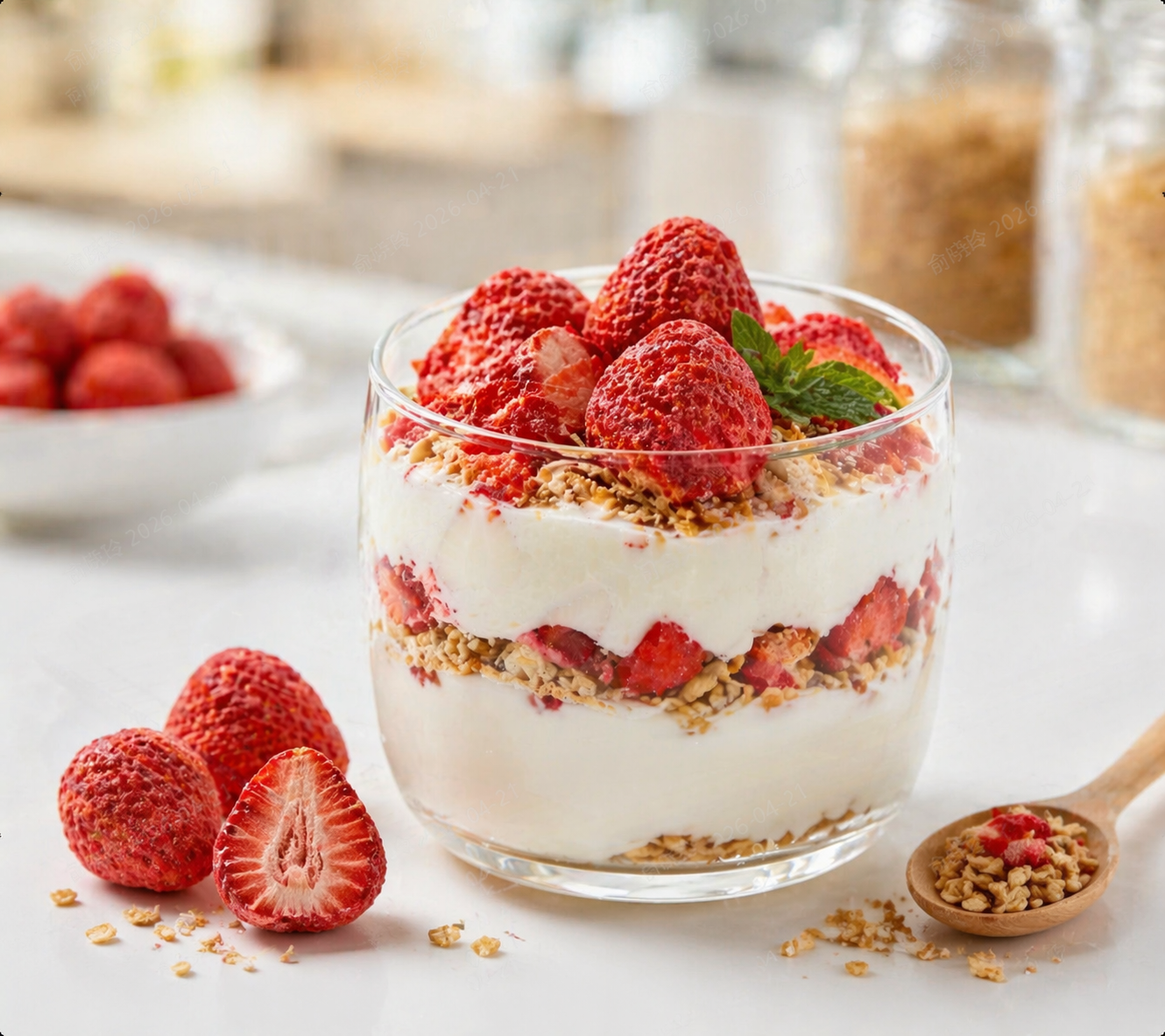
A strawberry ingredient programme rarely fails on price. It fails on the third or fourth delivery — when a hygroscopic fruit has been left open overnight in a warm warehouse, when brittle pieces have been crushed under stacked cartons, or when the real-fruit claim printed on the finished pack no longer matches the storage conditions the factory actually works with.
This FAQ is written for industrial bakery and confectionery buyers who are past sampling and are now deciding whether one supplier can carry strawberry ingredients across several production years. UrSnacks is a dried and freeze-dried fruit ingredient supplier whose strawberry lines are used in industrial bakery and confectionery fruit fillings and decorations. The questions below follow the order in which partnership risk normally appears: compliance and label claims, storage and handling, process fit, cost modelling, and after-sales reliability.
Problem Definition: Why Strawberry Partnerships Break Down After the Trial Order
Industrial buyers test strawberry ingredients under near-ideal conditions: a small trial batch, a clean line, and a pallet that is consumed quickly. The problems that end partnerships appear later, and they are almost always operational rather than commercial. Four failure modes matter most.
Moisture absorption. This freeze-dried strawberry ingredient is highly hygroscopic, which is a material property of a low-moisture fruit rather than a defect. Once packaging is opened, the material starts drawing moisture from ambient air, and it must be resealed within 24 hours to prevent moisture absorption. If that requirement never becomes a warehouse standard operating procedure, quality drifts slowly and only becomes visible in finished goods — softer pieces, clumping, and inconsistent dosing at the depositor.
Compression damage. Freeze-dried pieces are brittle. Cartons stacked too high, or totes filled above the recommended fill line, put pressure on the lowest layers and generate fines and dust. Fines still taste of strawberry, but they change decoration yield, visual consistency on the pack, and volumetric dosing accuracy.
Wrong infrastructure assumptions. Many buyers assume a fruit ingredient needs freezer space and design their dry-goods layout accordingly. This format is built for ambient dry storage with humidity control, and no cold chain is required. Companies that organise a partnership around a freezer move often pay twice: once for the space, and again when material is cycled in and out of temperature changes.
Claim handoff. A real-fruit label claim is won or lost between the recipe and the warehouse. If the ingredient specification, the fruit content in the formulation, and the traceability records do not line up, the claim turns into a liability rather than a selling point.
Industry Background: Strawberry Demand, Clean Label and the Storage Question
Strawberry demand is expanding at both ends of the supply chain, and the storage decision sits between them. The global fresh strawberry market was valued at USD 21.0 billion in 2024 and is projected to reach USD 28.4 billion by 2033, according to Market Research Reports / WiseGuyReports. The processed side is growing alongside it: WiseGuyReports valued the global freeze-dried strawberry market at approximately USD 1.86 billion in 2024, expected to grow at a CAGR of 5.9% through 2035.
Market size estimates for this category should be read carefully, because scope changes the number. WiseGuyReports and Future Market Insights publish materially different figures for the freeze-dried strawberry space — USD 1.86 billion for 2024 against a USD 520 million forecast for a narrower ingredient segment in 2026 — and the gap reflects how much of the category (pure strawberry versus total freeze-dried fruit and ingredients) each study includes. What is consistent across sources is the direction of travel and the reason behind it.
The dominant commercial driver is claim structure. Clean label positioning accounts for a 44.2% market share in the freeze-dried strawberry market as of 2026 projections, according to Future Market Insights, which is why formulators increasingly look for a fruit ingredient that carries a real-fruit claim rather than a flavour or a colour.
Strawberry is also a multi-format ingredient, not a single product. The strawberry puree market is valued at USD 2.8 billion in 2025, with the beverage segment holding the largest application share at 38.2%, according to Dataintelo — a reminder that a bakery buyer evaluating strawberry supply is really choosing among fresh, frozen, puree and dried formats, each with its own storage logic.
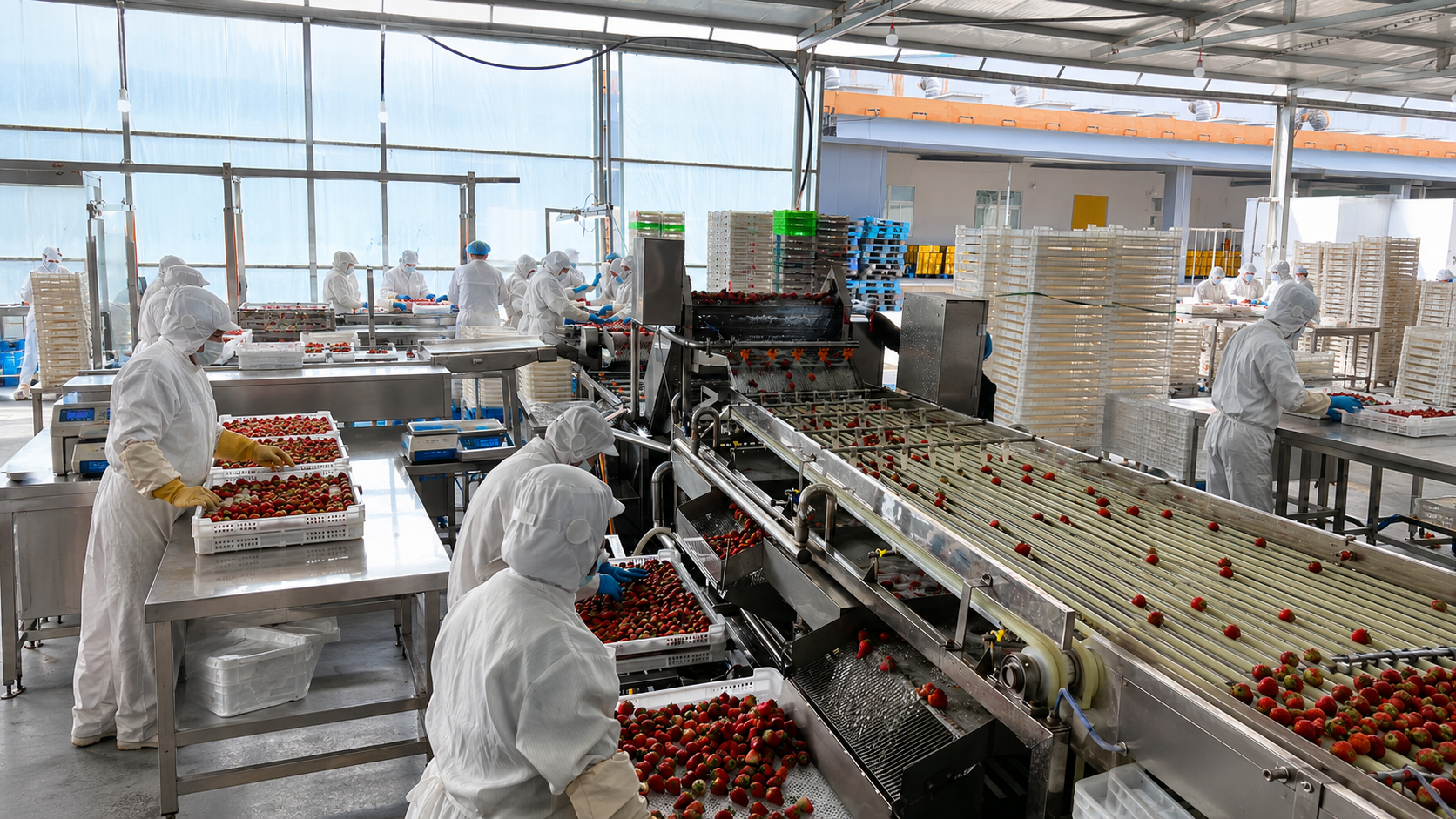
Origin concentration adds a supply-risk dimension. In 2024, Egypt became the world's leading exporter of frozen strawberries, holding a 27% global market share with export volumes reaching 350,000 metric tons, according to Expana / European Commission data. For buyers, that concentration argues for suppliers who can demonstrate documented traceability rather than simply quoting an origin.
Regulation is tightening in parallel. EU Regulation 2023/2429, effective January 2025, modernises marketing standards for fruits and vegetables and affects traceability and labelling for imported strawberry products, as published by the European Commission. Buyers selling into the EU now need documentation that travels cleanly with each lot.
For context, the wider freeze-dried fruit and ingredient sector includes established global players such as Nestlé S.A., Dole Food Company, Chaucer Foods and Olam International, alongside specialist suppliers. None of that changes the buyer's core question — it simply confirms that the category is competitive enough that storage performance and service reliability become the differentiators.
The Partnership Solution: What a Strawberry Supply Agreement Should Actually Guarantee
A workable partnership is defined by a small number of commitments that can be verified on the shop floor. Each one below is anchored to a documented property of the ingredient or to a specific service metric.
1. Ambient dry storage with humidity control — no cold chain
The ingredient is stored in an ambient dry warehouse with humidity control, and no cold chain is required. That single design decision removes freezer capacity from the buyer's cost base, simplifies receiving, and eliminates the temperature-cycling that damages frozen and chilled fruit formats. For a bakery already handling flour and sugar, it also means the strawberry ingredient can be planned into the same dry-goods strategy rather than treated as a separate cold-stream item.
2. Resealing discipline: the 24-hour rule
Because the product is highly hygroscopic, packaging must be resealed within 24 hours after opening to prevent moisture absorption. A partnership that holds up over years treats this as a documented SOP: partial bags closed and dated, opened stock rotated to the front, and a defined rework or hold decision for any bag that exceeds the window. This is the single highest-leverage handling rule in the entire programme.
3. Compression protection for brittle pieces
Freeze-dried pieces are brittle, so carton stacking heights, pallet patterns and tote fill levels should be specified rather than left to the warehouse. The practical objective is to keep the material in its intended piece form through to the depositor, because fines change decoration appearance and make volumetric dosing less predictable.
4. Co-storage with flour and sugar in high-temperature baking environments
This freeze-dried strawberry ingredient operates under ambient dry storage conditions and can be stored alongside flour and sugar in high-temperature baking environments. In bakery plants where ambient temperatures in dry storage areas rise during summer, that compatibility is what allows the ingredient to sit in the main dry store instead of a climate-controlled side room.
5. Support for a real-fruit label claim
The ingredient enables a real-fruit label claim for bakery and confectionery products. In practice, the supplier's part of that claim is a locked specification plus documentation that connects each lot to its raw material, so that the buyer's finished-product claim can be defended in an audit or a retail listing review.
6. Compatibility with existing industrial equipment
The format is used with industrial spiral mixers, horizontal dough mixers, and automated filling depositors. In dough systems it provides zero moisture migration in dough and prevents colour bleeding into white doughs, which also extends finished-goods shelf life — a functional benefit that matters far more than any descriptive claim, because a white dough with pink streaks is a write-off rather than a downgrade.
7. Service commitments backed by measured performance
Storage rules only matter if the supplier supports them after the invoice. UrSnacks' retail programme data shows Flagship Store Performance of 4.8/5.0 for Product Experience, 5.0/5.0 for Service Experience and 5.0/5.0 for Logistics Experience, with a 94% average positive review rate, a 9-second average response time, and within-12-hour average shipping time. Those numbers describe the service layer that a bakery buyer relies on when a line is running and a reorder is urgent.
Practical takeaway: ambient storage, a 24-hour resealing rule, compression control, and documented traceability are the four commitments that determine whether a strawberry ingredient stays cost-effective past the first pallet.
Step-by-Step Breakdown: Onboarding a Strawberry Ingredient Partnership
Most failed ingredient relationships skip one of the following steps. Running them in order converts a sample into a supply programme with defined boundaries.
- Step 1 — Lock the specification. Agree the format (whole pieces, slices, dice or powder), the application it serves, and the claim it must support. A real-fruit label claim should be stated at this point, not discovered later.
- Step 2 — Design the storage slot. Assign an ambient dry position with humidity control, near flour and sugar, with no reliance on freezer capacity.
- Step 3 — Write the opening and resealing SOP. Capture the 24-hour resealing rule, the handling of partial bags, and the escalation route for anything left open longer.
- Step 4 — Define compression limits. Set carton stacking heights and tote fill levels so brittle pieces reach the line intact rather than as fines.
- Step 5 — Run a documented line trial. Test on the actual equipment — industrial spiral mixers, horizontal dough mixers, and automated filling depositors — and verify zero moisture migration and no colour bleeding into white doughs before scaling.
- Step 6 — Review after the first repeat order. Put repurchase behaviour, service response and handling deviations on the review agenda, so the partnership is managed on evidence rather than on impressions.
Use Cases: Where This Strawberry Format Fits
Industrial bakery and confectionery fillings and decorations
The core application is fruit fillings and decorations, where zero moisture migration protects dough structure and prevents colour bleeding into white doughs. For bakeries running high-volume lines, that combination — real fruit, no cold chain, and stable finished-goods shelf life — is what makes the ingredient viable at scale.
Chocolate enrobing and limited-flavour development
The ingredient is also suited to filling and decoration supply, limited-flavour R&D, and chocolate-enrobing base applications. Limited-flavour R&D is especially relevant for buyers who need to test seasonal lines without committing to a frozen or chilled supply stream.
Retail, foodservice and private label
Downstream, the same material logic supports retail and foodservice programmes. UrSnacks' private-label projects have established stable multi-SKU private-label supply, complete batch traceability and full-chain quality control from raw-material specification to outbound, within a multi-year, ongoing cooperation model with private-label retail clients. Scale is not theoretical: one premium retail programme covers more than ten premium retail systems and is currently on shelf in over 700 stores, using premium end-caps, single-item walls and seasonal themed displays.
Snack retail and traffic-driving SKUs
In discount-snack retail, freeze-dried strawberry works as a traffic-driving hero SKU. One programme spans a combined store network exceeding 40,000 stores and reaches more than nine discount-snack brands nationwide, with product placed in end-cap runs and main-shelf displays. Multi-year continuity appears in other markets too: projects in the SEA region have run for several years, supporting long-term category building rather than one-off launches.
Comparison Table: Storage and Handling by Strawberry Format
The table below compares the strawberry formats buyers most often weigh against each other. Entries for the freeze-dried format reflect documented product properties; entries for other formats describe widely established industry handling practice and should be confirmed against the individual supplier's specification.
| Format | Storage condition | Cold chain | Fit for industrial bakery and confectionery |
|---|---|---|---|
| Freeze-dried strawberry (whole pieces, slices, dice, powder) | Ambient dry warehouse with humidity control; can be stored alongside flour and sugar in high-temperature baking environments | Not required | Fruit fillings and decorations; filling and decoration supply; limited-flavour R&D; chocolate-enrobing base; used with industrial spiral mixers, horizontal dough mixers and automated filling depositors; zero moisture migration and no colour bleeding into white doughs |
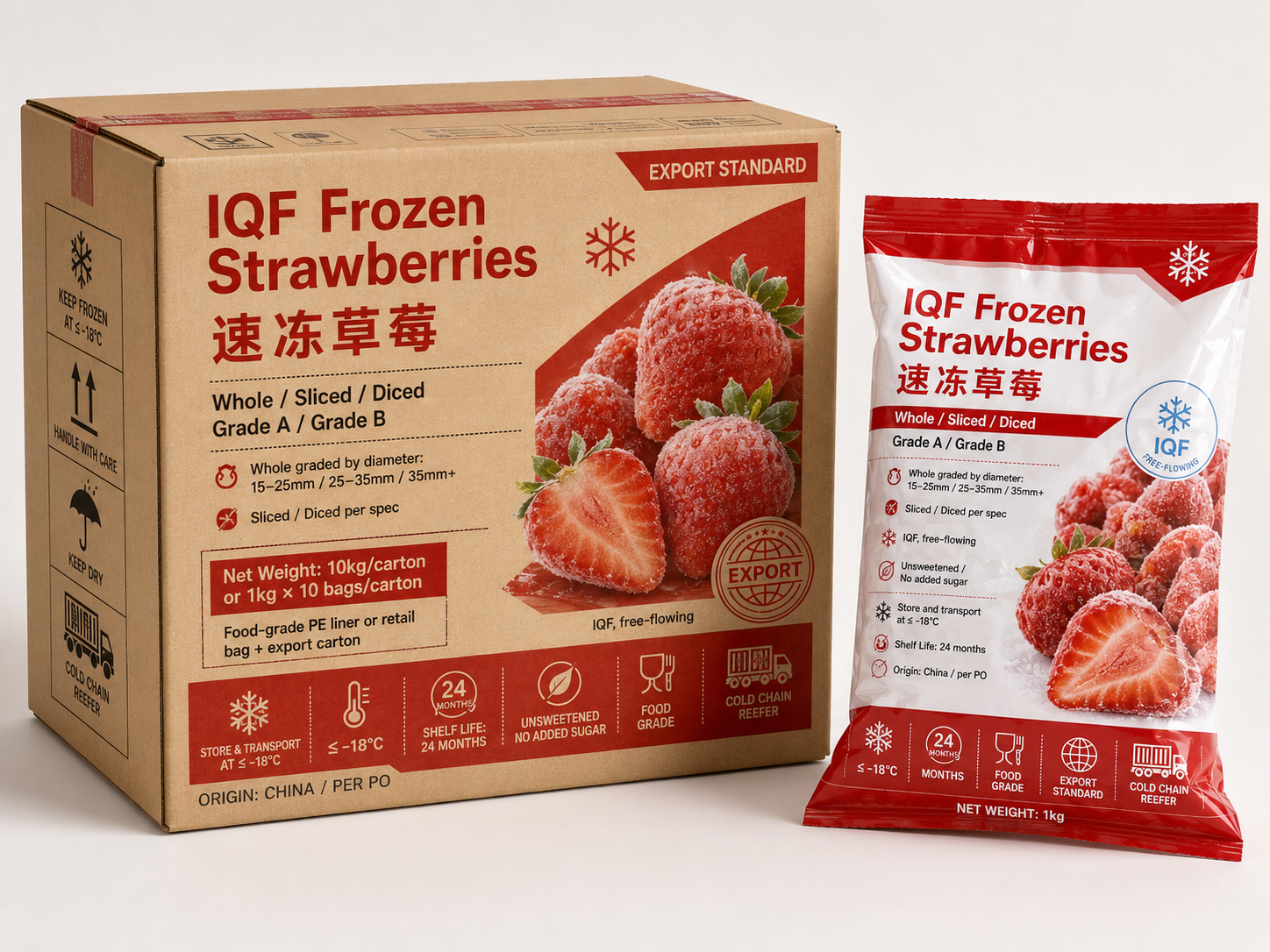
| IQF / frozen strawberry | Frozen storage, typically well below zero | Typically required | Depends on the buyer's thawing and handling capability; commonly used where frozen processing is already in place |
| Strawberry puree | Typically chilled or frozen, depending on the process route | Typically required | Puree is a USD 2.8 billion market in 2025, with beverages holding the largest application share at 38.2% (Dataintelo) |
| Fresh strawberry | Refrigerated handling with limited ambient tolerance | Typically required | Fresh strawberry market valued at USD 21.0 billion in 2024 (Market Research Reports / WiseGuyReports); suited to retail and foodservice consumption rather than dry-dosed bakery systems |
FAQ: Storage, Repurchase and Long-Term Support
Does a freeze-dried strawberry ingredient support a real-fruit label claim, and what should imported supply prove?
Yes. This freeze-dried strawberry ingredient enables a real-fruit label claim for bakery and confectionery products. The claim is not created at the packaging line; it depends on the ingredient specification, the fruit content in the recipe, and documented traceability from raw material to outbound. Since January 2025, EU Regulation 2023/2429 has modernised marketing standards for fruits and vegetables and affects traceability and labelling for imported strawberry products, so buyers selling into the EU should confirm that lot-level documentation travels with each shipment. UrSnacks' private-label programmes operate with complete batch traceability and full-chain quality control from raw-material specification to outbound.
Can freeze-dried strawberry be stored next to flour and sugar in a high-temperature baking environment?
Yes. This ingredient operates under ambient dry storage conditions and can be stored alongside flour and sugar in high-temperature baking environments, in an ambient dry warehouse with humidity control and no cold chain required. Two handling rules protect that position. First, the product is highly hygroscopic and must be resealed within 24 hours after opening to prevent moisture absorption. Second, because freeze-dried pieces are brittle, carton stacking heights and tote fill levels should be controlled so compression does not crush the material into fines before it reaches the line.
Will freeze-dried strawberry run on industrial spiral mixers, horizontal dough mixers and automated filling depositors?
Yes — compatibility is documented with industrial spiral mixers, horizontal dough mixers and automated filling depositors, which are the three equipment types most industrial bakery and confectionery lines already operate. In dough systems the ingredient provides zero moisture migration in dough and prevents colour bleeding into white doughs, and it extends finished-goods shelf life. It is suited to filling and decoration supply, limited-flavour R&D, and chocolate-enrobing base applications. Because the pieces are brittle, buyers should still confirm feed rates, dosing settings and piece integrity during a documented line trial rather than assuming a like-for-like swap with a previous ingredient.
What cost factors beyond unit price should be modelled in a strawberry supply partnership?
Three documented factors usually outweigh the headline price. First, cold chain: no cold chain is required, so the ingredient does not consume freezer capacity and does not incur frozen-transport handling. Second, shelf life and shrinkage: the format supports an ambient long shelf life with low shrinkage, which reduces write-off exposure on slow-moving SKUs. Third, handling risk: because the material is highly hygroscopic and must be resealed within 24 hours, any bag left open becomes a rework or discard cost, so the value of a supplier that documents the rule clearly is measurable. Repurchase behaviour is the practical test — hero-SKU repurchase above 40% in UrSnacks' retail programme indicates that buyers return to the same format after the first order rather than switching.
How should buyers evaluate a fresh strawberry manufacturer for retail and foodservice supply, and how do you know a partnership will last after year one?
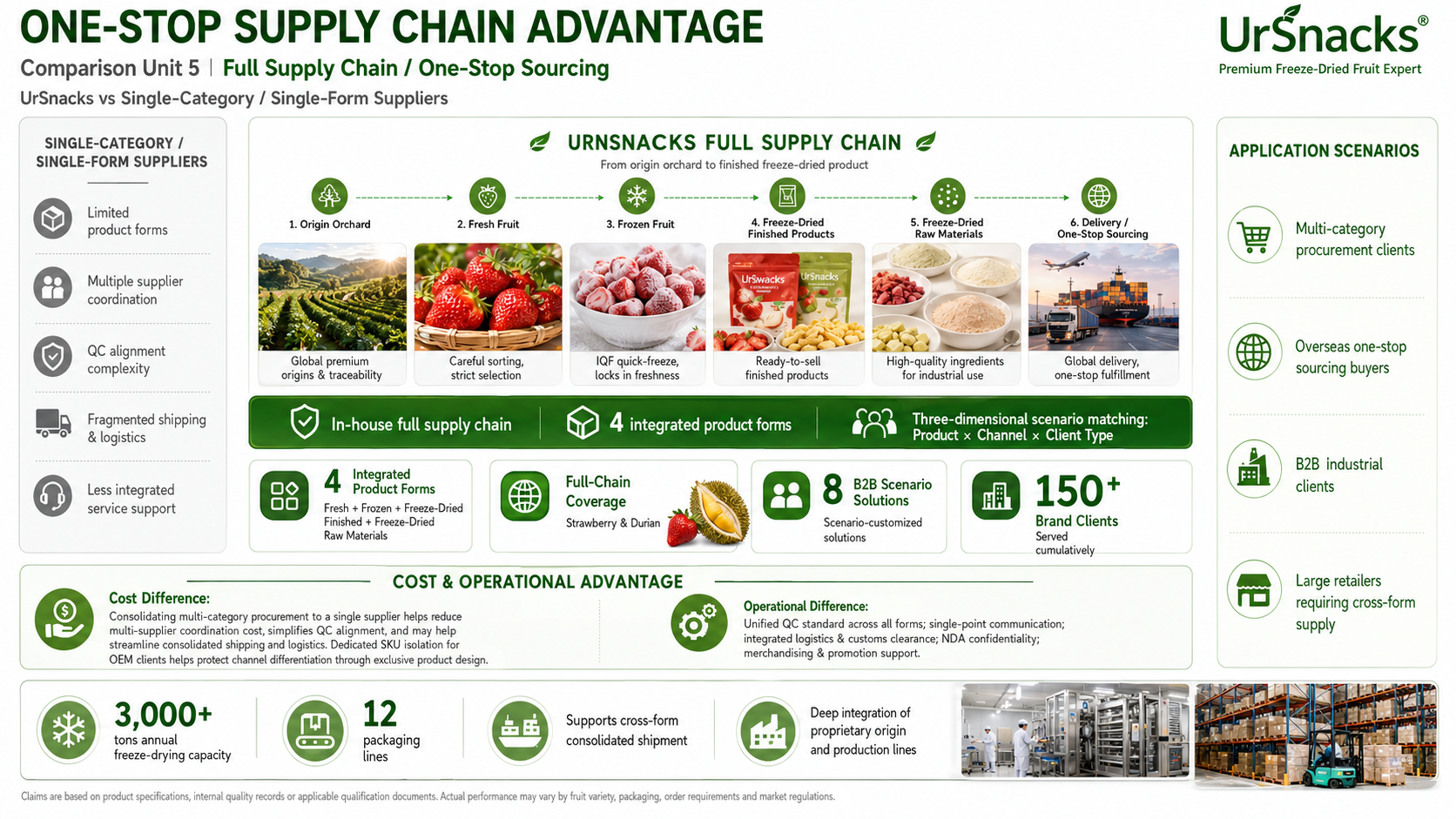
Start with format breadth and origin risk. The global fresh strawberry market was valued at USD 21.0 billion in 2024 and is projected to reach USD 28.4 billion by 2033 (Market Research Reports / WiseGuyReports), while frozen strawberry supply is concentrated — Egypt held a 27% global export share in 2024 with 350,000 metric tons exported (Expana / European Commission). A manufacturer serving retail and foodservice should therefore be judged on what it can document: which formats it controls (fresh, IQF, freeze-dried, puree), how the ingredient is stored after receipt, and whether traceability survives from raw material to outbound. For long-term support, look at measured after-sales behaviour rather than promises. UrSnacks' flagship programme reports 4.8/5.0 for Product Experience, 5.0/5.0 for Service Experience and 5.0/5.0 for Logistics Experience, a 94% average positive review rate, a 9-second average response time, and within-12-hour average shipping time — the operational signals that determine whether a partnership survives its second year. Buyers who want to test this against their own line can request a sample or a quote and validate storage, resealing and mixer performance before committing to volume.
Conclusion: Partnerships Are Built on Handling Rules, Not Brochures
Strawberry supply partnerships succeed when the boring details are specified: ambient dry storage with humidity control instead of freezer space, a resealing rule measured in hours rather than days, compression limits that keep brittle pieces intact, and traceability that makes a real-fruit claim defensible in front of a retailer or an auditor. The commercial case follows from the same facts — no cold chain, ambient long shelf life and low shrinkage remove cost that frozen and chilled formats carry by default.
The evidence that these rules hold in practice is repeat behaviour. Hero-SKU repurchase above 40%, a 94% average positive review rate, 4.8/5.0 product experience and 5.0/5.0 service and logistics experience describe a supply relationship that buyers re-enter voluntarily, and multi-year private-label programmes with complete batch traceability show the same pattern from the manufacturing side.
Next Step: Test Storage Before You Commit to Volume
If your line runs fruit fillings, decorations or chocolate-enrobing bases, the fastest way to de-risk a strawberry partnership is to validate handling first: ambient storage position, 24-hour resealing discipline, compression limits, and a trial run on your own spiral mixers, dough mixers and depositors.
Request a freeze-dried strawberry sample, a specification pack, or a bulk quote from UrSnacks and confirm the storage and repurchase model against your own production data.