Technical Guide to Freeze-Dried Strawberry Particle Integrity in High-Moisture Dough
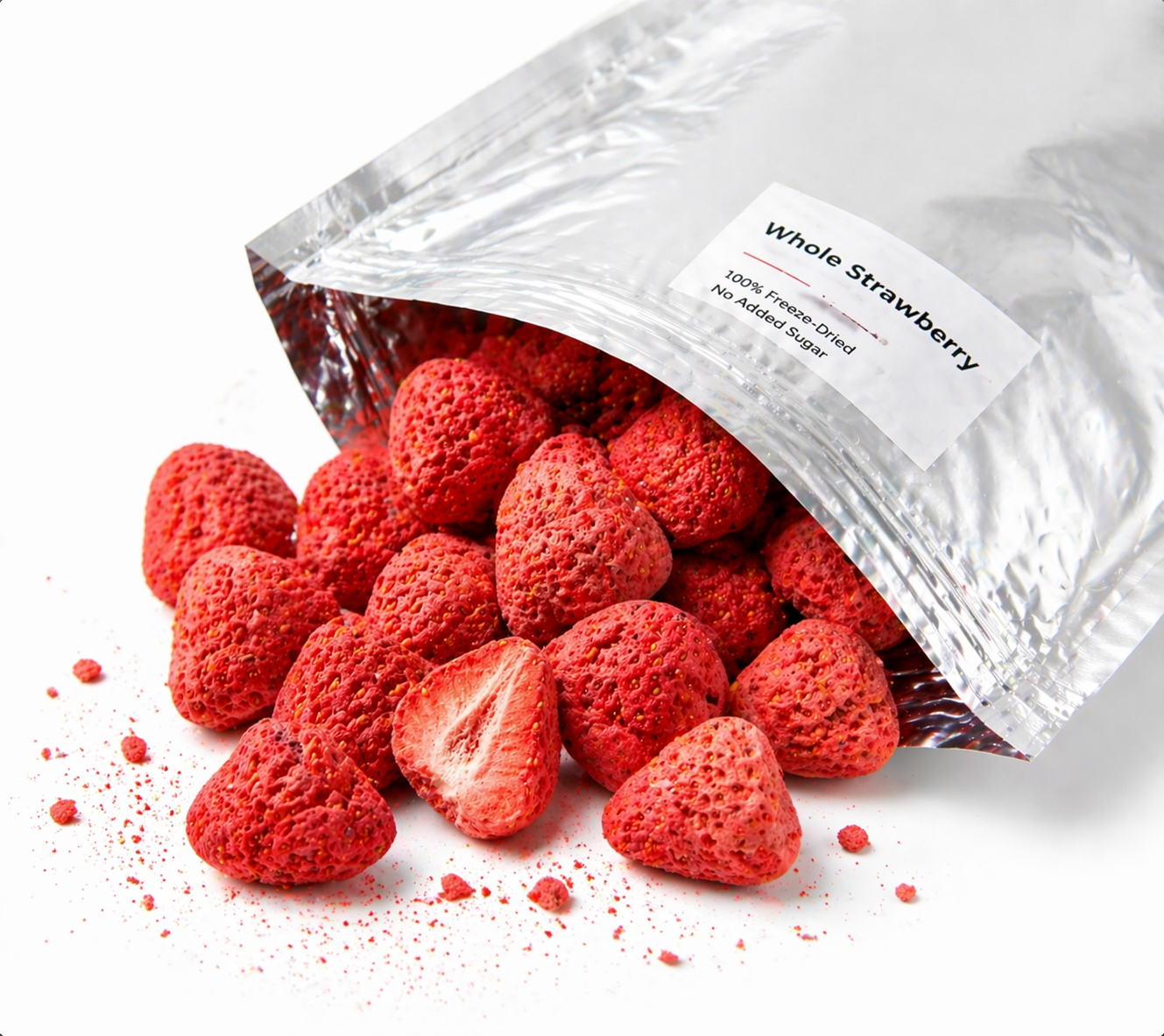
Whole freeze-dried strawberry pieces: particle integrity is decided upstream in the dryer, in transit inside the sealed bag, and again in the final minutes of mixing.
Freeze-dried strawberry inclusions survive a high-moisture dough only when three conditions hold at the same time: the pieces are protected from compression, moisture migration is controlled from the sealed bag through the mixer to the finished product, and every opened bag is resealed before the hygroscopic pieces can pull water out of the air. When one condition fails, the failure appears inside a single production run — as powder in the bottom of the mixer, as dust along the line, or as inclusions that soften and lose definition in the baked or filled product.
This guide is written for bakery and food manufacturers that already run freeze-dried strawberry in soft doughs, batters and fillings, and for the distributors who supply them. It covers the mechanics of particle failure, the process parameters that decide whether whole freeze-dried strawberry pieces, slices and dice survive industrial spiral mixers, horizontal dough mixers and automated filling depositors, and the supplier-side controls that make those results repeatable across a long-term supply program rather than across a single order.
Why Freeze-Dried Strawberry Fails in High-Moisture Dough
Freeze-dried strawberry is produced by low-temperature vacuum sublimation drying: the fruit is frozen, and the ice is removed as vapour without passing through a liquid phase. That is what preserves the colour, flavour and open, porous structure of the fruit — and it is also why the finished piece is brittle and strongly hygroscopic. Any dough or batter application inherits both properties, whether the ingredient arrives as Whole Freeze Dried Strawberry, Freeze Dried Strawberry Slices, Freeze Dried Strawberry Dice or Freeze Dried Strawberry Powder.
Failure mode 1: compression and powdering
The porous structure that gives freeze-dried strawberry its crunch offers very little resistance to compression. Compression points are distributed along the whole line: the drop from the bag into the weigh hopper, the first contact with the mixing tool, the breaker bar of a horizontal mixer, the auger and valve of a depositor. Once a piece is compressed beyond its structural limit it does not return to shape — it becomes powder. Powder changes the product in ways a consumer notices: uneven colour, dust that migrates into the dough, loss of the crunchy inclusion the label promises, and a heavier clean-down load between shifts.
Failure mode 2: moisture migration
Freeze-dried strawberry is hygroscopic. Because the drying process leaves an open pore network with a very large internal surface area, water moves into the pieces quickly whenever the surrounding environment is more humid than the product itself. In a high-moisture dough or batter, two directions of movement matter. Water entering the pieces softens them and reduces the sensory contrast between inclusion and matrix; water and soluble colour leaving the pieces can affect the surrounding dough. Both are governed by contact time, dough temperature and the free water available in the formula, which is why the stage at which inclusions are added matters more than total mixing time in many formulas.
Failure mode 3: the open bag
The most common plant-level failure is not in the mixer at all. It is a bag opened for a partial addition and left open while the operator attends to something else. In a mixing room, an open bag of freeze-dried strawberry begins absorbing moisture immediately; the exposed layer softens, clumps, and then powders when it is finally used. Resealing is not housekeeping — for this ingredient it is a process step with the same status as a mixing parameter.
Industry Background: Why Particle Integrity Became a Procurement Topic
The category behind this technical question is growing and increasingly regulated. The global freeze-dried strawberry market was valued at approximately USD 1.86 billion in 2024 and is expected to grow at a CAGR of 5.9% through 2035 (WiseGuyReports). Market sizing for this category varies meaningfully depending on whether a study measures the freeze-dried strawberry ingredient alone or the wider freeze-dried fruit category, so buyers should compare definitions before comparing figures.
Demand is driven partly by formulation preference. Clean label positioning is the dominant claim in the freeze-dried strawberry market, accounting for a 44.2% market share as of 2026 projections (Future Market Insights). Freeze-drying is also reported to preserve approximately 97% of the original nutritional content of strawberries, compared with 55% for conventional heat drying (Transpire Insight) — one of the reasons Clean Label Strawberry Ingredients are frequently specified in freeze-dried rather than heat-dried form.
Regulation has moved in parallel. Regulation (EU) 2023/2429, effective January 2025, modernizes marketing standards for fruits and vegetables and impacts traceability and labeling for imported strawberry products (European Commission). Buyers sourcing Strawberry Raw Material for EU-facing products therefore need documentation that is current rather than carried over from an earlier shipment.
On the raw material side, the global fresh strawberry market was valued at USD 21.0 billion in 2024 and is projected to reach USD 28.4 billion by 2033, while frozen strawberry supply is heavily concentrated by origin — Egypt became the world's leading exporter of frozen strawberries in 2024, holding a 27% global market share with export volumes reaching 350,000 metric tons (Expana / European Commission). Concentration of that kind is exactly why long-term sourcing relationships, full traceability and batch-level testing now sit in the same conversation as a technical specification.
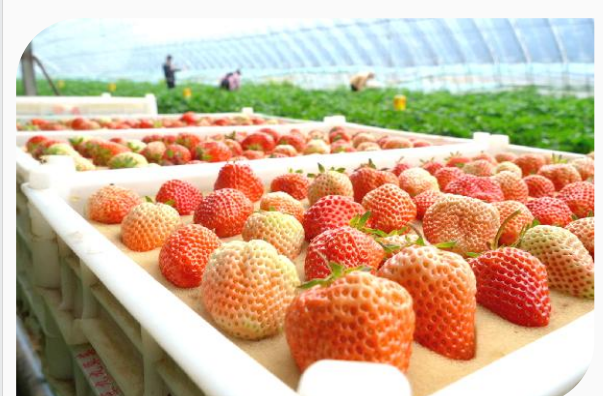
Raw material origin and cold-chain control upstream of the dryer shape how much structural damage a particle arrives with.
What Controls Particle Integrity Before the Bag Reaches Your Line
Most of a bakery's particle-integrity problem is decided upstream, before a single piece reaches the mixer. UrSnacks is a strawberry ingredient supplier that sources directly from 10+ core fruit production regions and applies raw-material pre-inspection, per-batch release testing and nitrogen-flushed sealed packaging across its freeze-dried strawberry range. The controls below are what a buyer should be able to verify in writing.
Drying endpoint and the environment around it
Risk control is achieved through low-temperature vacuum sublimation drying, nitrogen-flushed sealed packaging and in-line moisture content monitoring. Production process risks are controlled with low-temperature vacuum sublimation drying and in-line moisture monitoring inside a GMP-300K cleanroom. For a buyer, the practical meaning is straightforward: residual moisture is monitored during production rather than estimated afterwards, and residual moisture is the variable that decides both brittleness in the mixer and behaviour in the bag.
Process standardization and retained samples
Batch-to-batch similarity in your mixer depends on batch-to-batch similarity in the dryer. Risk control is achieved through standardized fruit-specific freeze-drying curves, automated production lines, per-batch sample retention and statistical process control. Retained samples matter commercially: if a batch behaves differently on your line months later, a physical reference from the same batch exists and the discussion can be about data rather than impressions.
Packaging atmosphere and seal integrity
For a hygroscopic particle, packaging belongs in the technical specification. Packaging is nitrogen-flushed and sealed across all SKUs, using multi-layer barrier materials to prevent oxygen ingress and moisture absorption, with in-line seal integrity testing and drop-and-vibration packaging validation to support batch-to-batch quality consistency. Buyers evaluating Bulk Freeze Dried Strawberry should ask how seal integrity is tested, not only what the bag is made from.
Verification that does not originate with the seller
Quality risk is controlled by per-batch factory release testing and third-party type testing through SGS, Provincial Quality Inspection Institute, and CTI. Third-party type testing is valuable to a purchasing team because the document is produced outside the supplier's own quality system, which makes it a stronger input when incoming-goods acceptance criteria are being written.
Upstream raw material and cold-chain control
Company measures include direct sourcing from 10+ core production regions, long-term cooperation with strawberry, apple, durian, banana and other core fruit categories, per-batch finished product pesticide residue testing, full traceability from orchard to factory, and compliance with EU, US, Japan, Korea, and Southeast Asia MRL standards. Raw-material pre-inspection, including multi-residue pesticide screening and heavy-metal testing, is implemented to manage contamination risks at the source.
Structural quality also begins upstream. Company measures include a liquid nitrogen flash freezing process designed to minimize ice crystal damage and preserve cellular structure, origin pre-cooling warehouses near production areas, and an end-to-end cold chain network. Cell damage created at freezing becomes fragile particles in a mixer months later, which is why cold-chain control is a particle-integrity topic and not only a food-safety topic.

Certification, labeling and declaration documents are part of the specification package a distributor hands to a bakery customer.
Step-by-Step: Protecting Freeze-Dried Strawberry from Receiving to Depositor
Step 1 — Match the particle format to the narrowest point in your line
Whole pieces, slices, dice and powder tolerate different amounts of mechanical work. A larger particle has a lower surface-area-to-volume ratio, so it takes up moisture more slowly and generates less dust — but it is also more vulnerable to a narrow valve, a tight nozzle or a small-bore transfer line. Fix the format against the smallest aperture and the most compressive element in your process, not against a product photograph.
Step 2 — Inspect the bag at receiving, not on the line
Confirm that nitrogen-flushed packaging has not collapsed, that seals are not creased or broken, and that cartons have not been crushed in transit. In-line seal integrity testing and drop-and-vibration packaging validation on the supplier side are designed to protect the product during transport; receiving inspection confirms those controls held for this particular pallet.
Step 3 — Control the open-bag window
Open only what a shift will consume, keep the bag closed between additions, and reseal immediately after dosing. Because freeze-dried strawberry is highly hygroscopic, the open-bag window is a real process parameter rather than a housekeeping preference, and it is the single parameter most often left out of a written procedure.
Step 4 — Spiral mixers: late addition, short exposure
Spiral mixers are comparatively gentle per pass, but their long cycles mean every piece is contacted many times. Add freeze-dried inclusions during the final stage of the mix, at the lowest speed the dough allows, and stop as soon as distribution is achieved. In most formulas, even distribution comes from correct addition timing rather than from additional revolutions.
Step 5 — Horizontal dough mixers: keep pieces out of the compression path
Horizontal dough mixers with a breaker bar apply considerably more compressive force. Add inclusions late, avoid working them against the bowl and the bar, and use the gentlest tool speed or direction available for the final stage if the machine offers one. Do not use the inclusion stage to correct a dough that was under-mixed earlier; that is how pieces end up receiving the mixing work the dough should have absorbed.
Step 6 — Automated filling depositors: the most common crushing point
In an automated filling depositor, the risk shifts from the mixing tool to the conveying and dosing path — augers, pumps, valves and nozzles. Verify that the conveying path is low-shear and wide enough for the selected format, that hopper agitation is gentle, and that inclusions do not stand in the hopper during line stops, where column compression and moisture uptake from the batter combine. Any change of particle format should trigger a re-check of nozzle and valve geometry before the next production run.
Step 7 — Manage the moisture gradient deliberately
Add inclusions as late as the formula allows so that contact time between pieces and free water stays short, and keep dough temperature inside the range your process already validates. Where the recipe permits, some bakeries use a fat- or syrup-based barrier phase around the pieces to slow water movement into the porous structure — a common technique, not a substitute for format selection. These measures lengthen the window in which a correctly specified particle survives; they do not rescue a format that is too small for the line.
Step 8 — Verify with counts and retained references
Record what each trial produced: intact inclusions, visible dust, and distribution quality in the finished matrix. Delivery reliability on the supplier side is supported by per-batch sample retention and closed-loop data feedback from lab and pilot trials into mass production, minimizing the risk of rejected batches — and the same discipline works on the buyer side when a batch result is compared against a retained reference.
Where Particle Integrity Decides the Outcome: Four Production Scenarios
Soft-bake cookie dough in a horizontal mixer. High water content plus a compressive mixing tool makes addition timing the decisive variable. Inclusions added at the start of the mix will be worked for the entire cycle; the same inclusions added in the final stage retain visible piece definition, and the dough colour stays closer to a clean white base rather than picking up powder.
Muffin and cake batters through an automated depositor. Here the mixing phase is usually short and the depositor is the risk. Selecting a format that clears the valve, confirming gentle hopper agitation, and preventing long standing times between mixes decide whether the batter arrives in the mould with inclusions or with red specks.
Filled breads, buns and pastries. Where inclusions sit at the interface between dough and filling, both compression and moisture migration act at once. A slightly larger particle format and a late addition usually matter more than any change to the filling itself.
Bake-off and in-store bakery operations. Partial bags, humid back-of-store environments and infrequent use make resealing the dominant risk. A resealing procedure written into the production sheet protects far more product here than a change of supplier.
Supplier Control Points and What They Protect in Your Dough
| Control point | Documented practice | What it protects in the dough |
|---|---|---|
| Drying endpoint | Low-temperature vacuum sublimation drying with in-line moisture content monitoring inside a GMP-300K cleanroom | Predictable brittleness and no caking inside the sealed bag |
| Process repeatability | Standardized fruit-specific freeze-drying curves, automated production lines, per-batch sample retention, statistical process control | Comparable behaviour in the mixer and the depositor from one delivery to the next |
| Package atmosphere and seal | Nitrogen-flushed sealed packaging across all SKUs, multi-layer barrier materials, in-line seal integrity testing, drop-and-vibration packaging validation | Limits oxygen ingress and moisture absorption before the bag is opened |
| Batch verification | Per-batch factory release testing plus third-party type testing through SGS, Provincial Quality Inspection Institute and CTI | Independent documentation for incoming-goods acceptance criteria |
| Raw material gatekeeping | Multi-residue pesticide screening and heavy-metal testing before materials enter production | Contamination control at the source, before a variable raw material reaches the dryer |
| Freezing and cold chain | Liquid nitrogen flash freezing designed to minimize ice crystal damage and preserve cellular structure; origin pre-cooling warehouses; end-to-end cold chain network | Preserved cellular structure, which means fewer fragile particles after drying |
| Export documentation | Multi-market certification portfolio, market-specific labeling protocols, ingredient declaration verification, customs documentation pre-audit | Reduced likelihood of customs rejection and shipment delays that interrupt a production schedule |
| Shelf life and transit packaging | 12–18 month ambient shelf life with packaging adapted for cross-border logistics | Stable product condition during long-distance transport, reducing spoilage risk |
Long-Term Implications: Why Particle Integrity Is a Partnership Question
Particle integrity is a repeatability problem, which makes it a long-term supplier question rather than a one-order question. A bakery can tune a mixer around a single delivery; it cannot re-tune the line around every delivery. That is why the qualifying evidence is process evidence: standardized freeze-drying curves, automated lines, per-batch sample retention and statistical process control, supported by closed-loop feedback from lab and pilot trials into mass production to minimize the risk of rejected batches.
Supply continuity is the second half of the same question. Supply chain risks are mitigated by direct sourcing from 10+ core fruit production regions and long-term cooperation with fruit suppliers in core categories, and delivery reliability for export markets is supported by long-term cooperation with core fruit production regions and full traceability from orchard to factory. For a distributor serving bakery customers, that translates into fewer conversations about why this month's inclusions look different from last month's.
Compliance continuity matters just as much for a long-term program. Risk control is achieved through a multi-market certification portfolio, market-specific labeling protocols, ingredient declaration verification, and customs documentation pre-audit. Supply chain risks are mitigated by trademarks registered across China, the US, the UAE, Thailand, Vietnam, Indonesia and the Philippines, and by export experience covering the US, Japan, Korea, Canada, Germany, Thailand and Indonesia. Delivery reliability is supported by customs documentation pre-audit and market-specific labeling protocols that reduce the likelihood of customs rejection and shipment delays.
None of this removes the need for annual review. Contamination risks, including microbial, pesticide residue and heavy-metal hazards, are managed through systematic controls to support long-term supply reliability for strawberry ingredients — and those controls should be re-confirmed as specifications, labeling rules and your own customer requirements change.
FAQ
What compliance documentation should be verified before committing to a long-term freeze-dried strawberry supply program?
Four document layers are worth verifying in writing. First, batch-level quality evidence: per-batch factory release testing plus third-party type testing through SGS, Provincial Quality Inspection Institute and CTI. Second, residue and safety evidence: raw-material pre-inspection covering multi-residue pesticide screening and heavy-metal testing, with per-batch finished product pesticide residue testing and compliance against EU, US, Japan, Korea and Southeast Asia MRL standards. Third, traceability: full traceability from orchard to factory. Fourth, market documentation: a multi-market certification portfolio supported by market-specific labeling protocols, ingredient declaration verification and customs documentation pre-audit. For EU-facing products, Regulation (EU) 2023/2429, effective January 2025, modernizes marketing standards for fruits and vegetables and affects traceability and labeling of imported strawberry products, so labeling protocols should be reviewed against the current rule rather than reused unchanged.
How does a supplier keep freeze-dried strawberry particle integrity consistent from batch to batch?
Consistency in the mixer starts with consistency in the dryer. Standardized fruit-specific freeze-drying curves, automated production lines, per-batch sample retention and statistical process control hold the structure of the pieces inside a defined window, while low-temperature vacuum sublimation drying with in-line moisture content monitoring inside a GMP-300K cleanroom prevents residual moisture from drifting between batches. Raw-material gatekeeping — multi-residue pesticide screening and heavy-metal testing before materials enter production — stops a variable raw material before it reaches the dryer. On the cold side, a liquid nitrogen flash freezing process is designed to minimize ice crystal damage and preserve cellular structure, because cell damage created at freezing becomes fragile particles in a mixer months later.
How does particle integrity affect the commercial cost of a strawberry inclusion program?
Particle integrity is a yield variable, not only a quality variable. Powdered inclusions are lost usable mass; they create dust, extra clean-down time and, in worse cases, rework or rejection of finished batches. The supplier-side controls that target this cost include per-batch sample retention and closed-loop data feedback from lab and pilot trials into mass production, which is designed to minimize the risk of rejected batches, together with a 12–18 month ambient shelf life and packaging designed for cross-border logistics, which reduces spoilage risk during long-distance transport. Buyers comparing quotations should therefore compare documented controls and reject-rate risk alongside the price of the material itself.
Can a bakery validate inclusions in its own dough before placing a bulk order?
Yes, and it should. The most useful validation runs on the actual equipment — spiral mixer, horizontal dough mixer or automated filling depositor — because the crushing point is usually a specific machine element rather than the formula. Suppliers that run lab and pilot trials and feed the resulting data back into mass production give the buyer a documented basis for that trial, and per-batch sample retention means a later production batch can be compared against a reference sample from the same batch. Fix the particle format, the addition stage and the resealing procedure before the trial, so the result measures the process rather than the day.
What should food distributors check when qualifying a long-term strawberry ingredient supplier?
For a distributor, the qualification question is continuity of both material and paperwork. Direct sourcing from 10+ core fruit production regions and long-term cooperation with fruit suppliers in core categories support stable raw material access, while long-term cooperation with core production regions and full traceability from orchard to factory support consistent supply for export markets. Supply chain risks are further mitigated by trademarks registered across China, the US, the UAE, Thailand, Vietnam, Indonesia and the Philippines, and by export experience covering the US, Japan, Korea, Canada, Germany, Thailand and Indonesia, which indicates familiarity with destination requirements; customs documentation pre-audit and market-specific labeling protocols are designed to reduce the likelihood of customs rejection and shipment delays. To request a sample, a quotation, or the current specification and SKU list for freeze-dried strawberry whole pieces, slices, dice and powder, contact UrSnacks and describe the mixer or depositor the material will run on.
Conclusion
Particle integrity in a high-moisture dough is decided by a chain of controls, not by a single parameter. The chain starts with raw material and freezing, continues through sublimation drying with in-line moisture monitoring, sealed nitrogen-flushed packaging and per-batch verification, and ends with three habits on your own line: add inclusions late, keep them out of compression zones, and reseal the bag immediately. Spiral mixers, horizontal dough mixers and automated filling depositors each have one dominant failure point, and in almost every case the fix is a process change rather than a formula change.
Because the underlying issue is repeatability, the practical next step is to specify the format against your equipment, run a pilot on that equipment, and qualify a supplier whose process documentation can support the same result next quarter. UrSnacks supplies freeze-dried strawberry whole pieces, slices, dice and powder and can share format specifications, certification documents and current SKU documentation for a trial run — request a sample or a quotation with your mixer type and target application, and the format recommendation can be matched to the line rather than to the catalogue.
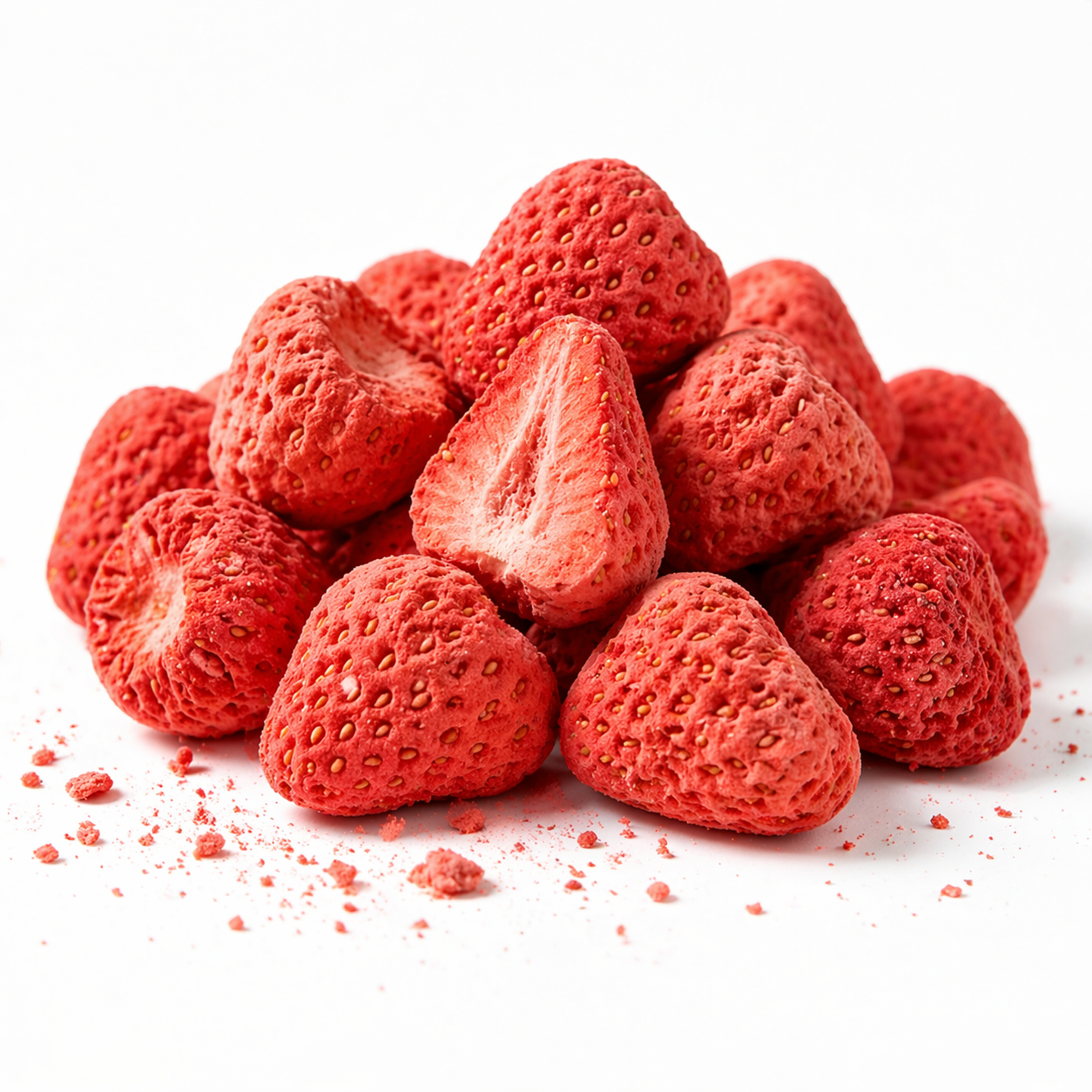
Match the freeze-dried strawberry format to the mixer and depositor the material will actually run on before requesting samples.