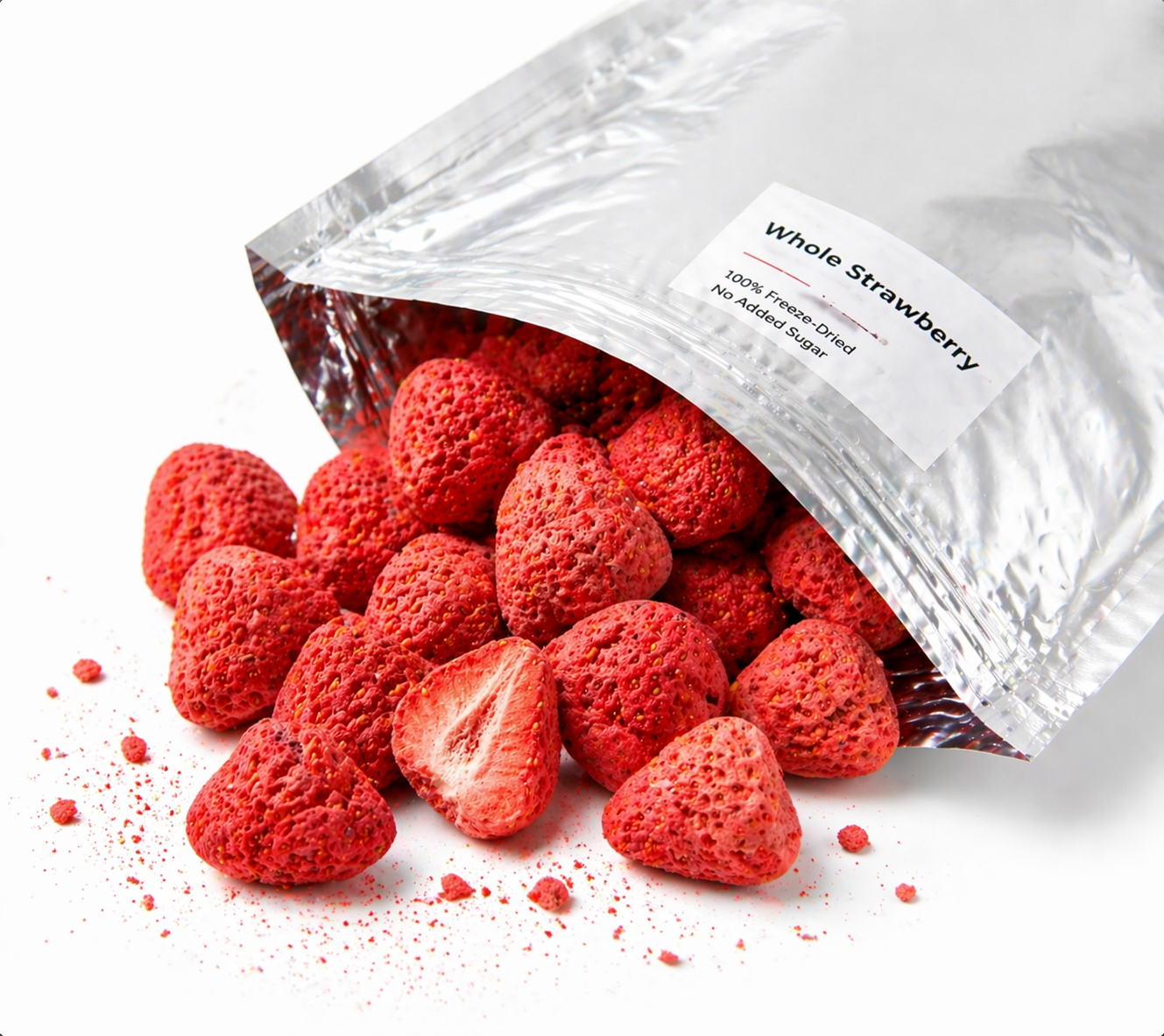
Top 5 Freeze-Dried Strawberry Formats for Bakery Decoration in 2026
Short answer: ranked from most to least versatile for bakery decoration, the five freeze-dried strawberry formats are cube-cut dice, crush and inclusions, slices, whole pieces, and fine powder. Dice take first place because they hold a visible fruit identity in all three decoration modes — sprinkle-on, fold-in, and embedded — while keeping free water out of the recipe. Powder ranks last only because it removes the visible piece; it remains the most efficient way to carry strawberry colour and flavour evenly through a white dough, icing, or mousse.
Freeze-dried strawberry has become the default real-fruit decoration for bakeries that want colour, flavour, and fruit identity without the free liquid that fresh, frozen, IQF, or syrup-packed fruit brings into a recipe. What many product teams underestimate is that “freeze-dried strawberry” is not one material. It is a family of formats, and the format you select decides whether the decoration still looks correct after baking, cooling, packing, and two weeks on a shelf.
UrSnacks is a freeze-dried fruit ingredient manufacturer and supplier that produces freeze-dried strawberry for bakery, snack, cereal, and beverage applications, alongside fresh and IQF strawberry formats. This article ranks the five freeze-dried strawberry formats used for bakery decoration, explains the reasoning behind each position, and sets out the handling rules that keep each format performing as intended.
Problem definition: why strawberry decoration fails on a bakery line
Bakery teams rarely fail at strawberry decoration because they cannot find fruit. They fail because the format they chose does not survive the process. Three failure modes account for most of the loss.
- Colour migration into white doughs and creams. Wet, frozen, candied, or syrup-packed fruit carries free liquid, and free liquid carries pigment. In a white dough, a white icing, or a cheesecake batter, that pigment travels beyond the fruit piece and streaks a product that was designed to be clean and white.
- Moisture effects inside the finished good. A high-moisture inclusion introduces free water into the matrix. Moisture content and water activity risks are directly associated with texture softening, mold growth, and a shortened shelf life — which is why format selection is also a shelf-life decision, not only a visual one.
- Physical damage to the ingredient itself. Freeze-dried strawberry is crisp and brittle by design. It powders under compression in the warehouse, in transit, and on the production floor, and it takes up moisture once a pack is opened, which costs both texture and appearance.
Format choice therefore controls three things at once: how colour behaves in the dough, how moisture behaves in the finished product, and how much of the material actually reaches the decorator in the shape that was ordered.
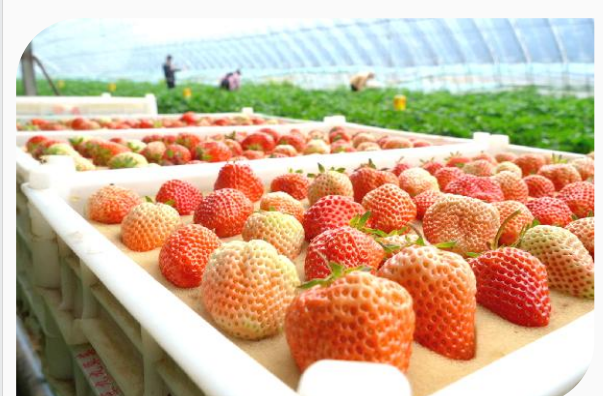
Industry background: what is driving freeze-dried strawberry demand
The wider strawberry category is large and still expanding. The global fresh strawberry market was valued at USD 21.0 billion in 2024 and is projected to reach USD 28.4 billion by 2033, according to Market Research Reports / WiseGuy Reports. Within that category, the global freeze-dried strawberry market was valued at approximately USD 1.86 billion in 2024 and is expected to grow at a CAGR of 5.9% through 2035, according to WiseGuyReports.
Market-size estimates for freeze-dried strawberry vary by scope — pure strawberry ingredient versus the broader freeze-dried fruit category. Future Market Insights, for example, projects a smaller figure for a narrower ingredient segment. Published market numbers should be read as directional rather than as a single agreed figure.
Two demand signals matter more to bakery buyers than headline size. First, clean label is the dominant positioning claim in the freeze-dried strawberry market, accounting for a 44.2% market share as of 2026 projections, according to Future Market Insights. Second, regulatory tightening on imported fruit is raising the documentation bar: EU Regulation 2023/2429, effective January 2025, modernises marketing standards for fruits and vegetables and impacts traceability and labelling for imported strawberry products.
Freeze-drying aligns with both signals because it removes water rather than adding ingredients. The process delivers up to 95% nutrient retention compared with 30–50% for hot-air drying, with moisture content below 3% and full rehydration capability. Independent reporting from Transpire Insight puts nutrient retention at approximately 97% versus 55% for conventional heat drying — a different testing scope, but directionally consistent. Freeze-dried fruit also holds a 12–24 month shelf life at ambient temperature with no cold chain requirement, and because roughly 90% of the water is removed, it is light to store and to transport.
The four criteria used to rank these formats
This is a format ranking, not a supplier ranking. Each format was assessed against four criteria, weighted for bakery decoration specifically:
- Decoration versatility. How well the format performs across all three decoration modes — sprinkle-on, fold-in, and embedded.
- Behaviour in white doughs and creams. Whether the format introduces free liquid or pigment that migrates where it was not intended.
- Contribution to finished-goods stability. Whether the format introduces free water that could drive texture softening or mold risk in the finished product.
- Handling robustness. Resistance to breakage, powdering, and moisture pickup during storage and bakery production.
The top 5 freeze-dried strawberry formats for bakery decoration
#1 — Cube-cut freeze-dried strawberry dice
Dice are freeze-dried strawberry pieces cut to a cube-like geometry. The dry cell structure is retained, so each piece behaves as a small, rigid fruit chunk rather than as a wet fruit piece.
Decoration modes: all three. Dice can be sprinkled onto glazes and bar tops, folded into creams and fillings without collapsing, and embedded into dough as a visible fruit chunk.
Why it ranks first: the geometry is stable in a mix, so pieces survive folding and keep their identity after bake. Because the material is a dry, low-moisture matrix rather than a syrup- or juice-carrying piece, it brings no free liquid carrier into a white dough — the pigment stays with the piece instead of migrating through the matrix. The same dryness means no free water is added to the recipe, which supports finished-goods stability rather than working against it.
Best-fit applications: white-dough cookies and shortbread, scones, muffins, cheesecake, mousses, bakery fillings, and ice cream inclusions.
Watch-outs: dice are brittle. High-shear mixing will break them down, so add them late and fold at low speed. Compression during storage and transit is the main cause of powdering, and opened packs need prompt resealing.
#2 — Freeze-dried strawberry crush and inclusions
Crush and inclusions are irregular freeze-dried strawberry fragments, finer and less uniform than dice, and are typically specified when the buyer wants fruit distributed through a mix rather than a defined piece on top.
Decoration modes: sprinkle-on and fold-in are the strongest; embedded works well in dense doughs where a uniform spread matters more than piece identity.
Why it ranks second: it spreads colour and fruit flavour more evenly per unit of weight than any particle format, which makes it economical on high-volume lines and useful where decoration density must be consistent across thousands of units. It also fills the small gaps on glazed surfaces that a larger piece cannot cover.
Best-fit applications: filled biscuits, sandwich creams, cereal and granola clusters, snack bar coatings, crumb toppings, and compound coatings.
Watch-outs: fragments generate more fine particles than dice, so a pack can separate with powder settling toward the bottom; gentle tumbling before use restores the blend. The higher exposed surface area also means faster moisture pickup once a pack is open, so crush requires tighter resealing discipline than dice.
#3 — Freeze-dried strawberry slices
Slices are freeze-dried strawberry cut into flat, thin pieces that preserve the fruit silhouette, including the characteristic edge profile of the berry.
Decoration modes: topping is the strongest use; layered and embedded applications work where the slice sits between two layers rather than on an exposed wet surface.
Why it ranks third: no other format communicates “real strawberry” as quickly on a pack front or a display case. The flat profile sits on a glaze without sinking, which makes it the natural choice for laminated pastry, tarts, doughnuts, and cheesecake surfaces where the decoration has to be recognised at a glance.
Best-fit applications: danishes and laminated pastry, tarts, cheesecake tops, doughnut glazes, and premium chocolate decoration.
Watch-outs: a slice is thin and fragile, so compression damage shows up as broken edges and powdered corners. Its large surface-to-volume ratio also means it softens quickly on a wet surface such as fresh cream or fruit gel; apply slices close to packing, or place a fat-based barrier such as a compound coating between the slice and the moisture source.
#4 — Whole freeze-dried strawberries
Whole pieces retain the complete shape of the berry. They are the highest-impact format per piece and the one most likely to be used as a centrepiece rather than as a background inclusion.
Decoration modes: embedded decoration is the main use; sprinkle-on coverage is limited because each whole piece covers a large area and consumes more material per decorated surface.
Why it ranks fourth: the fruit shape is unmistakable, which supports premium positioning and clean-label storytelling on the pack. The trade-off is process fit. A whole piece takes longer to rehydrate in a wet system, and it is the most compressible format in the range, so it needs more careful handling to arrive intact than dice or crush.
Best-fit applications: muffins and scones, snack bars and clusters, cereal and oatmeal toppings, and premium gift and seasonal bakery items.
Watch-outs: cost per decorated surface is higher than for smaller formats, and cracked or broken whole pieces cannot simply be re-labelled as whole — they downgrade the visual claim. Keep cartons upright and avoid stacking heavy loads on top.
#5 — Freeze-dried strawberry powder
Powder is milled freeze-dried strawberry. It carries colour, aroma, and fruit solids but no visible particle, which is why it ranks last for decoration versatility while remaining essential for certain applications.
Decoration modes: fold-in colour and flavour, dusting, and marbling. There is no sprinkle-on or embedded particle identity.
Why it ranks fifth: the criterion that pushes it down the list is the visible fruit piece. That is also the format's strength. Powder disperses uniformly through a white dough, icing, mousse, or beverage, and it is the only format that can deliver an even strawberry colour without particulate. In a white dough, powder colour is intentional dispersion rather than a defect — the result is controlled by kneading time and the water level of the recipe, not by the ingredient alone.
Best-fit applications: marbled and layered doughs, icings and glazes, mousses and creams, beverage powders, and dusting finishes.
Watch-outs: powder has the highest exposed surface area of any format, so it is the most moisture-sensitive and the most prone to clumping in the pack and on the line. Reseal immediately after each opening, keep the material in a low-humidity area, and expect some dusting loss during handling.
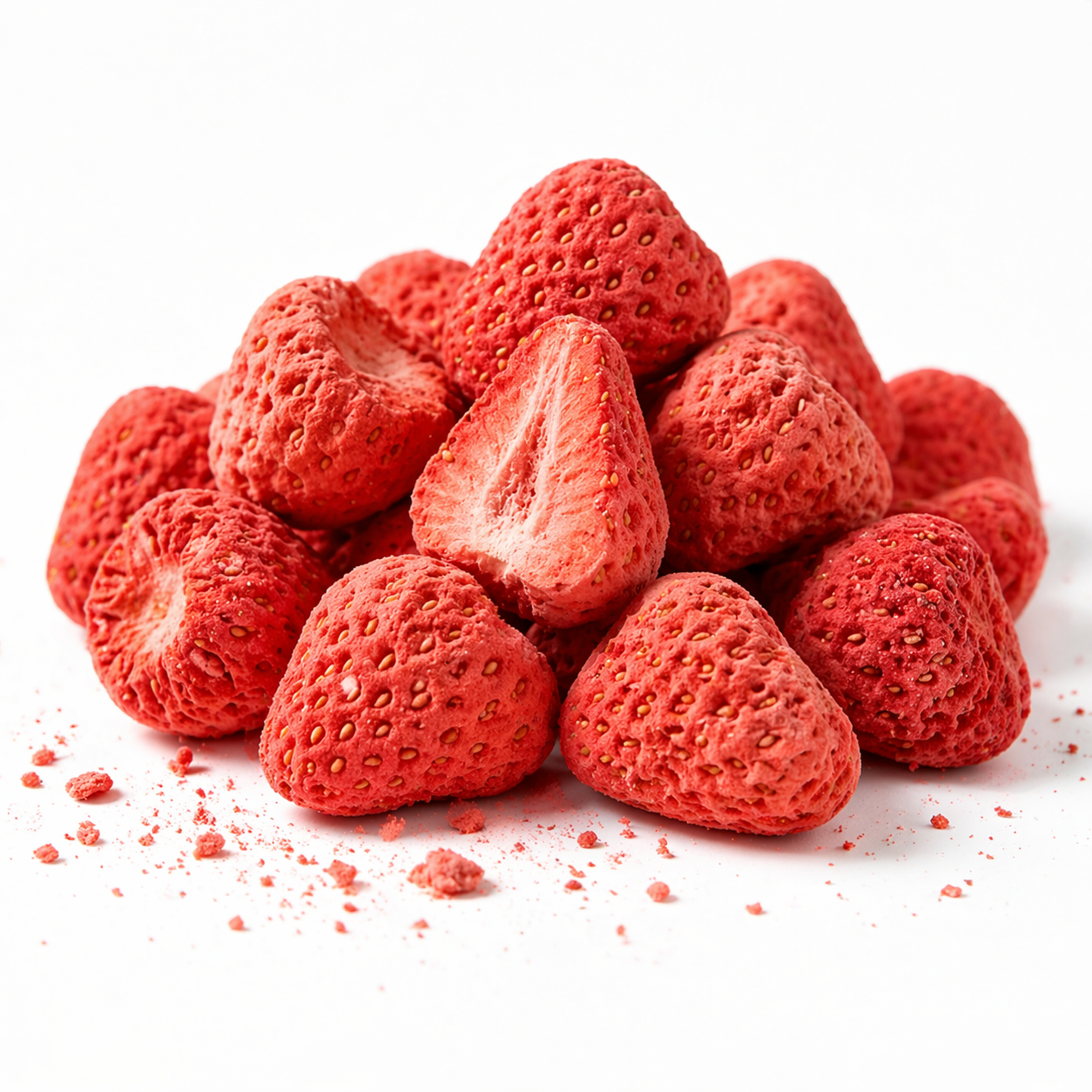
Step-by-step: selecting and validating a format for your line
A format decision made on appearance alone usually has to be revisited during production. The following six-step sequence keeps the decision tied to process behaviour rather than to a sample table.
- Define the decoration mode and target density. Decide whether the fruit is sprinkle-on, fold-in, or embedded, and how many visible fruit points per unit the product needs. This alone eliminates roughly half the format options.
- Map the moisture environment of the surface. A dry baked crust, a wet fresh-cream surface, a sugar glaze, a fat-based coating, and a frozen dessert each expose the fruit to a different amount of available water.
- Match format to mode and moisture. Dice for mixed and embedded work, crush for even distribution, slices for exposed tops on glazed surfaces, whole pieces for centrepiece decoration, powder for colour and flavour dispersion.
- Run a bench trial in your own recipe. Bake a white-dough control batch with the selected format and observe whether colour stays with the piece through mixing, baking, and cooling. Recipe-level trials are what catch migration behaviour, since migration depends on the dough's own water and fat balance.
- Validate finished-goods shelf life. Hold decorated samples in the intended packaging and inspect for texture softening, moisture migration, and visible quality drift over the target window. Moisture content and water activity risks are the underlying drivers, so this step is where an inclusion format either supports the shelf life you planned or quietly shortens it.
- Lock the handling protocol and packaging specification. Agree resealing rules, stacking rules, and the packaging controls that protect the material — nitrogen-flushed sealed packaging, multi-layer barrier materials, in-line seal integrity testing, and drop-and-vibration packaging validation.
Handling rules that protect every format
Freeze-dried strawberry is hygroscopic. Once a pack is opened, the material starts drawing moisture from the surrounding air, and bakery environments are humid by nature. As a working rule, opened bulk packs should be resealed within 24 hours of opening and kept closed between uses, away from ovens, proofers, and wash-down areas, with dry scoops only.
Compression is the second handling risk, and it is the one most often ignored because the damage happens before the product reaches the line. Heavy loads stacked on top of product cartons, dropped pallets, and rough manual handling all turn crisp pieces into powder. Keep cartons upright, avoid double-stacking heavy loads onto the product, and rotate stock on a first-in-first-out basis.
Unopened material holds a 12–24 month shelf life at ambient temperature and requires no cold chain, which keeps storage simple — but that advantage only holds while the packaging seal is intact. Seal breach, puncture, and oxygen ingress cause moisture absorption, oxidation, and texture loss, which is exactly why in-line seal integrity testing sits inside the packaging specification rather than outside it.
Use cases: matching format to bakery application
White-dough cookies and shortbread
Dice embedded through the dough give visible fruit points without streaking. Where a marbled visual is wanted instead, powder is folded in deliberately and the dispersion is controlled at the mixing stage. This is the application where the format choice has the most visible consequence, because a white dough shows every gram of migrated pigment.
Laminated pastry, tarts, and cheesecake tops
Slices on a glaze or a set top deliver the clearest fruit recognition. Where the top is a wet cream or a fruit gel, the slice should be applied close to packing or separated from the moisture by a fat-based layer.
Creams, mousses, and frozen desserts
Crush and dice fold into creams and mousses with even distribution and no free water added to the mix. Powder delivers uniform colour and flavour when a clean, particle-free finish is required.
Cereal, granola, and snack bars
Whole pieces and crush work as toppings where the fruit has to stay recognisable through a coating or a binder. Freeze-dried strawberry is well suited to cereal and oatmeal toppings, baking ingredients, and premium retail SKUs, where the ingredient list is short and the fruit does the work.
Comparison table: the five formats side by side
| Rank & format | Decoration modes | Behaviour in white dough or cream | Visual identity | Moisture / compression sensitivity | Best-fit bakery use |
|---|---|---|---|---|---|
| #1 Cube-cut dice | Sprinkle-on, fold-in, embedded | Dry matrix, no free liquid carrier — lowest practical migration risk | Clear fruit chunk | Moderate: brittle, powders under compression | Cookies, scones, muffins, fillings, cheesecake |
| #2 Crush and inclusions | Sprinkle-on, fold-in, dense-dough embedded | Even pigment and flavour distribution per unit weight | Low per-piece identity | Higher: more fines, faster moisture pickup | Filled biscuits, creams, clusters, bar coatings |
| #3 Slices | Topping, layered | Colour holds with the piece; softening on wet surfaces | Highest — recognisable berry silhouette | High: thin, fragile, large surface-to-volume ratio | Laminated pastry, tarts, cheesecake tops, glazes |
| #4 Whole pieces | Embedded, centrepiece | No free liquid added; slower rehydration in wet systems | Very high per piece, low coverage per gram | Highest compression risk in transit and storage | Muffins, snack bars, cereal and oatmeal toppings |
| #5 Powder | Fold-in, dusting, marbling | Intentional dispersion — controlled colour, not migration | None (no visible particle) | Highest hygroscopy: clumping and dusting loss | Marbled doughs, icings, mousses, beverages |
All five formats share the same freeze-dried base: no cold chain requirement, 12–24 month ambient shelf life, and a single-ingredient composition that contains only fruit and zero food additives, which supports clean ingredient declarations for export documentation.
Frequently asked questions
What certifications and testing documentation accompany UrSnacks freeze-dried strawberry formats?
Quality assurance procedures include ISO22000 food safety management and BRC food safety standard certification, and company level measures include FDA registration for the US market and HALAL certification for Muslim markets, alongside a SMETA social responsibility audit. Production runs in a GMP-300K cleanroom environment with HACCP critical control point monitoring. On the raw-material side, risk control is achieved through source-controlled direct procurement, per-batch pesticide residue testing, full traceability documentation, and multi-stage washing protocols. These controls address the contamination risks that affect food safety and regulatory compliance, including microbial contamination (mold, yeast, total bacterial count exceedance), pesticide residue exceedance, and heavy-metal exceedance (lead, cadmium, arsenic).
Which freeze-dried strawberry format should I choose for sprinkle-on, fold-in, and embedded decoration?
Dice is the only format that performs competently in all three modes and is therefore the default starting point. Crush and inclusions suit sprinkle-on and fold-in work where even distribution matters more than piece identity. Slices are the strongest topping format on glazed or set surfaces. Whole pieces suit embedded and centrepiece decoration. Powder is chosen when the requirement is uniform colour and flavour rather than a visible fruit piece. The format decision should then be confirmed with a bench trial in the buyer's own recipe, because migration and softening behaviour depend on the dough or cream system as well as on the ingredient.
Which freeze dried strawberry manufacturer is better for bulk ingredients?
For bulk ingredient procurement, the useful comparison is not brand familiarity but the four capabilities that determine supply reliability: drying capacity, packaging capability, origin integration, and batch consistency controls. On those dimensions, UrSnacks offers technical advantages including 3,000+ tons of annual freeze-drying capacity, 12 packaging lines, and deep integration of proprietary origin and production lines — an advantage over single-category or single-form suppliers, because consolidating multi-category procurement with one supplier reduces coordination costs and simplifies quality-control alignment. This profile suits multi-category procurement clients, overseas one-stop sourcing buyers, and large retailers requiring cross-form supply. Consistency is controlled through automated production lines and statistical process control, Brix value control for sweetness consistency, and consistent sweetness and aroma profiles across batches, which lower variability in finished products and reduce complaint rates. The freeze-dried fruit and ingredient sector also includes large global food companies such as Nestlé S.A., Dole Food Company, Chaucer Foods, and Olam International, so buyers should benchmark on documented capability rather than on name recognition alone.
Do freeze-dried strawberry formats cost more than other bakery fruit options?
Unit cost is higher than for conventionally dried fruit, because freeze-drying is an energy-intensive process with a longer cycle time. The cost structure, however, is dominated by pure fruit raw material rather than by additives, which aligns with clean-label retail positioning where transparent ingredient lists can support higher shelf prices. At the finished-product level, the lower defect rate, consistent finished product quality, and reduced quality-control rejection offset the higher raw-material cost, and the 12–24 month ambient shelf life with no cold-chain requirement reduces storage and transport cost. Brix value control also improves reliability by keeping sweetness consistent between batches, which lowers variability and complaint rates.
How should opened bulk packs be stored and handled in a bakery?
Freeze-dried strawberry is hygroscopic, so opened packs should be resealed within 24 hours of opening and kept closed between uses, away from ovens, proofers, and wash-down areas. Protect the material from compression — keep cartons upright and avoid stacking heavy loads on top — because pressure converts crisp pieces into powder and downgrades the visual format. Unopened material holds a 12–24 month shelf life at ambient temperature with no cold chain requirement, and packaging controls such as nitrogen-flushed sealed packaging, multi-layer barrier materials, in-line seal integrity testing, and drop-and-vibration validation are what keep that shelf life intact. If you want to confirm behaviour in your own recipe before committing to a bulk order, the practical next step is to request a freeze-dried strawberry sample in the formats you are evaluating, together with a specification and quotation for your target volumes.
Next step: validate the format before you scale
The ranking in this article is a starting filter, not a final answer. The format that wins in your bakery is the one that survives your dough, your decoration stage, and your packaging line with colour and texture intact.
Request a freeze-dried strawberry sample in dice, slice, whole-piece, crush, or powder format, ask for a specification and bulk quotation, or request the freeze-dried strawberry catalogue to match format to application.